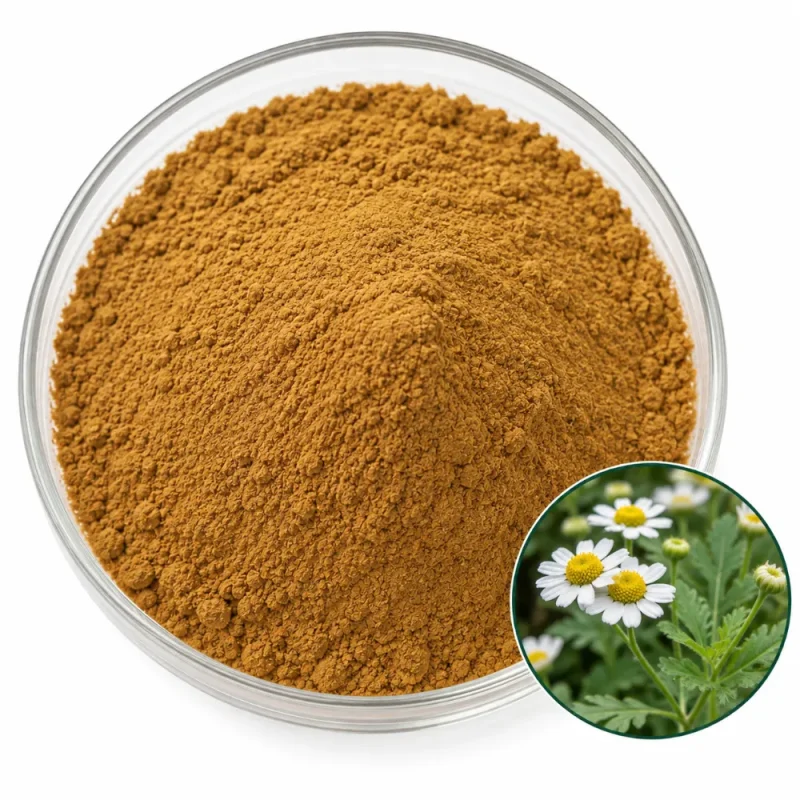
Feverfew Extract 0.5–1% Parthenolide

The dried aerial parts of Tanacetum parthenium, the feverfew of European hedgerows and herb gardens, are the only starting material in this extract, and the root and stem base are excluded. Ethanol extraction takes up the sesquiterpene lactones of the leaf and flower, and the concentrate is dried to a light brown powder.

Parthenolide is measured by HPLC, with a primary grade of 1% and a lower grade of 0.5%. The powder is 80 mesh and insoluble in water. Both grades fit capsules and tablets, and the lower grade also fits blends in which the herb matrix is wanted.

Parthenolide Standardization & Grades

Parthenolide is a sesquiterpene lactone with a reactive alpha-methylene gamma-butyrolactone group, and it is the characteristic compound of feverfew leaf. It is accompanied by related lactones such as canin and artecanin, and by flavonoid glycosides and volatile oil. The botanical entity is Tanacetum parthenium (L.) Sch.Bip., and the extract is standardized to parthenolide because it is the defining compound of the herb, the one used in pharmacopoeial identity statements, and the one that HPLC measures cleanly.

GradeAssay & MethodWhere It Fits
0.5% ParthenolideHPLCBlends, higher inclusion
1% ParthenolideHPLCCapsules and tablets

The two grades are close, so choice follows fill weight and herb matrix more than dose. The 1% grade carries twice the parthenolide of the 0.5% grade per gram, so a capsule reaches its target with less powder, while the 0.5% grade is bulkier and keeps more of the leaf’s flavonoids and fiber. Feverfew is also supplied as a 10:1 ratio extract with no marker figure, the Feverfew Extract Powder, as milled herb, the Feverfew Herb Powder, and as a single compound, Parthenolide. A parthenolide figure in the feverfew extract specification calls for the standardized extract.

Parthenolide Analysis & Purity Risks

HPLC separates parthenolide from the related lactones on a reversed-phase column and quantifies the peak against a reference standard, with UV detection at a low wavelength because the lactone has only a weak chromophore. The result is parthenolide specifically. A gravimetric lactone total or a UV reading would count other material, and neither can be converted into the HPLC value.

For identity, the fingerprint of the herb is read beside parthenolide. Canin, santamarine and the flavonoid glycosides appear as neighboring peaks, and the balance between them shows whether the material is feverfew herb and not a look-alike Asteraceae plant. The volatile oil, with camphor and chrysanthenyl acetate, is largely lost in drying and is not a marker for this product.

The purity risks here combine the reactivity of the lactone with the botanical group. Feverfew is known to occur in chemotypes, and some of them carry little or no parthenolide, so a named species alone does not guarantee a parthenolide content. The plant is also confused with tansy (Tanacetum vulgare), which carries thujone, and with chamomile and other daisy-like herbs. The alpha-methylene lactone group is reactive, which makes parthenolide a known contact allergen for people sensitive to Asteraceae, and it also reacts with nucleophiles in the sample, so the extraction solvent and hold time belong in the method definition.

Sample preparation uses a polar organic solvent at room temperature, followed by filtration and prompt injection. Prolonged exposure to water, heat or base opens the lactone and lowers the assay.

Raw material handling also matters. The aerial parts are harvested at flowering, dried at modest temperature and milled, because high drying temperature and slow drying reduce parthenolide. A well-dried herb is green-brown and aromatic, whereas a damp lot loses lactone content quickly.

Typical Specifications

Specification ItemProduct Information
Latin NameTanacetum parthenium
Plant PartLeaf & Herb
ProcessingEthanol Extraction
Compound ClassTerpenoids
Common NameFeverfew
Ingredient TypeStandardized Extract
Marker Compound(s)Parthenolide
Primary Grade1% Parthenolide (HPLC)
Available Grades0.5% · 1% Parthenolide (HPLC)
AppearanceLight Brown powder
Solubility / DispersibilityInsoluble in Water
Quality Parameters
Moisture (LOD)≤5.0%
Total Ash≤5.0%
Particle Size80 mesh
Heavy MetalsLead ≤2 ppm · Arsenic ≤1 ppm · Cadmium ≤1 ppm · Mercury ≤0.1 ppm
MicrobiologyTPC ≤1,000 cfu/g · Yeast & Mold ≤100 cfu/g · E. coli Negative · Salmonella Negative/25 g
Shelf Life24 months in unopened original packaging, cool and dry storage

Applications by Grade

1% Grade for Standard Capsules

The 1% grade of feverfew extract reaches a parthenolide target in a moderate fill, which suits two-piece capsules. Keep the filling room dry, because the lactone degrades when the powder takes up moisture, and use a desiccated bottle for the finished capsules.

0.5% Grade in Herbal Powder Blends

Herbal blends carry the 0.5% grade alongside other leaf and flower extracts. The low-density herb powder segregates if it is dumped into a large blender at once, so add it to a free-flowing carrier in stages.

1% Grade in Tablet Blends

Tablets of the 1% grade need a dry binder and a glidant, and a film coat covers the bitter, camphoraceous taste of the herb. Avoid wet granulation where possible, since water and heat open the lactone ring and lower the assay.

0.5% Grade in Sachet Premixes

Sachets dilute the 0.5% grade with a bulking carrier so the filler can weigh an accurate dose. A foil laminate with low moisture transmission protects the parthenolide from water and holds the faint herbal scent.

1% Grade in Lipid-Based Fills

Where a liquid or semi-solid capsule is wanted, the 1% grade is dispersed in an oil carrier, which keeps the lactone away from water. Mill the powder fine first and choose an antioxidant-stabilized oil to protect it during storage.

0.5% Grade for Contract Blending

Contract blenders place the 0.5% grade in multi-ingredient powders where a feverfew herb matrix is wanted. The camphoraceous scent lingers on equipment, so a dry purge and dedicated scoops protect the milder products that follow on the line.

Technical & Quality Considerations

Feverfew extract is a light brown to green-brown powder with a bitter, camphoraceous odor and a bitter taste. A liquid format has to use a suspension system or an oil carrier, since the extract is insoluble in water. Parthenolide dissolves in ethanol and in lipid phases but hardly in water, which is why oily or alcoholic phases give a more uniform dispersion than an aqueous mix.

Parthenolide is the stability-limiting compound. The reactive lactone degrades in the presence of water, heat, strong acid or base, and reacts with thiol and amine groups, so protein-containing or moisture-rich formats lose assay over shelf life. Low water activity, neutral pH and cool storage slow the loss, and a retained sample from release shows how the lot ages. Long hot-fill or extrusion steps lower the figure noticeably.

Scale-up begins with a sieve to break soft herb lumps, then a premix with part of the carrier and a weight check on the first fills. Drums are stored sealed and cool, with a desiccant liner in humid regions. Because feverfew can sensitize skin in people allergic to Asteraceae, workers should use gloves and local extraction at the charging point.

Compatibility with other ingredients deserves a short trial. Amino acids, proteins and strongly alkaline minerals react with the lactone, so an accelerated stability study at elevated temperature and humidity shows early whether a combination is sound.

Packaging & Commercial Supply

Essencefield supports product evaluation, formulation trials, commercial orders, and ongoing ingredient supply. Packaging, storage, and shipping arrangements are determined by product characteristics, order quantity, stability requirements, and destination-market needs.

Supply ItemGeneral Information
SampleAvailable upon request for formulation, testing, and supplier evaluation
Order Quantities100 g · 1 kg · 5 kg · 25 kg · 100 kg · 500 kg · Bulk
Sample Lead TimeTypically 5–7 days after sample confirmation
Production Lead TimeTypically 15–30 days after order and specification confirmation
PackagingSuitable protective inner packaging with bags, cartons, drums, or other appropriate outer packaging
StorageStore in tightly sealed, suitable protective packaging in a cool, dry environment. Protect from moisture, heat, and direct sunlight. Specific storage conditions follow the approved product specification.
DocumentationCOA · Product Specification · TDS · SDS · Applicable declarations (as applicable)

Final order quantities, lead times, packaging, documentation, and shipping arrangements are confirmed according to the selected product and commercial requirements.

Request Ingredient Specifications & Quote

Share your target specification, application, quantity, and documentation needs. We’ll help confirm suitable options, samples, and commercial supply details.