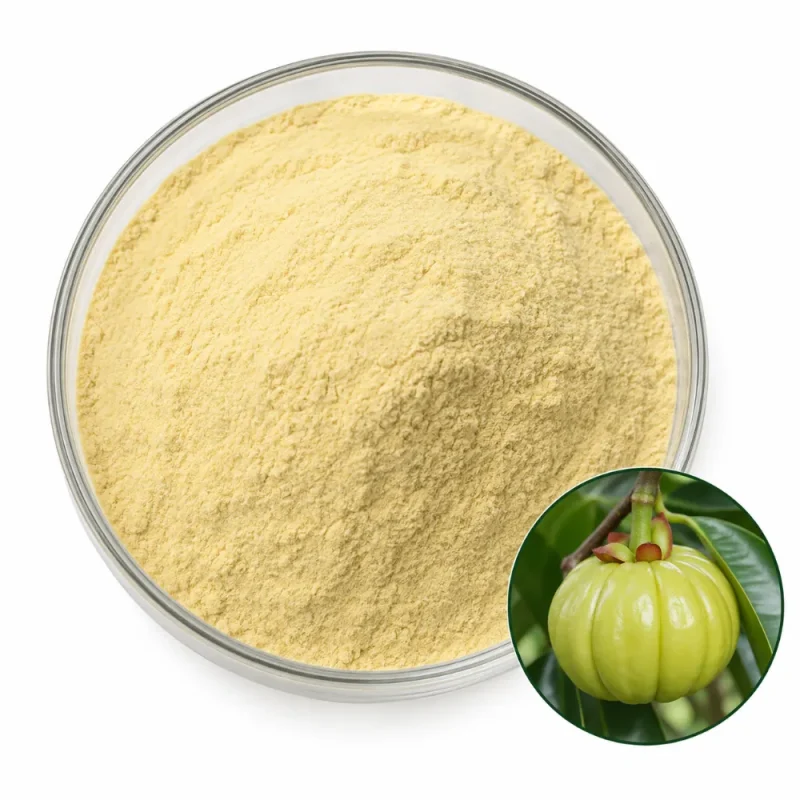
Garcinia cambogia Extract 50–60% HCA

The dried fruit rind of Garcinia cambogia, the Malabar tamarind of South and Southeast Asia, is the only part used in this extract, and the seed, leaf and bark are excluded. Water extraction takes up the organic acids of the rind, and the concentrate is dried to a light brown powder.

HCA is measured by HPLC, with a primary grade of 60% and a lower grade of 50%. The powder is 80 mesh and water soluble. Both grades fit capsules, tablets and drink powders, and the two grades differ mainly in fill weight.

HCA Standardization & Grades

HCA is hydroxycitric acid, a tricarboxylic acid that is the signature organic acid of the Garcinia rind. It occurs as two diastereomers and, on heating or concentration, partly closes to a lactone, so the form in which it is reported matters. The botanical entity is the Garcinia cambogia fruit as named in the trade, and the Garcinia cambogia extract is standardized to HCA because the rind acid is the defining and by far the largest measurable component of the extract.

GradeAssay & MethodWhere It Fits
50% HCAHPLCCapsules and drink powders
60% HCAHPLCCapsules and tablets, smaller fill

The two grades are close, so choice follows fill weight and handling more than dose. The 60% grade carries a fifth more HCA per gram, which makes a capsule slightly smaller, while the 50% grade is a little less dense and easier to handle. The Garcinia Cambogia Extract Powder is the 10:1 ratio extract of garcinia, which has no marker figure. The standardized extract is the row to use when an HCA figure has to appear in the specification of the Garcinia cambogia extract.

HCA Analysis & Purity Risks

HPLC separates hydroxycitric acid from the other organic acids of the rind, chiefly citric acid and tartaric acid, on an ion-exclusion or reversed-phase column and quantifies the peak against a reference standard. The result is HCA specifically. A titration reading would count all acids, and neither a titration nor a gravimetric figure can be converted into the HPLC value. The report should also state whether the figure is HCA as the free acid or as the whole salt, because the counter-ion adds weight to a salt.

For identity, the chromatogram is read beside HCA. Garcinia lactone appears as a separate peak at the position of the closed ring form, and the ratio of free acid to lactone shows how the Garcinia cambogia extract has been handled, because heat and low pH favor the lactone. Citric acid appears as a smaller neighbor, and an unusually high citric acid peak is a signal worth investigating.

Purity risks follow from the botanical group. The Garcinia genus is large, and several species are traded under overlapping names, among them Garcinia indica, kokum, and Garcinia atroviridis. Their rinds differ in HCA content and in other compounds. Plant databases also place the trade name under another accepted name, so the stated species and the stated rind part are part of the identity. HCA can be made synthetically or blended in as citric acid, so a fingerprint protects identity better than one percentage does.

Sample preparation uses a water or dilute acid extraction at room temperature. Heating converts HCA to the lactone and changes the apparent figure, so a controlled temperature and a fixed time are part of the method definition.

Raw material handling also matters. The rind is sun-dried or smoked, and heavy smoking or high heat darkens it and shifts HCA toward the lactone. Well-dried, lightly colored rind gives a cleaner extract than smoked, dark rind.

Typical Specifications

Specification ItemProduct Information
Latin NameGarcinia cambogia
Plant PartFruit & Berry
ProcessingWater Extraction
Common NameGarcinia, Malabar Tamarind
Ingredient TypeStandardized Extract
Marker Compound(s)HCA (hydroxycitric acid)
Primary Grade60% HCA (HPLC)
Available Grades50% · 60% HCA (HPLC)
AppearanceLight Brown powder
Solubility / DispersibilityWater Soluble
Quality Parameters
Moisture (LOD)≤5.0%
Total Ash≤5.0%
Particle Size80 mesh
Heavy MetalsLead ≤2 ppm · Arsenic ≤1 ppm · Cadmium ≤1 ppm · Mercury ≤0.1 ppm
MicrobiologyTPC ≤1,000 cfu/g · Yeast & Mold ≤100 cfu/g · E. coli Negative · Salmonella Negative/25 g
Shelf Life24 months in unopened original packaging, cool and dry storage

Applications by Grade

60% Grade for Compact Capsules

The 60% grade of Garcinia cambogia extract reaches an HCA target in a moderate fill. The acid-rich powder is strongly hygroscopic, so fill in a dry room and seal the capsules in a desiccated bottle with a tight closure.

50% Grade in Drink Powders

The 50% grade dissolves readily into a clear to slightly hazy light brown cup with a sour, fruity taste. Tropical, berry or tamarind-style flavors suit it, and the acidity lowers the pH of the drink.

60% Grade in Tablet Blends

Tablets of the 60% grade need a dry binder and a glidant, because the hygroscopic powder softens in humid air and can stick to punches. A film coat keeps moisture out, and the storage study should include a hardness test.

50% Grade in Sachet Premixes

Sachets of the 50% grade dilute the extract with a bulking carrier so the filler can weigh an accurate dose. A foil laminate with a low moisture transmission rate keeps the Garcinia cambogia powder flowing over the shelf life.

50% Grade in Stick-Pack Blends

Stick packs of the 50% grade carry the extract at a practical gram weight alongside other water-soluble ingredients. The acid-rich powder tends to cake, so a flow agent and a dry packing room are recommended.

60% Grade in Stepwise Dilutions

For a small dose, the 60% grade is stepped down with a bulking carrier in stages ahead of the filler. Uniformity is best checked on a pilot lot, since a potent powder diluted heavily tends to separate.

Technical & Quality Considerations

Garcinia cambogia extract is a light brown powder with a faint, fruity-sour odor and a sour, slightly salty taste. It is water soluble, giving a clear to slightly hazy brown solution with an acidic pH. Hydroxycitrate salts, such as the calcium and potassium forms known in the trade, behave differently from the free acid: their solutions sit closer to neutral pH and taste less sour.

HCA is sensitive to heat and low pH. At elevated temperature and in acidic solution, it closes to the lactone, which lowers the HCA figure and changes the sensory profile, so hot-fill and retort processes need a short trial. Calcium salts can also form insoluble compounds with phosphates and some other acids, which causes haze or sediment in a clear drink. Potassium salts are more soluble but more hygroscopic.

Scale-up starts with a sieve and a premix with part of the carrier, then a weight check on the first fills. The acid-rich powder takes up water quickly and cakes in humid air, so use a dry room, sealed drums and desiccant liners, and store cool.

Other ingredients in the formula can interact with the extract, which a short trial will reveal. Mineral blends can precipitate calcium hydroxycitrate, and acidic ingredients lower the pH enough to favor the lactone, so a pilot batch at the target pH and temperature shows early whether a combination is sound.

Packaging & Commercial Supply

Essencefield supports product evaluation, formulation trials, commercial orders, and ongoing ingredient supply. Packaging, storage, and shipping arrangements are determined by product characteristics, order quantity, stability requirements, and destination-market needs.

Supply ItemGeneral Information
SampleAvailable upon request for formulation, testing, and supplier evaluation
Order Quantities100 g · 1 kg · 5 kg · 25 kg · 100 kg · 500 kg · Bulk
Sample Lead TimeTypically 5–7 days after sample confirmation
Production Lead TimeTypically 15–30 days after order and specification confirmation
PackagingSuitable protective inner packaging with bags, cartons, drums, or other appropriate outer packaging
StorageStore in tightly sealed, suitable protective packaging in a cool, dry environment. Protect from moisture, heat, and direct sunlight. Specific storage conditions follow the approved product specification.
DocumentationCOA · Product Specification · TDS · SDS · Applicable declarations (as applicable)

Final order quantities, lead times, packaging, documentation, and shipping arrangements are confirmed according to the selected product and commercial requirements.

Request Ingredient Specifications & Quote

Share your target specification, application, quantity, and documentation needs. We’ll help confirm suitable options, samples, and commercial supply details.