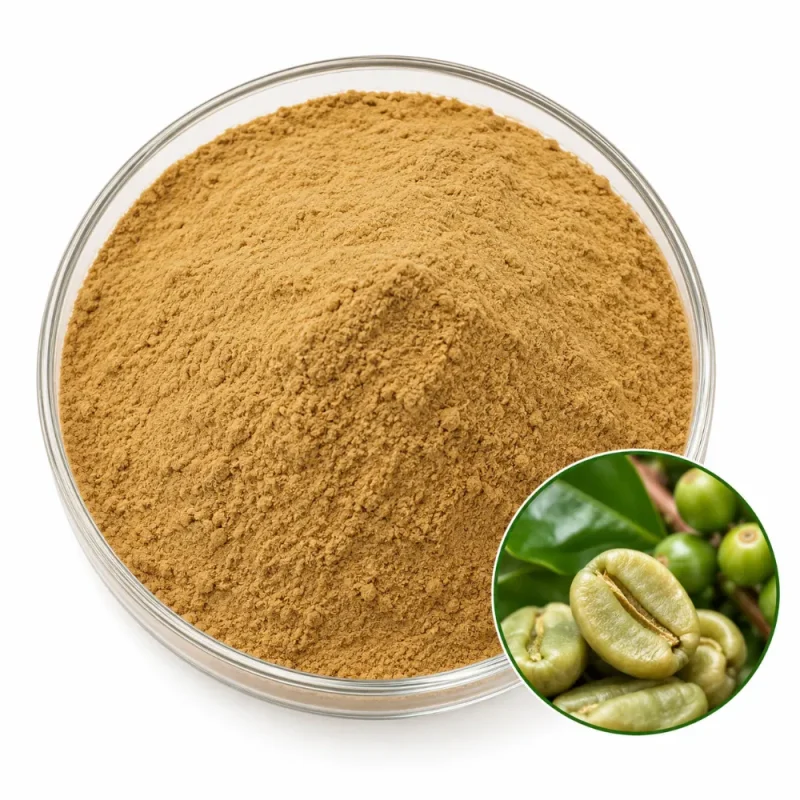
Green Coffee Bean Extract 30–50% Chlorogenic Acids

Green coffee bean extract is prepared from the unroasted seed of Coffea arabica, the arabica coffee tree, and the roasted bean, the cherry pulp and the leaf are not part of the starting material. Ethanol extraction takes up the chlorogenic acids of the bean, and the concentrate is dried to a yellow-brown powder.

Chlorogenic acids are measured by HPLC, with a primary grade of 50% and a lower grade of 30%. The powder is 80 mesh and water soluble. Both grades fit capsules, tablets and drink powders, and the two grades differ mainly in fill weight.

Chlorogenic Acid Standardization & Grades

Chlorogenic acids are esters of quinic acid with caffeic, ferulic or coumaric acid, and green coffee holds a family of them. The caffeoylquinic acids 3-CQA, 4-CQA and 5-CQA lead the pattern, followed by the dicaffeoylquinic acids and the feruloylquinic acids. A total chlorogenic acid figure sums the isomers. The botanical entity is Coffea arabica L., and the green coffee bean extract is standardized to chlorogenic acids because they are the defining phenolic class of the unroasted bean and the compounds that roasting destroys.

GradeAssay & MethodWhere It Fits
30% Chlorogenic AcidsHPLCDrink powders, higher inclusion
50% Chlorogenic AcidsHPLCCapsules and tablets, small fill weight

The two grades are close, so choice follows fill weight and taste more than dose. The 50% grade carries two-thirds more chlorogenic acid per gram, which makes a capsule smaller, while the 30% grade is bulkier, milder in taste and keeps more of the bean’s sugars and caffeine. Green coffee is also supplied as a 10:1 ratio extract with no marker figure, the Green Coffee Bean Extract Powder, and as a related single compound, Dihydrocaffeic Acid 98%. The standardized extract is the row to use when a chlorogenic acid figure has to appear in the specification of the green coffee bean extract.

Chlorogenic Acid Analysis & Purity Risks

HPLC separates the chlorogenic acid isomers on a reversed-phase column and quantifies them against reference standards, with UV detection at about 325 nm where the caffeoyl chromophore absorbs strongly. The result is a sum, so it depends on which isomers are included and which reference is used. A UV total or a Folin-Ciocalteu reading would count other phenolics, and neither can be converted into the HPLC sum.

For identity, the fingerprint of the bean is read beside the sum. 5-CQA is the largest peak, with 3-CQA and 4-CQA as neighbors, and the dicaffeoylquinic acids and feruloylquinic acids form a later cluster. The ratio of the isomers is informative, because heat and alkaline conditions isomerize 5-CQA into 3-CQA and 4-CQA, so a shifted isomer pattern signals a processed material.

Purity risks reflect the botanical group and the way the acids behave on heating. Coffea canephora, the robusta coffee, carries more chlorogenic acid than arabica, and the two are often blended. The stated species and the green, unroasted state are therefore part of the identity. Caffeine is extracted with the acids, and green coffee extracts are sometimes decaffeinated, so the residual caffeine level distinguishes types. A very high chlorogenic acid figure on a low-cost raw material is a reason to ask about the sample basis.

Sample preparation uses a dilute acidified alcohol extraction at room temperature and a short run, because chlorogenic acids isomerize and hydrolyze in warm, neutral or alkaline solution. Samples are protected from light and injected promptly.

Raw material handling also matters. Green beans are stored dry and cool, and long storage in warm, humid conditions lowers chlorogenic acid and gives a musty odor. Beans that have been steamed or lightly heated during processing show a changed isomer ratio.

Typical Specifications

Specification ItemProduct Information
Latin NameCoffea arabica
Plant PartSeed & Grain
ProcessingEthanol Extraction
Compound ClassPolyphenols
Common NameGreen Coffee Bean, Arabica
Ingredient TypeStandardized Extract
Marker Compound(s)Chlorogenic acids (caffeoylquinic acid isomers and related esters)
Primary Grade50% Chlorogenic Acids (HPLC)
Available Grades30% · 50% Chlorogenic Acids (HPLC)
AppearanceYellow-Brown powder
Solubility / DispersibilityWater Soluble
Quality Parameters
Moisture (LOD)≤5.0%
Total Ash≤5.0%
Particle Size80 mesh
Heavy MetalsLead ≤2 ppm · Arsenic ≤1 ppm · Cadmium ≤1 ppm · Mercury ≤0.1 ppm
MicrobiologyTPC ≤1,000 cfu/g · Yeast & Mold ≤100 cfu/g · E. coli Negative · Salmonella Negative/25 g
Shelf Life24 months in unopened original packaging, cool and dry storage

Applications by Grade

50% Grade for Compact Capsules

The 50% grade of green coffee bean extract reaches a chlorogenic acid target in a small fill, which suits compact capsules. The powder is hygroscopic and acidic, so fill in a dry room and use shells that tolerate an acidic fill.

30% Grade in Drink Powders

The 30% grade dissolves into a clear to slightly hazy yellow-brown cup with a bitter, astringent and faintly grassy taste. Citrus, berry or mocha-style flavors cover it, and cool water gives the cleanest dispersion in the cup.

50% Grade in Tablet Blends

Tablets of the 50% grade need a dry binder and a glidant, because the hygroscopic powder softens in humid air and can stick to punches. A film coat guards against moisture, and the retained tablets are tested for hardness at intervals.

30% Grade in Stick-Pack Blends

Stick packs of the 30% grade carry the green coffee bean extract at a practical gram weight alongside other water-soluble ingredients. Foil laminate with low moisture transmission keeps the powder free-flowing, because the acids draw water in humid air.

30% Grade in Sachet Premixes

Sachets of the 30% grade dilute the green coffee bean extract with a bulking carrier so the filler can weigh an accurate dose. Light-protective film holds the shade of the powder, which darkens under strong light during storage.

50% Grade in Stepwise Dilutions

When only a small dose is needed, the 50% grade is diluted in steps with a bulking carrier before the filler. Test the diluted blend for uniformity before scale-up, because the concentrate separates easily at low levels.

Technical & Quality Considerations

Green coffee bean extract is a yellow-brown powder with a faint, grassy, slightly woody odor and a bitter, astringent taste with little of the roasted aroma of brewed coffee. It is water soluble, giving a clear to slightly hazy yellow-brown solution with an acidic pH. The lower grade also carries sugars and caffeine, and the higher grade carries less.

Chlorogenic acids are heat and pH sensitive. At neutral and alkaline pH, and in prolonged heat, they isomerize and hydrolyze to caffeic acid and quinic acid, and caffeic acid then oxidizes to brown polymers. Hot-fill and retort steps therefore lower the figure and darken the product. They also chelate iron and darken, so stainless contact surfaces and low-iron fillers help. Acidic bases, antioxidants and light-protective packaging keep the figure steadier.

Scale-up starts by sieving the bean extract, premixing it with part of the carrier and weighing the first fills. Store the drums sealed and cool, out of direct light, with desiccant liners in humid regions. A closed charging system limits the yellow-brown dust.

Caffeine, where present, is part of the label and the sensory profile, and the residual level should be known when the extract is combined with other stimulant ingredients in a blend.

Flavor deserves a trial because green coffee bean extract does not taste like coffee. It is grassy, bitter and astringent, and flavors that suggest roasted coffee clash with it. Fruit, citrus and tea profiles integrate better, and a little acid sharpens the taste while protecting the acids from isomerization. In capsules none of this matters, and the only task is keeping the hygroscopic powder dry.

Packaging & Commercial Supply

Essencefield supports product evaluation, formulation trials, commercial orders, and ongoing ingredient supply. Packaging, storage, and shipping arrangements are determined by product characteristics, order quantity, stability requirements, and destination-market needs.

Supply ItemGeneral Information
SampleAvailable upon request for formulation, testing, and supplier evaluation
Order Quantities100 g · 1 kg · 5 kg · 25 kg · 100 kg · 500 kg · Bulk
Sample Lead TimeTypically 5–7 days after sample confirmation
Production Lead TimeTypically 15–30 days after order and specification confirmation
PackagingSuitable protective inner packaging with bags, cartons, drums, or other appropriate outer packaging
StorageStore in tightly sealed, suitable protective packaging in a cool, dry environment. Protect from moisture, heat, and direct sunlight. Specific storage conditions follow the approved product specification.
DocumentationCOA · Product Specification · TDS · SDS · Applicable declarations (as applicable)

Final order quantities, lead times, packaging, documentation, and shipping arrangements are confirmed according to the selected product and commercial requirements.

Request Ingredient Specifications & Quote

Share your target specification, application, quantity, and documentation needs. We’ll help confirm suitable options, samples, and commercial supply details.