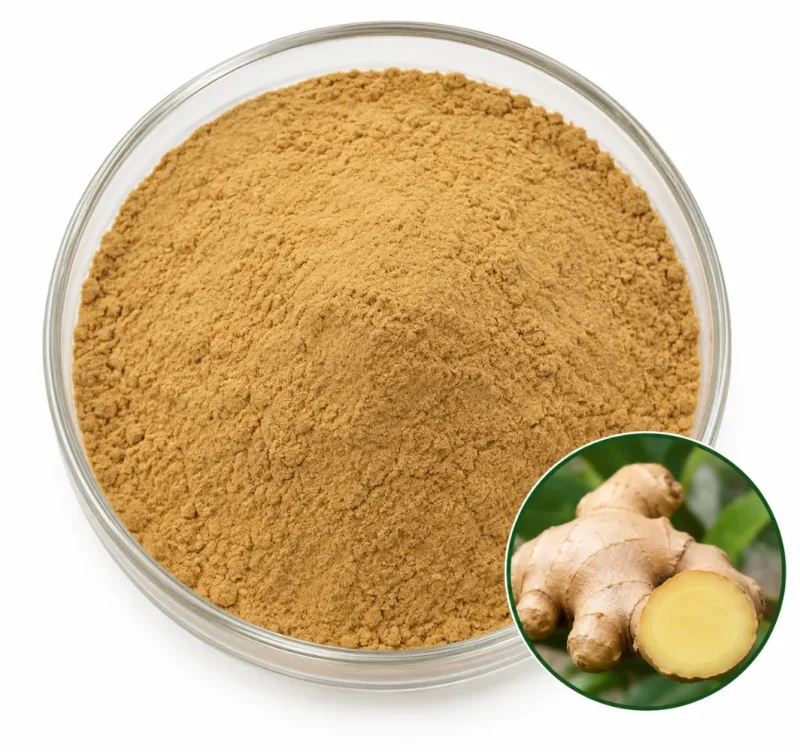
Ginger Extract 5–20% Gingerols

Ginger extract starts from the rhizome of Zingiber officinale, the culinary ginger, and not from the leaves or from the related shampoo ginger. Ethanol extraction concentrates the pungent phenolic ketones of the rhizome, and the liquor is dried to a light yellow powder.

The primary grade is 20% gingerols by HPLC, with a 5% grade as the lower end of the range. The powder is 80 mesh and slightly soluble in water. The 20% grade serves capsule and tablet formulas that need a small fill weight, while the 5% grade suits drink sticks, gummies and blends where the ginger character is wanted at a higher gram dose.

Gingerol Standardization & Grades

Gingerols are the main pungent compounds of fresh ginger, a series of phenolic ketones of which 6-gingerol is the most abundant member. They are the standardization target because they define the characteristic bite of the rhizome and because HPLC can resolve each homolog. The botanical entity is Zingiber officinale Roscoe, and the part used is the rhizome. A related family, the shogaols, forms from gingerols when the rhizome is dried or heated, so a gingerol figure describes a relatively gentle drying route.

GradeAssay & MethodWhere It Fits
5% GingerolsHPLCDrink sticks, gummies and ginger-led blends
20% GingerolsHPLCCapsules and tablets with small fill weight

Grade choice follows dose, fill weight and pungency. The 20% grade carries four times the gingerol load per gram of the 5% grade, so a capsule reaches its target in a smaller fill. The 5% grade is gentler and bulkier, which makes it easier to meter into sticks and to flavor in gummies where a hot, burning edge would be a drawback. Ginger is also supplied as a 10:1 ratio extract with no marker figure, the Ginger Extract Powder, as a milled rhizome, the Ginger Root Powder, and as the purified compound 6-Gingerol 98%.

The word gingerols stands for a group of homologs with side chains of different length, of which 6-gingerol is the most abundant, and the percentage on its own does not say which members were counted. Buyers who compare quotes should compare the list of quantified compounds before they compare numbers. The 5% grade is the choice when a formula wants the warm, rounded character of ginger at a high gram weight, and the 20% grade is the choice when gingerol dose is the design constraint.

Gingerol Analysis & Purity Risks

Both grades are measured by HPLC, which separates the gingerol homologs on a column and adds up the named members against reference standards. A UV total or a gravimetric figure counts every compound that responds in the same way and so is not comparable with an HPLC gingerol figure, and a number from one method should not be converted into the other.

The chemistry of gingerols explains why the figure depends on handling. A gingerol is a beta-hydroxy ketone, and heat or acid removes the hydroxyl group as water to give the corresponding shogaol, an alpha,beta-unsaturated ketone with a sharper bite. A chromatogram of a dried, heated or acidified ginger extract therefore shows more shogaol and less gingerol than one of a gently dried extract. The balance between the two families is part of the fingerprint.

Purity risks follow from the botany. Ginger is traded as fresh, dried and processed rhizome, and a total pungent figure can hide which family supplies the heat. Related species such as Zingiber zerumbet are also sold under the word ginger. A fixed plant part, a stated species and a chromatographic fingerprint protect identity better than one percentage does.

Sample preparation is simple but matters: the extract is dissolved in an organic solvent, filtered and run on a reversed-phase column, and the gingerol peaks are identified by retention time and UV spectrum against reference standards. Shogaols elute later than gingerols, so the same run shows how far a lot has been dried or heated. That is the reason the HPLC figure is read together with the chromatographic pattern, not alone.

Typical Specifications

Specification ItemProduct Information
Latin NameZingiber officinale
Plant PartRoot & Rhizome
ProcessingEthanol Extraction
Compound ClassPolyphenols
Common NameGinger, Ginger Rhizome
Ingredient TypeStandardized Extract
Marker Compound(s)Gingerols (phenolic ketones of Zingiber officinale)
Primary Grade20% Gingerols (HPLC)
Available Grades5% · 20% Gingerols (HPLC)
AppearanceLight Yellow powder
Solubility / DispersibilitySlightly Soluble in Water
Quality Parameters
Moisture (LOD)≤5.0%
Total Ash≤5.0%
Particle Size80 mesh
Heavy MetalsLead ≤2 ppm · Arsenic ≤1 ppm · Cadmium ≤1 ppm · Mercury ≤0.1 ppm
MicrobiologyTPC ≤1,000 cfu/g · Yeast & Mold ≤100 cfu/g · E. coli Negative · Salmonella Negative/25 g
Shelf Life24 months in unopened original packaging, cool and dry storage

Applications by Grade

20% Grade for Compact Capsules

The 20% grade supplies a gingerol target in a small fill. Capsules and tablets must be dried and sealed with care, because the extract is oily and sticky, and a glidant keeps the powder moving through the hopper.

5% Grade for Spiced Drink Sticks

At the lower grade, sticks carry the extract at a higher gram weight, which gives a warm, rounded ginger taste to hot water, lemon and honey mixes. Weight-based dosing matters, since pungency rises quickly with each added gram.

5% Grade Gummy Premixes

Gummies take the lower grade because the burn of a high-gingerol powder is hard to hide in a chewable gel. Add it after the main cook to protect the aroma, and pair it with lemon, orange or honey flavors.

20% Grade in Bar Premixes

A higher grade keeps the inclusion small, which protects bar texture. The extract is blended with the dry ingredients before the syrup, so that its oily, pungent solid spreads evenly through the matrix. Nut and honey bases soften the pungency.

5% Grade in Instant Drink Mixes

Instant drinks use the 5% grade with lemon and honey solids. The light yellow powder disperses with a haze and a warm bite, and the dose can be raised stepwise, because pungency builds quickly from the first taste to the last sip.

20% Grade in Tablet Blends

Tablets of the 20% grade need a dry binder and an absorbent, since the oily solid softens compacts and sticks to punches. Run a compression trial on the full blend and check hardness after storage. A dry room prevents the oily solid from sticking to punches.

Technical & Quality Considerations

The extract is a light yellow powder with a sharp, spicy odor and a hot, pungent taste. It is slightly soluble in water, so a solution turns cloudy and pale yellow, and the oily fraction can rise as a faint film. Gingerols lose their hydroxyl group under acid and heat, so long hot holds and acidic bases convert part of the gingerol to shogaol, which changes both the taste and the chromatogram.

For scale-up, a short sieving step comes first, and the extract is folded into a portion of the carrier ahead of the final mix. Verify capsule fill weight at each lot change, and check tablet hardness after storage since the oil can soften compacts. Keep the drum closed and away from light and heat, and compare each lot with a retained sample for color and aroma. Oily ginger extracts smear on sieves and hoppers, so schedule clean-down time between ginger and pale products, and keep a dedicated scoop for weighing.

Packaging & Commercial Supply

Essencefield supports product evaluation, formulation trials, commercial orders, and ongoing ingredient supply. Packaging, storage, and shipping arrangements are determined by product characteristics, order quantity, stability requirements, and destination-market needs.

Supply ItemGeneral Information
SampleAvailable upon request for formulation, testing, and supplier evaluation
Order Quantities100 g · 1 kg · 5 kg · 25 kg · 100 kg · 500 kg · Bulk
Sample Lead TimeTypically 5–7 days after sample confirmation
Production Lead TimeTypically 15–30 days after order and specification confirmation
PackagingSuitable protective inner packaging with bags, cartons, drums, or other appropriate outer packaging
StorageStore in tightly sealed, suitable protective packaging in a cool, dry environment. Protect from moisture, heat, and direct sunlight. Specific storage conditions follow the approved product specification.
DocumentationCOA · Product Specification · TDS · SDS · Applicable declarations (as applicable)

Final order quantities, lead times, packaging, documentation, and shipping arrangements are confirmed according to the selected product and commercial requirements.

Request Ingredient Specifications & Quote

Share your target specification, application, quantity, and documentation needs. We’ll help confirm suitable options, samples, and commercial supply details.