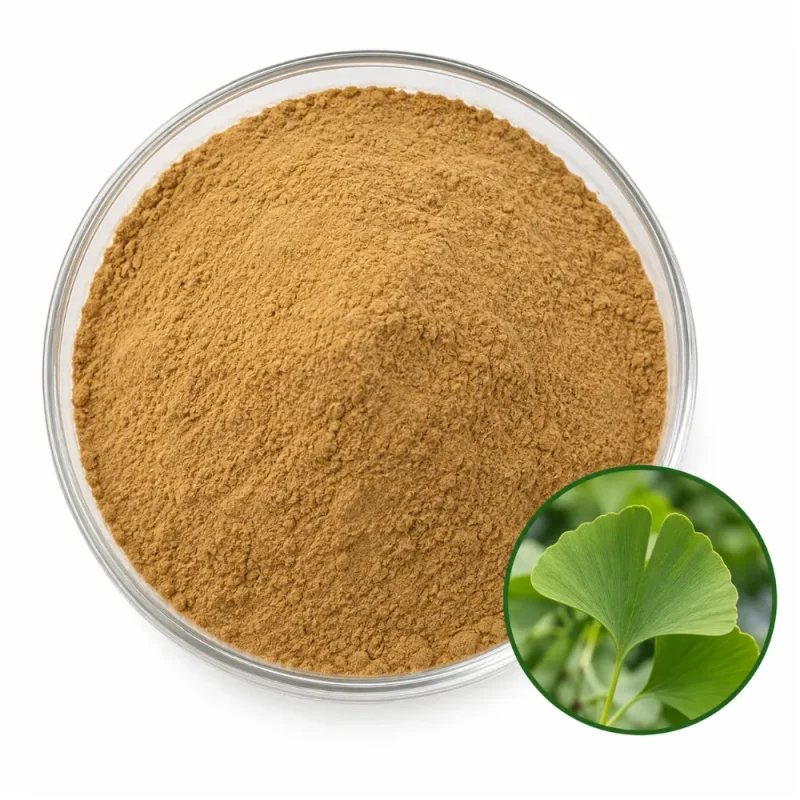
Ginkgo Biloba Extract 24% Flavone Glycosides + 6% Terpene Lactones

Ginkgo biloba extract is prepared from the leaves of Ginkgo biloba, the only living species of its family, and not from the seeds or the fleshy seed coat. Ethanol extraction takes up the flavonol glycosides and terpene lactones, and the liquor is dried to a yellow-brown powder.

The grade is 24% flavone glycosides plus 6% terpene lactones, both measured by HPLC. The powder is 80 mesh and slightly soluble in water. A single dual-marker grade is supplied, which suits capsules and tablets that need a defined profile of two marker groups in a small fill.

Marker Compounds & Standardization

Ginkgo leaf carries two different marker groups, and the grade names both. The flavone glycosides are flavonol glycosides of quercetin, kaempferol and isorhamnetin, with sugars attached. The terpene lactones are the ginkgolides A, B, C and J and bilobalide, a group of cage-like compounds that is specific to ginkgo. The pair is reported together as 24% and 6%, and each must be met. The botanical entity is Ginkgo biloba L., and the part used is the leaf, picked green in late summer and early autumn.

The choice is between ginkgo materials. The leaf is also supplied as a 10:1 ratio extract, the Ginkgo Biloba Extract Powder, as a milled leaf, the Ginkgo Biloba Leaf Powder, and as the purified terpene lactone Bilobalide 98%. The seed is a separate material with different chemistry and different safety considerations, and ginkgo seed is not used for this product. Ginkgo biloba is the only surviving species of an ancient family, and ginkgo biloba extract therefore has no close botanical substitute in the trade. Ginkgo biloba extract is sold in many strengths, and the 24% and 6% pair is the reference profile that most buyers recognize.

Analytical Methods & Purity Risks

Both markers are measured by HPLC, but by different procedures. The flavonol glycosides are hydrolyzed to their aglycones, quercetin, kaempferol and isorhamnetin, which are quantified by UV detection, and the total is calculated back to glycosides with a conversion factor. The terpene lactones have no strong chromophore, so they are quantified with a light-scattering, refractive-index or mass detector against their reference compounds.

Two limits sit beside the grade in the pharmacopoeial tradition for ginkgo leaf extracts. One is a ratio between the flavonol glycosides, and the other is a very low limit for ginkgolic acids. Ginkgolic acids are alkylphenolic acids that occur in the leaf and the outer seed coat and are removed by processing, because they are allergenic. The data for this product carries no limit figure for them, so none is published here.

Purity risks follow from the botany and the method. A UV total would add all flavonoids and cannot be converted into an HPLC result, and a hydrolysis-based figure depends on the conversion factor, so the calculation should be stated. Only the leaf is used. The seed carries a different toxin, 4′-O-methylpyridoxine, and the fleshy seed coat carries allergens, so a clear separation of leaf from seed material is a first identity check. The pattern of the flavonol glycosides helps too: ginkgo leaf shows a characteristic ratio of quercetin, kaempferol and isorhamnetin, and an extract that departs from the ratio suggests added rutin or another flavonoid source. Terpene lactones are specific to ginkgo, so a figure for them supports the identity of the leaf in a way that a flavonoid figure alone cannot.

Typical Specifications

Specification ItemProduct Information
Latin NameGinkgo biloba
Plant PartLeaf & Herb
ProcessingEthanol Extraction
Compound ClassFlavonoids, Polyphenols, Terpenoids
Common NameGinkgo, Maidenhair Tree Leaf
Ingredient TypeStandardized Extract
Marker Compound(s)Flavone glycosides (flavonol glycosides) and terpene lactones (ginkgolides, bilobalide)
Primary Grade24% Flavone Glycosides + 6% Terpene Lactones (HPLC)
AppearanceYellow-Brown powder
Solubility / DispersibilitySlightly Soluble in Water
Quality Parameters
Moisture (LOD)≤5.0%
Total Ash≤5.0%
Particle Size80 mesh
Heavy MetalsLead ≤2 ppm · Arsenic ≤1 ppm · Cadmium ≤1 ppm · Mercury ≤0.1 ppm
MicrobiologyTPC ≤1,000 cfu/g · Yeast & Mold ≤100 cfu/g · E. coli Negative · Salmonella Negative/25 g
Shelf Life24 months in unopened original packaging, cool and dry storage

Applications by Grade

Dual-Marker Grade for Capsules

The grade delivers a defined two-marker profile from a small fill, which suits hard capsules. The yellow-brown powder is fine and slightly sticky, so a glidant improves hopper flow, and a dry filling room limits caking.

Dual-Marker Grade in Tablet Blends

Tablets need a dry binder and an absorbent filler, because the flavonol glycosides take up moisture and the powder softens compacts. Coat the tablet to protect it from humidity and to hide the bitter, astringent taste.

Leaf Extract in Softgel Fills

Softgel fills carry the powder as a milled suspension in oil. The slightly soluble solid does not dissolve in oil, so particle size and a suspending agent decide whether the fill stays uniform through filling and storage.

Leaf Extract in Dry Premixes

Dry premixes combine the powder with other leaf and root extracts. Pre-blend it with a portion of the carrier to avoid color streaks, since the yellow-brown powder is strongly colored and can tint pale blends.

Leaf Extract in Stick Packs

Stick packs carry the powder with a flow agent and a sweet carrier at a low fill. The powder is slightly soluble and leaves a yellow haze in water, so a suspension aid and a note to stir are needed.

Leaf Extract in Film-Coated Tablets

Film-coated tablets use the coat to isolate the flavonol glycosides from light and metal contact. Check the coating pan for iron contact, which can turn the glycosides dark, and test the disintegration time after storage.

Technical & Quality Considerations

The extract is a yellow-brown powder with a faint, tea-like odor and a bitter, astringent taste. It is slightly soluble in water, and the solution is yellow and hazy. The ginkgolides dissolve poorly in water, which limits clear-solution use, and the flavonol glycosides are better dissolved in a polar organic solvent than in cold water. The extract therefore suits solid forms and oil suspensions better than clear beverages.

Flavonol glycosides darken on contact with iron and copper and react slowly with light, so use stainless steel and glass and protect the powder from sunlight. Terpene lactones are stable at normal processing temperatures but can rearrange in strong alkali, so avoid high-pH bases. A sealed liner and a cool, dry store keep the powder free-flowing.

For production, compare each lot with a retained sample for color, odor and the two sets of marker peaks, and control humidity at weighing and filling. The yellow-brown powder stains plastic and rubber contact parts, so dedicated scoops and a clean-down step after a ginkgo run keep pale products free of tint. A taste trial with the final coating sets the usable dose for tablets. Ginkgo biloba extract absorbs moisture slowly but steadily, so keep the drum sealed and store it in a cool place. A retained sample from each lot tested again near the end of shelf life shows whether the packaging holds the marker figures and the color together.

Packaging & Commercial Supply

Essencefield supports product evaluation, formulation trials, commercial orders, and ongoing ingredient supply. Packaging, storage, and shipping arrangements are determined by product characteristics, order quantity, stability requirements, and destination-market needs.

Supply ItemGeneral Information
SampleAvailable upon request for formulation, testing, and supplier evaluation
Order Quantities100 g · 1 kg · 5 kg · 25 kg · 100 kg · 500 kg · Bulk
Sample Lead TimeTypically 5–7 days after sample confirmation
Production Lead TimeTypically 15–30 days after order and specification confirmation
PackagingSuitable protective inner packaging with bags, cartons, drums, or other appropriate outer packaging
StorageStore in tightly sealed, suitable protective packaging in a cool, dry environment. Protect from moisture, heat, and direct sunlight. Specific storage conditions follow the approved product specification.
DocumentationCOA · Product Specification · TDS · SDS · Applicable declarations (as applicable)

Final order quantities, lead times, packaging, documentation, and shipping arrangements are confirmed according to the selected product and commercial requirements.

Request Ingredient Specifications & Quote

Share your target specification, application, quantity, and documentation needs. We’ll help confirm suitable options, samples, and commercial supply details.