
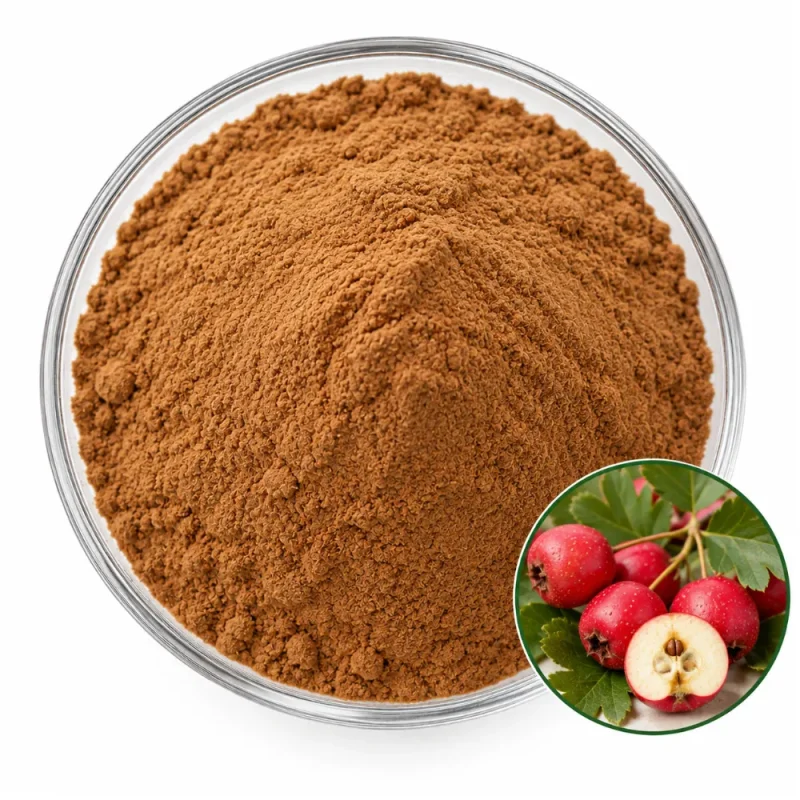
Flavonoid Standardization & Grades
Flavonoids are plant phenols built on a three-ring skeleton, and the grade reports their total. In hawthorn leaf the main members are C-glycosyl flavones, among them vitexin and its glucoside and rhamnoside, together with flavonol glycosides such as rutin, hyperoside and isoquercitrin, and the flavan-3-ol epicatechin. The grade is a class total and does not name one compound. The botanical entity is Crataegus pinnatifida Bunge, a tree of the Rosaceae with deeply lobed leaves, and the part used is the leaf.
| Grade | Assay & Method | Where It Fits |
|---|---|---|
| 2% Total Flavonoids | UV | Tea-style blends and drink powders |
| 20% Total Flavonoids | UV | Capsules and tablets with small fill |
The two grades are different in character. The 20% grade is a flavonoid concentrate that supplies a defined load from a small fill. The 2% grade is closer to the leaf, with more of the sugars, tannins and chlorophyll, so hawthorn extract at this level suits tea-style blends and drink powders. Hawthorn leaf and hawthorn fruit extracts are both sold as hawthorn extract, and the plant part, not the name, defines the product. The fruit and the leaf of hawthorn are separate materials, and the fruit is supplied as the Hawthorn Fruit Extract Powder. The leaf is also supplied as a 10:1 ratio extract, the Hawthorn Leaf Extract Powder, and the purified flavone is listed as Vitexin 98%.


