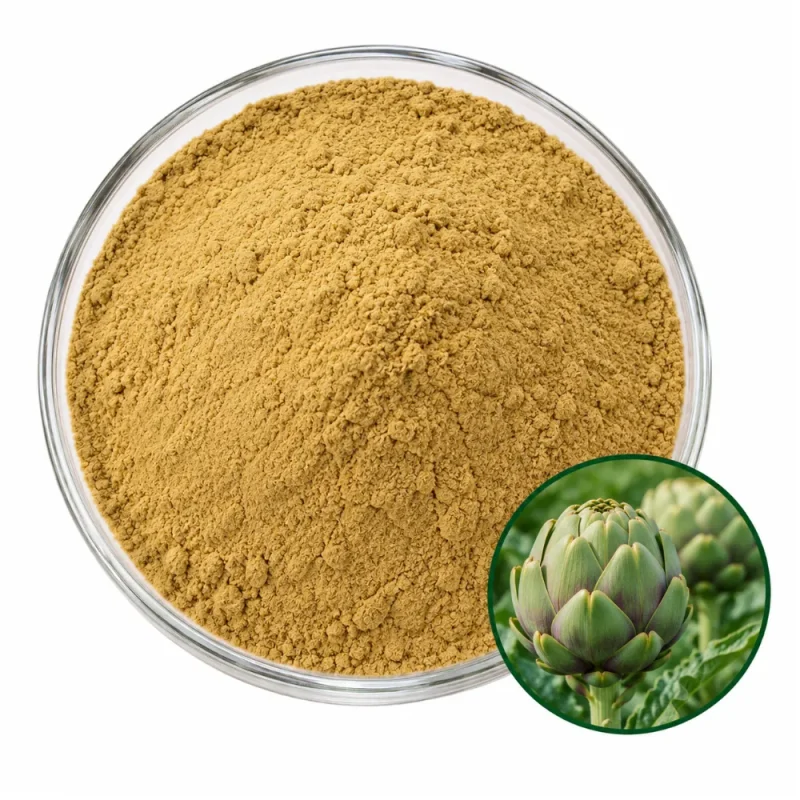
Artichoke Extract 0.5–5% Cynarin

Artichoke extract is prepared from the large basal leaves of Cynara scolymus, the globe artichoke, and not from the edible flower buds, bracts or receptacles. Ethanol extraction takes up the caffeoylquinic acids of the leaf, and the liquor is dried to a light brown powder with a persistent bitter taste.

The grade range is 0.5–5% cynarin by HPLC, and the primary grade is the 5% end. The powder is 80 mesh and slightly soluble in water. The 0.5% grade keeps the full leaf profile for blends, while the 5% grade carries a higher marker load for compact capsules and tablets.

Cynarin Standardization & Grades

Cynarin is the common name for 1,3-dicaffeoylquinic acid, a compound in which two caffeic acid units are attached to quinic acid. It is the standardization target because it is the compound most associated with artichoke in the trade, and because a pure reference standard exists. In commerce the name is sometimes used loosely for the whole family of dicaffeoylquinic acids, and the leaf also holds chlorogenic acid and the bitter sesquiterpene lactone cynaropicrin. The botanical entity is Cynara scolymus L., and the part used is the leaf.

GradeAssay & MethodWhere It Fits
0.5% CynarinHPLCBroad extract for blends and tea-style mixes
5% CynarinHPLCCapsules and tablets with small fill

The two grades differ tenfold. The 5% grade is a marker concentrate that supplies a defined load from a small fill. The 0.5% grade is closer to the leaf, with more of the sugars, the chlorogenic acid and the bitter lactones, so artichoke extract at this level suits blends and tea-style mixes. The same leaf is also supplied as a 10:1 ratio extract, the Artichoke Extract Powder, as a milled leaf, the Artichoke Leaf Powder, and as the purified acid 1,3-Dicaffeoylquinic Acid 98%. The flower bud is the food part of the plant, and it is a different material from the leaf.

Cynarin Analysis & Purity Risks

Both grades are measured by HPLC against a cynarin reference standard. The caffeoyl groups absorb ultraviolet light strongly, so a UV detector gives clean peaks. The method separates the 1,3 isomer from the 1,5 and 3,5 isomers and from chlorogenic acid. A colorimetric polyphenol total counts all of them together, and it cannot be converted into an HPLC cynarin result.

The data for this product lists caffeoylquinic acids as a secondary marker group. These acids isomerize easily. Heat, light and a shift in pH move a caffeoyl group from one position on the quinic acid to another, so the share of the 1,3 isomer can change during drying, extraction and storage. A figure for cynarin is therefore a statement about processing as well as about the plant.

Sample preparation must limit isomerization. The powder is dissolved in a cold, mildly acidic diluent, filtered and injected promptly, and long standing at room temperature changes the peak pattern. The chromatogram of an artichoke leaf extract is read as a pattern of several dicaffeoylquinic isomers, not as one peak.

Purity risks follow from naming. The artichoke is sometimes called Cynara cardunculus var. scolymus, and the Jerusalem artichoke, Helianthus tuberosus, is a different plant altogether. Leaf, bract and receptacle differ in chemistry, so a fixed part is the first identity check. Cynarin is often named in marketing for the whole group of dicaffeoylquinic acids. Artichoke leaf extract differs from the edible bud in taste as well: the leaf is far more bitter and is not eaten as food, so the extract is formulated as a supplement ingredient and not as a flavor.

Typical Specifications

Specification ItemProduct Information
Latin NameCynara scolymus
Plant PartLeaf & Herb
ProcessingEthanol Extraction
Compound ClassPolyphenols
Common NameArtichoke Leaf, Globe Artichoke
Ingredient TypeStandardized Extract
Marker Compound(s)Cynarin (1,3-dicaffeoylquinic acid)
Primary Grade5% Cynarin (HPLC)
Available Grades0.5% · 5% Cynarin (HPLC)
AppearanceLight Brown powder
Solubility / DispersibilitySlightly Soluble in Water
Quality Parameters
Moisture (LOD)≤5.0%
Total Ash≤5.0%
Particle Size80 mesh
Heavy MetalsLead ≤2 ppm · Arsenic ≤1 ppm · Cadmium ≤1 ppm · Mercury ≤0.1 ppm
MicrobiologyTPC ≤1,000 cfu/g · Yeast & Mold ≤100 cfu/g · E. coli Negative · Salmonella Negative/25 g
Shelf Life24 months in unopened original packaging, cool and dry storage

Applications by Grade

5% Grade for Compact Capsules

The 5% grade puts the cynarin target into a small fill, so it suits capsules and tablets. The light brown powder is slightly soluble in water, bitter and hygroscopic, so a glidant and a desiccant are needed in humid rooms.

5% Grade in Tablet Blends

Tablets of the 5% grade need a dry binder and a moisture-tolerant filler, because caffeoyl acids take up water and soften compacts. A film coat hides the persistent bitter taste, and an iron-free path avoids darkening of the phenolic acids.

0.5% Grade in Tea-Style Blends

Tea-style blends use the 0.5% grade with citrus peel, mint or fennel to cover the bitterness. The powder is slightly soluble, so the infusion is hazy, and a filter bag keeps the particles out of the cup.

0.5% Grade in Drink Powders

Drink powders carry the 0.5% grade with strong flavors and a sweetener. Bitterness is the main limit on dose, and a lemon or ginger base masks it better than a neutral base, while a thickener holds the slightly soluble particles in suspension.

0.5% Grade in Gummy Premixes

Gummy premixes accept the 0.5% grade but the leaf is bitter, so the flavor system needs acid and sweetener in the right balance. Add the powder after the main cook and keep the hold short, since heat shifts the isomers.

5% Grade in Stick Packs

Stick packs carry the 5% grade at a small fill with a flow agent and a sweet carrier. Seal the packs in moisture-barrier film, because the powder clumps at the seal, and check the taste of the dissolved drink at the target dose.

Technical & Quality Considerations

The extract is a light brown powder with a green, herbal odor and an intense, lingering bitter taste. Caffeoylquinic acids are sensitive to heat, light, alkaline pH and metal ions, and artichoke extract darkens in high-pH bases and on contact with iron or copper. A mildly acidic system keeps color and the isomer pattern more stable.

For production, control humidity in weighing and filling, since the powder gains water and cakes. The 5% grade packs more densely than the 0.5% grade, and a fine flow aid helps it pass through hoppers and feeders.

In liquids, wet the powder with a small amount of alcohol or a surfactant solution before dilution, and mix at high shear so that it does not float. Bitterness is the main limit on dose, and early taste trials with the final sweetener and flavor system save work later. Keep the drum sealed and away from light, compare each lot with a retained sample, and clean the line after a run, because the bitter residue is persistent. Artichoke extract keeps its isomer pattern best when it is stored cool and dry, and a sample from each lot tested again near the end of shelf life shows whether the packaging holds the cynarin figure.

Packaging & Commercial Supply

Essencefield supports product evaluation, formulation trials, commercial orders, and ongoing ingredient supply. Packaging, storage, and shipping arrangements are determined by product characteristics, order quantity, stability requirements, and destination-market needs.

Supply ItemGeneral Information
SampleAvailable upon request for formulation, testing, and supplier evaluation
Order Quantities100 g · 1 kg · 5 kg · 25 kg · 100 kg · 500 kg · Bulk
Sample Lead TimeTypically 5–7 days after sample confirmation
Production Lead TimeTypically 15–30 days after order and specification confirmation
PackagingSuitable protective inner packaging with bags, cartons, drums, or other appropriate outer packaging
StorageStore in tightly sealed, suitable protective packaging in a cool, dry environment. Protect from moisture, heat, and direct sunlight. Specific storage conditions follow the approved product specification.
DocumentationCOA · Product Specification · TDS · SDS · Applicable declarations (as applicable)

Final order quantities, lead times, packaging, documentation, and shipping arrangements are confirmed according to the selected product and commercial requirements.

Request Ingredient Specifications & Quote

Share your target specification, application, quantity, and documentation needs. We’ll help confirm suitable options, samples, and commercial supply details.