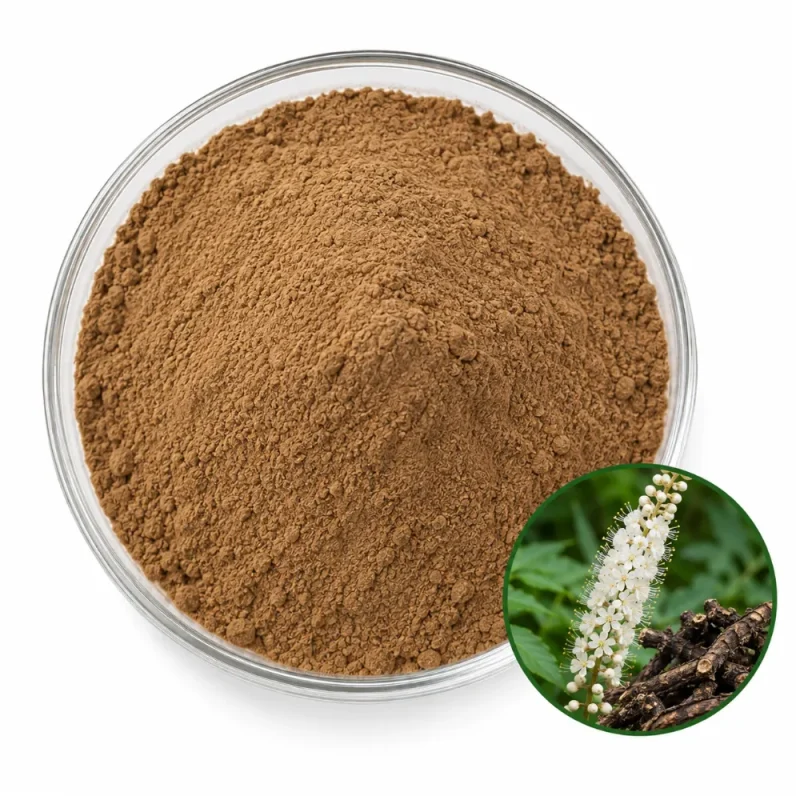
Black Cohosh Extract 2.5–8% Triterpene Glycosides

Black cohosh extract is prepared from the root and rhizome of Actaea racemosa, the North American woodland perennial, and not from the Asian Actaea species that sometimes enter the trade under similar names. Ethanol extraction takes up the triterpene glycosides, and the liquor is dried to a brown powder.

The grade range is 2.5–8% triterpene glycosides by UV, and the primary grade is the 8% end. The powder is 80 mesh and slightly soluble in water. The 2.5% grade suits blended powders and tea-style mixes, while the 8% grade carries a higher marker load for compact capsules and tablets.

Triterpene Glycoside Standardization & Grades

Black cohosh rhizome holds a family of cycloartane triterpene glycosides, among them actein and 23-epi-26-deoxyactein, together with phenolic acids such as the cimicifugic and fukinolic acids. The grade reports the triterpene glycosides as a class total, and the phenolic acids are not counted. The botanical entity is Actaea racemosa L., a member of the Ranunculaceae also known by the older name Cimicifuga racemosa, and the part used is the rhizome with its roots.

GradeAssay & MethodWhere It Fits
2.5% Triterpene GlycosidesUVBlended powders and tea-style mixes
8% Triterpene GlycosidesUVCapsules and tablets with small fill

The two grades differ by about a factor of three. The 8% grade is a glycoside concentrate that supplies a defined load from a small fill. The 2.5% grade is closer to the rhizome, with more of the phenolic acids, starch and fiber, so black cohosh extract at this level suits blended powders and tea-style mixes. The same plant is also supplied as a 10:1 ratio extract, the Black Cohosh Extract Powder, and as a milled root, the Black Cohosh Root Powder. Blue cohosh, Caulophyllum thalictroides, belongs to a different family and is unrelated. Black cohosh extract at 8% is a glycoside concentrate, and black cohosh at 2.5% stays near the rhizome. Both are extracts of one species and one plant part, and they differ in concentration, not in identity. The plant grows in the woodlands of eastern North America.

Triterpene Glycoside Analysis & Purity Risks

Both grades are measured by UV, a colorimetric method. The sample reacts with an acid reagent to give a colored product, and the absorbance is read against a reference triterpene glycoside. It is not an HPLC result, and it cannot be converted into a figure for actein or deoxyactein alone.

The reaction is not specific, so phenolic acids and other terpenoids can add color. The method suits comparison of lots made by the same route and read in the same laboratory, and HPLC with a light-scattering or mass detector is used beside it to show the pattern of individual glycosides. That pattern separates black cohosh from related Actaea species.

Sample preparation affects the reading. The powder must be dissolved completely, the reaction time and temperature are controlled, and a blank corrects for the color of the extract itself. A figure from another laboratory or another reference compound is not directly comparable.

The Asian Actaea species, including Actaea cimicifuga, Actaea dahurica and Actaea simplex, are sold as sheng ma and have been found in retail products by DNA testing. Their glycoside patterns differ from those of Actaea racemosa. A stated species and a fingerprint are therefore more reliable than a colorimetric total, and the rhizome is wild-collected in many supply chains, which adds a further identity risk. Because the glycoside classes are close in structure, adulteration with an Asian species can leave the colorimetric total almost unchanged, and only the fingerprint shows the difference. A reference sample of authenticated Actaea racemosa rhizome is therefore the right comparison for each lot.

Typical Specifications

Specification ItemProduct Information
Latin NameActaea racemosa
Plant PartRoot & Rhizome
ProcessingEthanol Extraction
Compound ClassTriterpenoids, Terpenoids
Common NameBlack Cohosh, Black Bugbane
Ingredient TypeStandardized Extract
Marker Compound(s)Triterpene glycosides (actein-type cycloartane glycosides)
Primary Grade8% Triterpene Glycosides (UV)
Available Grades2.5% · 8% Triterpene Glycosides (UV)
AppearanceBrown powder
Solubility / DispersibilitySlightly Soluble in Water
Quality Parameters
Moisture (LOD)≤5.0%
Total Ash≤5.0%
Particle Size80 mesh
Heavy MetalsLead ≤2 ppm · Arsenic ≤1 ppm · Cadmium ≤1 ppm · Mercury ≤0.1 ppm
MicrobiologyTPC ≤1,000 cfu/g · Yeast & Mold ≤100 cfu/g · E. coli Negative · Salmonella Negative/25 g
Shelf Life24 months in unopened original packaging, cool and dry storage

Applications by Grade

8% Grade for Compact Capsules

The 8% grade delivers a glycoside load from a small fill, which suits capsules and tablets. The brown powder is slightly soluble in water and takes up moisture slowly, so fill in a dry room and keep a desiccant in the bottle.

8% Grade in Tablet Blends

Tablets of the 8% grade need a dry binder and a lubricant, because the earthy, tannin-bearing powder is cohesive and sticks to punches. Keep the blend away from iron-bearing equipment and check hardness after storage.

2.5% Grade in Blended Powders

Blended powders use the 2.5% grade, which fills at a larger weight and is easier to meter. The brown powder tints pale blends, so mix it with a portion of the carrier first to avoid dark streaks in the finished product.

2.5% Grade in Tea-Style Mixes

Tea-style mixes carry the 2.5% grade with spices and dried fruit. The powder is slightly soluble and gives a hazy brown infusion with an earthy, bitter taste, so strong flavors such as cinnamon, clove or citrus help to cover it.

2.5% Grade in Drink Powders

Drink powders accept the 2.5% grade with cocoa, malt or caramel flavors. A thickener holds the slightly soluble particles in suspension, and a taste trial at the target dose shows how much bitterness the base can hide.

8% Grade in Softgel Fills

Softgel fills can carry the 8% grade as a milled suspension in oil. The slightly soluble solid does not dissolve in oil, so particle size and a suspending agent decide whether the fill stays uniform through storage.

Technical & Quality Considerations

The extract is a brown powder with an earthy, slightly smoky odor and a bitter, astringent taste. The triterpene glycosides are stable at normal processing temperatures, but the phenolic acids, caffeic acid derivatives among them, darken in alkaline bases and on contact with iron or copper. Neutral to mildly acidic systems keep the color more stable.

Sieve before blending to break up soft lumps and pre-blend black cohosh extract with a portion of the carrier. The 8% grade packs more densely than the 2.5% grade, and a fine flow aid helps it pass through hoppers and feeders.

In liquids, wet the powder with a small amount of alcohol or a surfactant solution before dilution and mix at high shear. Keep the drum sealed and away from light, compare each lot with a retained sample for color, odor and the glycoside fingerprint, and clean the line after a run, because the dark, earthy powder stains mixers and hoppers and carries odor. Black cohosh extract keeps its color best in a sealed liner away from sunlight, and a cool, dry store protects the powder from caking. A sample from each lot tested again near the end of shelf life shows whether the packaging holds the glycoside reading and the fingerprint.

Packaging & Commercial Supply

Essencefield supports product evaluation, formulation trials, commercial orders, and ongoing ingredient supply. Packaging, storage, and shipping arrangements are determined by product characteristics, order quantity, stability requirements, and destination-market needs.

Supply ItemGeneral Information
SampleAvailable upon request for formulation, testing, and supplier evaluation
Order Quantities100 g · 1 kg · 5 kg · 25 kg · 100 kg · 500 kg · Bulk
Sample Lead TimeTypically 5–7 days after sample confirmation
Production Lead TimeTypically 15–30 days after order and specification confirmation
PackagingSuitable protective inner packaging with bags, cartons, drums, or other appropriate outer packaging
StorageStore in tightly sealed, suitable protective packaging in a cool, dry environment. Protect from moisture, heat, and direct sunlight. Specific storage conditions follow the approved product specification.
DocumentationCOA · Product Specification · TDS · SDS · Applicable declarations (as applicable)

Final order quantities, lead times, packaging, documentation, and shipping arrangements are confirmed according to the selected product and commercial requirements.

Request Ingredient Specifications & Quote

Share your target specification, application, quantity, and documentation needs. We’ll help confirm suitable options, samples, and commercial supply details.