
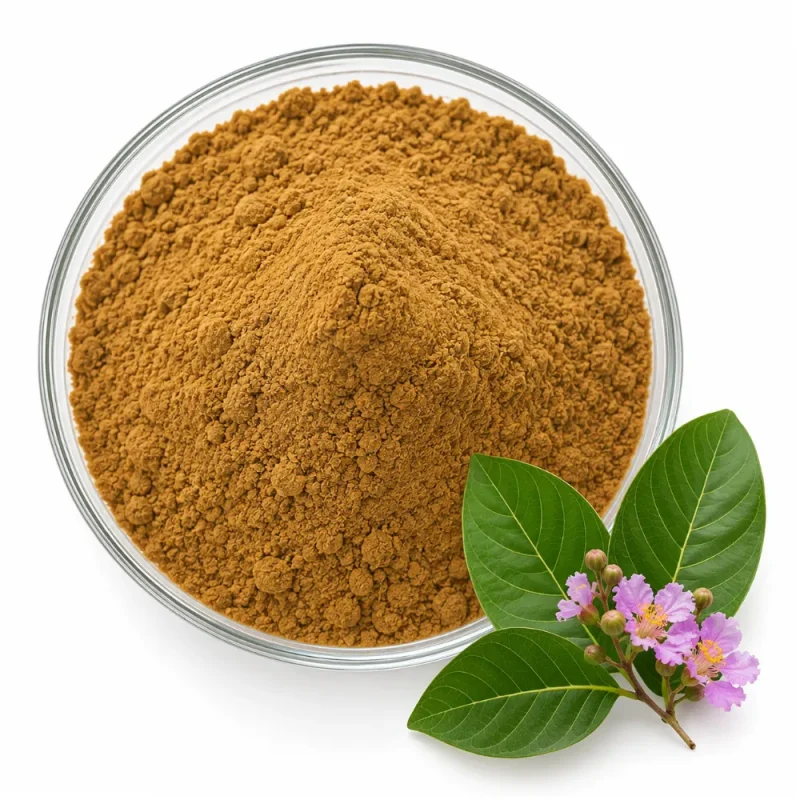
Corosolic Acid Standardization & Grades
Corosolic acid is 2α-hydroxyursolic acid, a pentacyclic triterpenoid acid. It is closely related to ursolic acid and oleanolic acid, which differ from it by a hydroxyl group or a double-bond position, and it is lipophilic. It is the standardization target because it is the characteristic triterpenoid of banaba leaf and because a pure reference compound exists. The leaf also holds ellagitannins, among them the compound called lagerstroemin, and gallic acid. The botanical entity is Lagerstroemia speciosa (L.) Pers., a tree of the Lythraceae, and the part used is the leaf.
| Grade | Assay & Method | Where It Fits |
|---|---|---|
| 1% Corosolic Acid | HPLC | Capsule blends and dry premixes |
| 10% Corosolic Acid | HPLC | Capsules and tablets with small fill |
The two grades differ tenfold. The 10% grade is a marker concentrate that supplies a defined load from a small fill. The 1% grade is closer to the leaf, with more of the tannins, chlorophyll and polar solids, so banaba leaf extract at this level suits capsule blends and dry premixes. The leaf is also supplied as a 10:1 ratio extract, the Banaba Leaf Extract Powder, and the purified acid is listed as Corosolic Acid 98%. A purified food-grade product at 98% is a very different material from a leaf extract, and the percentage on a label should be read with the grade name. Banaba leaf extract at 10% is the more concentrated of the two grades, and banaba leaf extract at 1% is the fuller one. The tree is widely planted as an ornamental.


