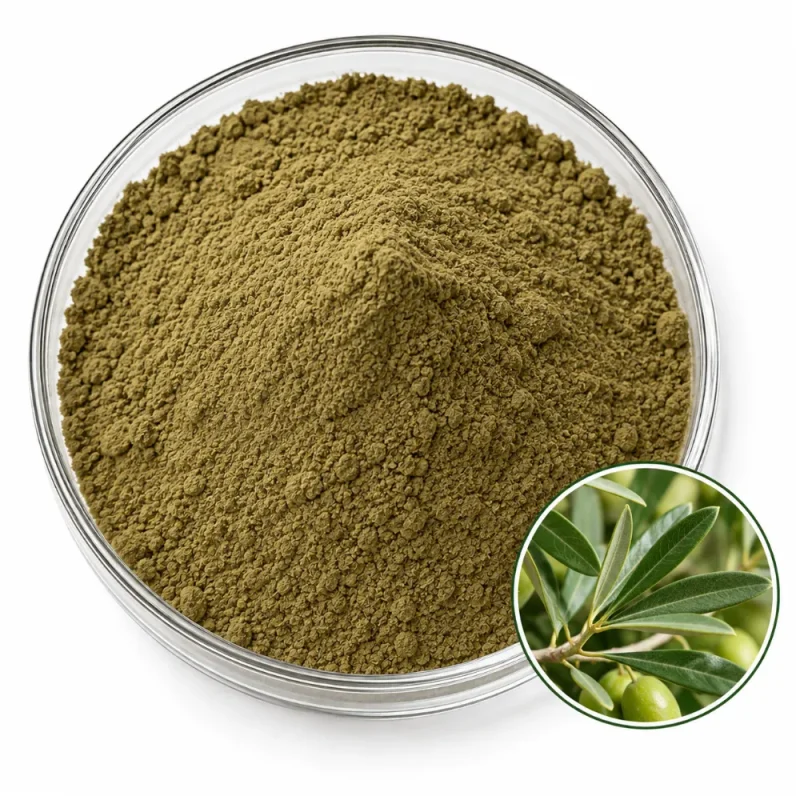
Olive Leaf Extract 10–40% Oleuropein

Olive leaf extract is prepared from the leaves of Olea europaea, the Mediterranean olive tree, and not from the fruit, the pulp or the pressed oil. Ethanol extraction takes up the secoiridoid glycosides of the leaf, and the liquor is dried to a green powder that dissolves in water.

The grade range is 10–40% oleuropein by HPLC, and the primary grade is the 40% end. The powder is 80 mesh and water soluble. The 10% grade suits drink powders and blended premixes, while the 40% grade carries a high marker load for compact capsules and tablets.

Oleuropein Standardization & Grades

Oleuropein is a secoiridoid glycoside, a bitter compound in which a glucose unit is joined to an iridoid-derived acid that is esterified with the phenol hydroxytyrosol. It is the main phenolic of the olive leaf and the compound that gives unripe olives and leaf teas their strong bitterness. It is the standardization target because it is the characteristic compound of the leaf and can be measured against a pure reference. The botanical entity is Olea europaea L., a tree of the Oleaceae, and the part used is the leaf.

GradeAssay & MethodWhere It Fits
10% OleuropeinHPLCDrink powders and blended premixes
40% OleuropeinHPLCCapsules and tablets with small fill

The two grades differ by a factor of four. The 40% grade is a marker concentrate that supplies a defined load from a small fill. The 10% grade holds more of the flavonoids, sugars and chlorophyll-derived solids of the leaf, so olive leaf extract at this level is bulkier and suits drink powders and blended premixes. The leaf is also supplied as a 10:1 ratio extract, the Olive Leaf Extract Powder, and as a milled leaf, the Olive Leaf Powder. The fruit is a separate material with a different marker, the Olive Fruit Extract 10–40% Hydroxytyrosol. Olive leaf extract at 40% is the more concentrated of the two grades, and olive leaf extract at 10% is the fuller one. The leaf is the plant part that carries oleuropein as its main phenolic.

Oleuropein Analysis & Purity Risks

Both grades are measured by HPLC against an oleuropein reference standard. The molecule absorbs ultraviolet light well, so a UV detector gives a clean peak. A colorimetric polyphenol total counts every phenolic compound in the leaf and cannot be converted into an HPLC oleuropein figure. Oleuropein is also measured separately from its breakdown products, which gives the chromatogram its diagnostic value.

Oleuropein is hydrolyzed by plant enzymes and by acid and heat. The ester bond and the glycosidic bond both split, releasing hydroxytyrosol, the simple phenol, and elenolic acid derivatives. A chromatogram that shows a high hydroxytyrosol and tyrosol peak beside a lowered oleuropein peak tells the history of the lot, because it points to enzyme action or hot, acidic handling before drying.

Sample preparation must stop the enzyme and limit hydrolysis. The powder is dissolved in a cold, mildly acidic diluent, filtered and injected promptly, and a prepared sample left at room temperature shows a falling oleuropein peak. The percentage is reported on an as-is or a dry basis, and the basis belongs with the figure.

Purity risks follow from the plant part. Olive leaf, fruit and oil carry different phenolics. The leaf is rich in oleuropein, while the fruit extract is standardized to hydroxytyrosol, and a leaf extract sold under a fruit name would show the wrong marker. A stated species, the leaf as the plant part and the oleuropein peak with its hydrolysis products are the first checks.

Typical Specifications

Specification ItemProduct Information
Latin NameOlea europaea
Plant PartLeaf & Herb
ProcessingEthanol Extraction
Compound ClassPolyphenols
Common NameOlive Leaf
Ingredient TypeStandardized Extract
Marker Compound(s)Oleuropein (secoiridoid glycoside)
Primary Grade40% Oleuropein (HPLC)
Available Grades10% · 40% Oleuropein (HPLC)
AppearanceGreen powder
Solubility / DispersibilityWater Soluble
Quality Parameters
Moisture (LOD)≤5.0%
Total Ash≤5.0%
Particle Size80 mesh
Heavy MetalsLead ≤2 ppm · Arsenic ≤1 ppm · Cadmium ≤1 ppm · Mercury ≤0.1 ppm
MicrobiologyTPC ≤1,000 cfu/g · Yeast & Mold ≤100 cfu/g · E. coli Negative · Salmonella Negative/25 g
Shelf Life24 months in unopened original packaging, cool and dry storage

Applications by Grade

40% Grade for Compact Capsules

The 40% grade delivers an oleuropein load from a small fill, which suits capsules and tablets. The green powder is bitter, water soluble and hygroscopic, so fill in a dry room and keep a desiccant in the closure of the bottle.

40% Grade in Tablet Blends

Tablets of the 40% grade need a dry binder and a moisture-tolerant filler, because the polar powder softens compacts under humidity. A film coat covers the persistent bitter taste, and a sealed blister limits moisture during storage.

10% Grade in Drink Powders

The 10% grade dissolves in water to a clear green-brown drink with a bitter, grassy taste. It suits mixes with lemon, mint or ginger, and a sweetener helps cover the bitterness, which is the main limit on dose.

10% Grade in Tea-Style Blends

Tea-style blends carry the 10% grade with lemon peel, mint and green tea. The extract clears quickly in hot water and replaces the leaf pieces, with a more even flavor and no sediment in the cup.

10% Grade in Gummy Premixes

Gummy premixes accept the 10% grade only with a strong flavor system, because the bitterness is persistent. Add the powder after the main cook, keep the hold short, and test the gel after storage, since heat and acid break oleuropein down.

40% Grade in Stick Packs

Stick packs carry the 40% grade at a very small fill with a flow agent and a sweet carrier. The bitterness of oleuropein is strong in a clear liquid, so test the dissolved stick with the final flavor, and seal the pack against humidity.

Technical & Quality Considerations

The extract is a green powder with a faint, leafy, olive-like odor and an intense, lingering bitter taste. It is water soluble, and solutions are clear and green-brown. Oleuropein is the least stable component, and it is hydrolyzed by acid, by heat and by enzymes, so long hot holds in acidic bases lower the oleuropein peak and raise the hydroxytyrosol peak.

For olive leaf, sieve before blending to break up soft lumps and fold the olive leaf extract into a portion of the carrier. A fine flow aid helps the 40% grade, which packs more densely, pass through hoppers and feeders. Avoid contact with iron and copper, which darken polyphenols.

In liquids, add the powder under agitation to a base at a moderate pH, and add it late in the process. Compare each lot with a retained sample for color, taste and the oleuropein peak. The green powder stains mixers and hoppers, so schedule clean-down time after an olive leaf run, and keep the drum sealed, away from light and heat, in a cool, dry store. A retained sample from each lot, tested again near the end of shelf life, shows whether the packaging holds the oleuropein figure, which falls first if moisture and warmth reach the powder, and the green color, which turns brown.

Olive leaf extract can taste harsh at the 40% level, and a trial that covers the bitterness with sweetener, acid or a flavor such as lemon shows the highest dose that stays palatable in a drink or chewable.

Packaging & Commercial Supply

Essencefield supports product evaluation, formulation trials, commercial orders, and ongoing ingredient supply. Packaging, storage, and shipping arrangements are determined by product characteristics, order quantity, stability requirements, and destination-market needs.

Supply ItemGeneral Information
SampleAvailable upon request for formulation, testing, and supplier evaluation
Order Quantities100 g · 1 kg · 5 kg · 25 kg · 100 kg · 500 kg · Bulk
Sample Lead TimeTypically 5–7 days after sample confirmation
Production Lead TimeTypically 15–30 days after order and specification confirmation
PackagingSuitable protective inner packaging with bags, cartons, drums, or other appropriate outer packaging
StorageStore in tightly sealed, suitable protective packaging in a cool, dry environment. Protect from moisture, heat, and direct sunlight. Specific storage conditions follow the approved product specification.
DocumentationCOA · Product Specification · TDS · SDS · Applicable declarations (as applicable)

Final order quantities, lead times, packaging, documentation, and shipping arrangements are confirmed according to the selected product and commercial requirements.

Request Ingredient Specifications & Quote

Share your target specification, application, quantity, and documentation needs. We’ll help confirm suitable options, samples, and commercial supply details.