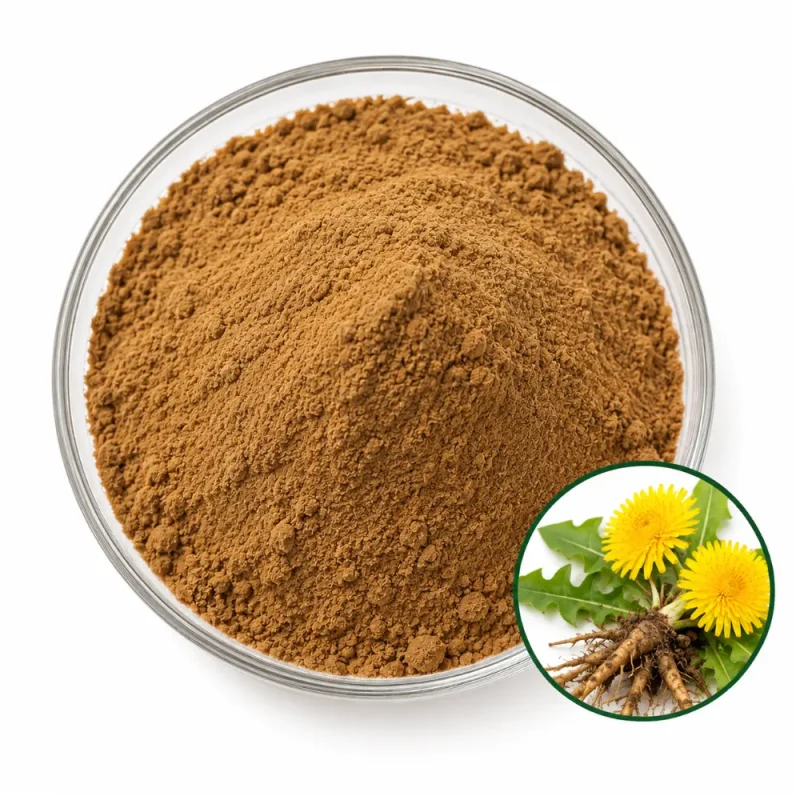
Dandelion Extract 3–5% Flavonoids

Dandelion extract is prepared from the leaves of Taraxacum officinale, the common dandelion of lawns and meadows, and not from the flowers or from the milky root. Ethanol extraction takes up the flavonoids and phenolic acids of the leaf, and the liquor is dried to a light brown powder.

The grade range is 3–5% flavonoids by UV, and the primary grade is the 5% end. The powder is 80 mesh and slightly soluble in water. The 3% grade suits tea-style blends and drink powders, while the 5% grade carries a somewhat higher flavonoid load for capsules and tablets.

Flavonoid Standardization & Grades

In dandelion leaf the main members are glycosides of luteolin and apigenin, accompanied by phenolic acids such as chicoric acid and chlorogenic acid. The leaf also carries bitter sesquiterpene lactones, and the root holds the storage carbohydrate inulin, which the leaf lacks. The grade is a class total and does not name a single compound. The botanical entity is Taraxacum officinale Weber ex F.H.Wigg., a plant of the Asteraceae, and the part used is the leaf.

GradeAssay & MethodWhere It Fits
3% FlavonoidsUVTea-style blends and drink powders
5% FlavonoidsUVCapsules and tablets

The two grades are close in strength, so the choice is about fill size and flavor. The 5% grade gives a little more flavonoid in a capsule of the same weight. The 3% grade is closer to the leaf, with more of the sugars, the bitter lactones and the chlorophyll-derived solids, so dandelion extract at this level suits tea-style blends and drink powders. Dandelion is also supplied as a 10:1 ratio extract, the Dandelion Extract Powder, as a milled root, the Dandelion Root Powder, and as a peptide product, the Dandelion Peptide Powder. The leaf, the root and the peptide are different materials with different chemistry. Dandelion extract at 5% is the more concentrated of the two grades, and dandelion extract at 3% is the fuller one. Dandelion leaves are deeply toothed and bitter, and the dandelion leaf is the part that carries the flavonoid glycosides named in the grade.

Flavonoid Analysis & Purity Risks

For dandelion, the flavonoid figure is measured by UV. The method is colorimetric: the sample forms a colored complex with a metal salt reagent, and the absorbance is compared with a reference flavonoid. It is not an HPLC result, and it cannot be converted into a figure for luteolin or apigenin.

The reference compound belongs with the figure. A procedure that reads against rutin and one that reads against luteolin give different percentages for the same extract, because the response of each flavonoid differs. Phenolic acids can add color in the same conditions, so the UV total of a leaf extract can include a small contribution that is not flavonoid. HPLC is used beside the total to show the individual glycosides.

Sample preparation affects the reading. The extract is dissolved in alcohol, mixed with the reagent, and left for a fixed time before the absorbance is read, and a blank corrects for the color of the extract. Chlorophyll residues from a green leaf can interfere, so a well-cleaned extract gives a more repeatable result.

Purity risks follow from naming and the plant part. Taraxacum is a large group of closely related microspecies, and the name Taraxacum officinale covers an aggregate. The leaf and the root have different chemistry, so the plant part belongs with the name. The data for the sibling products includes a root powder and an extract that may refer to the root, which is why a stated part and a flavone fingerprint are the first identity checks.

Typical Specifications

Specification ItemProduct Information
Latin NameTaraxacum officinale
Plant PartLeaf & Herb
ProcessingEthanol Extraction
Compound ClassFlavonoids, Polyphenols
Common NameDandelion, Dandelion Leaf
Ingredient TypeStandardized Extract
Marker Compound(s)Total flavonoids (luteolin and apigenin glycosides)
Primary Grade5% Flavonoids (UV)
Available Grades3% · 5% Flavonoids (UV)
AppearanceLight Brown powder
Solubility / DispersibilitySlightly Soluble in Water
Quality Parameters
Moisture (LOD)≤5.0%
Total Ash≤5.0%
Particle Size80 mesh
Heavy MetalsLead ≤2 ppm · Arsenic ≤1 ppm · Cadmium ≤1 ppm · Mercury ≤0.1 ppm
MicrobiologyTPC ≤1,000 cfu/g · Yeast & Mold ≤100 cfu/g · E. coli Negative · Salmonella Negative/25 g
Shelf Life24 months in unopened original packaging, cool and dry storage

Applications by Grade

5% Grade for Capsules and Tablets

The 5% grade delivers a flavonoid load at a reasonable fill, which suits capsules and tablets of dandelion leaf. The slightly soluble powder fills as a dry solid, and a desiccant in the bottle protects it from humid air.

5% Grade in Tablet Blends

Tablets of the 5% grade need a dry binder and a moisture-tolerant filler, because leaf extract powders take up water and soften compacts. Keep the blend away from iron-bearing equipment, which darkens flavonoid glycosides on contact, and check hardness after storage.

3% Grade in Tea-Style Blends

Tea-style blends use the 3% grade with lemon, mint or fennel. The powder is slightly soluble and gives a hazy infusion with a mild, bitter, leafy taste, so a filter bag or a note to stir keeps the cup uniform.

3% Grade in Drink Powders

Drink powders carry the 3% grade with citrus or herbal flavors and a sweetener that covers the bitter lactones well. The slightly soluble solid forms a haze, so a thickener holds the particles in suspension and a stir note on the pack helps.

3% Grade in Gummy Premixes

Gummy premixes accept the 3% grade as a fine dispersion in warm syrup. Add it after the main cook, keep the hold short, and check the color of the finished gummy after storage, because it turns brown if the phenolics oxidize at high pH.

5% Grade in Dry Botanical Blends

Dry blends combine the 5% grade with other leaf and root extracts, and the dandelion powder should be checked for uniform color in the finished blend. Pre-blend it with part of the carrier, because the light brown powder tints pale blends and can leave specks if it is added in one step.

Technical & Quality Considerations

The extract is a light brown powder with a green, leafy odor and a bitter, slightly salty taste. Flavonoid glycosides darken on contact with iron and copper and in alkaline bases, and they fade slowly in light, so stainless steel, glass and opaque packaging protect the color.

Sieve before blending to break up soft agglomerates and fold dandelion extract into a portion of the carrier. A fine flow aid helps the 5% grade pass through hoppers and feeders, and dedicated scoops avoid cross-contact with pale products.

Compare each lot with a retained sample for color, odor and the flavonoid reading. Cool, dry storage in a sealed liner keeps the powder free-flowing, and retesting a sample near the end of shelf life shows whether the packaging holds the marker figure and the color. Taste trials in the final drink show how much of the bitter leaf note dandelion extract adds at the target dose.

Dandelion extract is mild but slightly salty and bitter in a clear drink, and a trial with lemon or mint and a sweetener shows whether the leaf note is acceptable at the planned dose.

Packaging & Commercial Supply

Essencefield supports product evaluation, formulation trials, commercial orders, and ongoing ingredient supply. Packaging, storage, and shipping arrangements are determined by product characteristics, order quantity, stability requirements, and destination-market needs.

Supply ItemGeneral Information
SampleAvailable upon request for formulation, testing, and supplier evaluation
Order Quantities100 g · 1 kg · 5 kg · 25 kg · 100 kg · 500 kg · Bulk
Sample Lead TimeTypically 5–7 days after sample confirmation
Production Lead TimeTypically 15–30 days after order and specification confirmation
PackagingSuitable protective inner packaging with bags, cartons, drums, or other appropriate outer packaging
StorageStore in tightly sealed, suitable protective packaging in a cool, dry environment. Protect from moisture, heat, and direct sunlight. Specific storage conditions follow the approved product specification.
DocumentationCOA · Product Specification · TDS · SDS · Applicable declarations (as applicable)

Final order quantities, lead times, packaging, documentation, and shipping arrangements are confirmed according to the selected product and commercial requirements.

Request Ingredient Specifications & Quote

Share your target specification, application, quantity, and documentation needs. We’ll help confirm suitable options, samples, and commercial supply details.