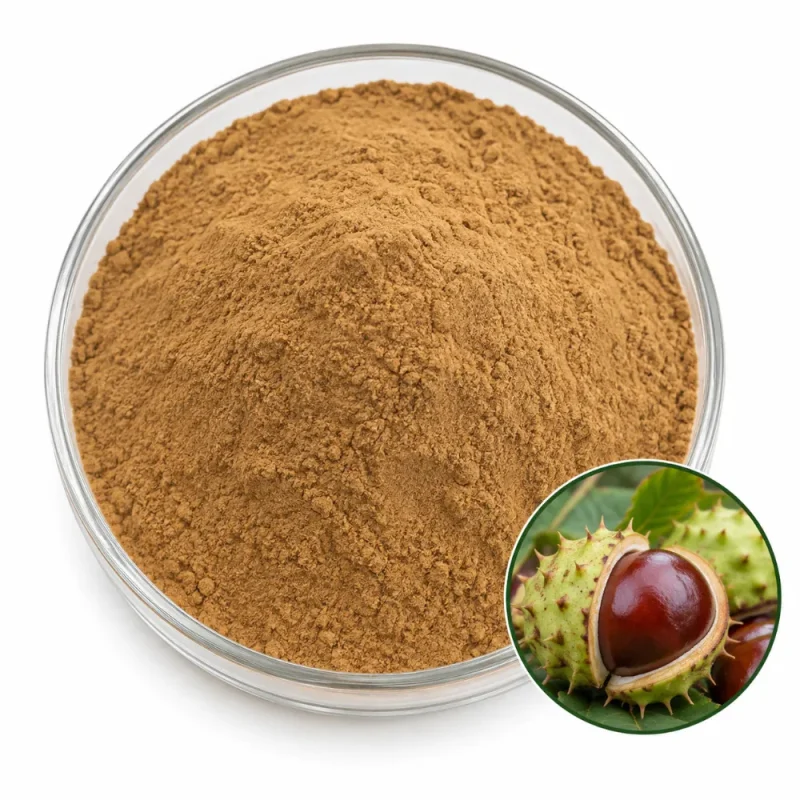
Horse Chestnut Extract 10–20% Aescin

The seed of Aesculus hippocastanum, the horse chestnut tree of southeastern Europe and a common street tree elsewhere, is extracted with ethanol to give this horse chestnut extract, which is standardized for its saponin mixture. After concentration the extract is dried to a light brown, 80 mesh powder that dissolves in water and foams on stirring.

Aescin is measured by HPLC and offered as a 10–20% range, with 20% as the primary grade and 10% as the lower grade. The higher grade fits small-fill capsules and tablets, and the lower grade fits blends that can carry more of the seed matrix.

Aescin Standardization & Grades

Aescin, also written escin, is not a single molecule. It is a mixture of triterpenoid saponins built on the aglycones protoaescigenin and barringtogenol C, esterified with small organic acids and carrying a glucuronic acid-based sugar chain. These saponins are the characteristic constituents of the seed of Aesculus hippocastanum L., and standardizing to aescin gives buyers a figure for the whole saponin family instead of one component.

GradeAssay & MethodWhere It Fits
10% AescinHPLCBlends, higher-inclusion powders
20% AescinHPLCCapsules and tablets, small fill weight

Grade choice follows dose and fill weight. The 20% grade carries twice the aescin of the 10% grade per gram, so a capsule reaches its target with half the powder, while the 10% grade is bulkier and blends easily at gram-level inclusion. Horse chestnut is also supplied as a 10:1 ratio extract without a marker figure, the Horse Chestnut Extract Powder, and as a purified saponin, Beta-Aescin 98%. The standardized extract is the row to use when an aescin figure has to appear on the specification.

Aescin Analysis & Purity Risks

HPLC separates the main aescin saponins on a reversed-phase column and detects them at a low UV wavelength, where the ester groups absorb weakly. The aescin figure is the sum of the identified saponin peaks quantified against an aescin reference standard, and it reflects the group, not a single component. A gravimetric saponin total or a colorimetric assay would count other triterpenoid material and gives a different number that cannot be converted into the HPLC result.

For identity, the fingerprint shows the beta-aescin and alpha-aescin families as a recognizable cluster. The beta forms dominate in normal seed, and their proportion against the alpha forms is part of the profile. The fingerprint also separates a horse chestnut seed extract from extracts of other Aesculus species.

Purity risks come from the botanical and from the seed chemistry. The Chinese buckeye (Aesculus chinensis) and other buckeyes are different species with different saponin patterns, and the sweet chestnut (Castanea sativa) is a different genus entirely, so the species and the seed part are stated as the identity. The seed also contains esculin, a coumarin glycoside, and tannins, which are removed or reduced by the extraction and purification steps and are handled as separate impurity classes.

Raw-material handling matters because the seeds are rich in starch and oil-poor, and they spoil quickly when stored damp. Seed that has molded or sprouted gives lower and more irregular saponin yields. Leaf, bark and flower of the tree belong to other drug definitions and are not part of this identity.

Sample preparation needs care because aescin is a surface-active mixture. The extract is dissolved in aqueous alcohol, and the solution is filtered through a membrane that does not bind saponins, since some filters adsorb them and lower the result. Foam in the autosampler vial can also cause dosing errors, so the sample is allowed to settle before injection.

Typical Specifications

Specification ItemProduct Information
Latin NameAesculus hippocastanum
Plant PartSeed & Grain
ProcessingEthanol Extraction
Compound ClassSaponins
Common NameHorse Chestnut, Aesculus
Ingredient TypeStandardized Extract
Marker Compound(s)Aescin (Escin)
Primary Grade20% Aescin (HPLC)
Available Grades10% · 20% Aescin (HPLC)
AppearanceLight Brown powder
Solubility / DispersibilityWater Soluble
Quality Parameters
Moisture (LOD)≤5.0%
Total Ash≤5.0%
Particle Size80 mesh
Heavy MetalsLead ≤2 ppm · Arsenic ≤1 ppm · Cadmium ≤1 ppm · Mercury ≤0.1 ppm
MicrobiologyTPC ≤1,000 cfu/g · Yeast & Mold ≤100 cfu/g · E. coli Negative · Salmonella Negative/25 g
Shelf Life24 months in unopened original packaging, cool and dry storage

Applications by Grade

20% Grade in Foaming Capsule Fills

The 20% grade of horse chestnut extract delivers an aescin target in a small fill, which suits two-piece capsules. Saponins make the powder hygroscopic and dusty, so a dry filling room and local extraction at the filler keep capsule weights steady and the area clean.

20% Grade in Coated Tablets

Tablets of the 20% horse chestnut grade need a dry binder and a film coat, because the saponin-rich powder softens in humid air. Direct compression works at low inclusion, while higher loads usually call for granulation, and a hardness check after a month shows moisture pickup.

10% Grade in Sachet Premixes

In sachets, the 10% grade is diluted with a bulking carrier so that the filler can meter an accurate dose. Aescin foams on stirring, so label directions should allow for a short rest before drinking, and a defoaming agent helps in pre-mixed drink formats.

10% Grade in Acid-Sensitive Drink Bases

The 10% grade suits neutral drink bases, where the saponins stay dissolved. Their solubility falls in strongly acidic bases, so check the pH of the drink and the clarity after a week of storage before settling on the fruit acid level.

20% Grade in Seed-Powder Blends

Blends that combine the 20% grade with ground seed or fiber ingredients use the saponin extract as a defined-marker component. The extract is much finer than the seed powder, so premix it with part of the carrier first to avoid layering in the drum.

Technical & Quality Considerations

Horse chestnut extract is a light brown powder with a faintly bitter, earthy character. It dissolves in water to a clear to hazy brown solution, and the dissolved saponins are strong surfactants, so agitation produces a persistent foam. This foaming is the most visible physical trait of the extract and shapes how mixers, filling lines and packaging headspace are specified.

Aescin solubility depends on pH. The saponins stay in solution in neutral and mildly acidic bases but tend to precipitate in strongly acidic conditions, which clouds a clear beverage. The ester groups on the aglycone can also hydrolyze under alkaline conditions and heat, changing the saponin profile, so mild pH and short heat treatment keep the profile intact.

The dry powder takes up moisture readily, which leads to caking and a darker shade. A desiccant sachet inside a sealed liner stops the powder from setting into lumps. Fine dust from a saponin powder irritates the nose and eyes, so closed charging and local extraction are advised.

In production, sieve the powder and meter it under low humidity. Compatibility trials are worthwhile with mineral premixes and acidic components, because divalent salts and low pH both reduce clarity over several days. An accelerated stability run with the intended pack shows early whether flow, color and clarity are stable in the finished product.

Particle size and flow deserve a check at receipt. The fine, light brown powder of horse chestnut extract, like most saponin powders, tends to form bridges in narrow hoppers, and a lot that has taken up moisture arrives in hard lumps. Screening the lot through a coarse sieve before use removes lumps and avoids dosing variation at the filler.

Packaging & Commercial Supply

Essencefield supports product evaluation, formulation trials, commercial orders, and ongoing ingredient supply. Packaging, storage, and shipping arrangements are determined by product characteristics, order quantity, stability requirements, and destination-market needs.

Supply ItemGeneral Information
SampleAvailable upon request for formulation, testing, and supplier evaluation
Order Quantities100 g · 1 kg · 5 kg · 25 kg · 100 kg · 500 kg · Bulk
Sample Lead TimeTypically 5–7 days after sample confirmation
Production Lead TimeTypically 15–30 days after order and specification confirmation
PackagingSuitable protective inner packaging with bags, cartons, drums, or other appropriate outer packaging
StorageStore in tightly sealed, suitable protective packaging in a cool, dry environment. Protect from moisture, heat, and direct sunlight. Specific storage conditions follow the approved product specification.
DocumentationCOA · Product Specification · TDS · SDS · Applicable declarations (as applicable)

Final order quantities, lead times, packaging, documentation, and shipping arrangements are confirmed according to the selected product and commercial requirements.

Request Ingredient Specifications & Quote

Share your target specification, application, quantity, and documentation needs. We’ll help confirm suitable options, samples, and commercial supply details.