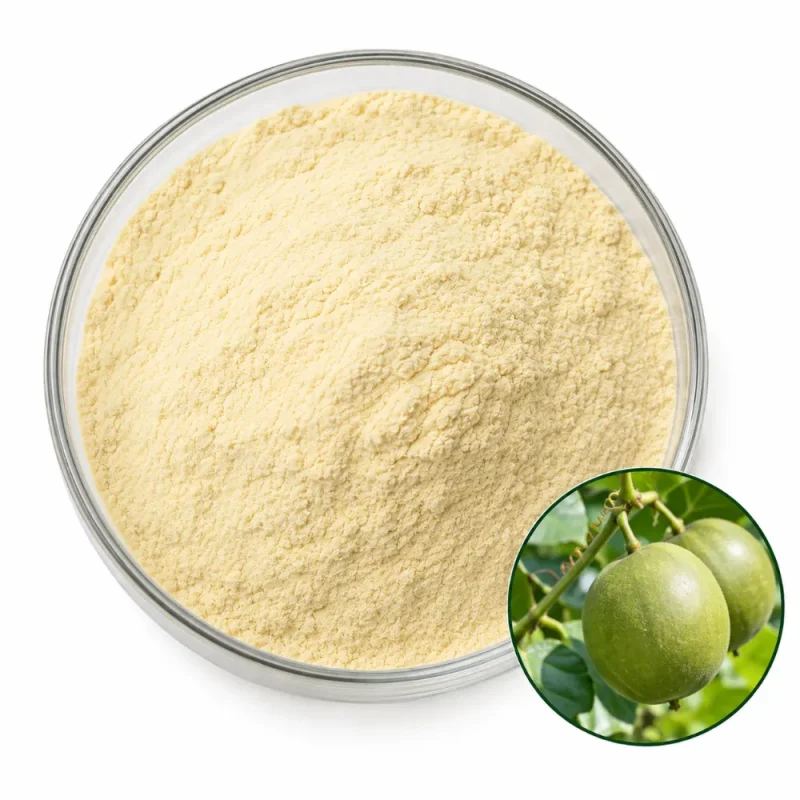
Monk Fruit Extract 30% Mogroside V

The fruit of Siraitia grosvenorii, the gourd-family vine known in southern China as luo han guo, is extracted to give this monk fruit extract, which is standardized for its principal sweet glycoside. The extract is dried and milled to a light brown, 80 mesh powder that dissolves readily in water and carries an intense sweetness.

Mogroside V is measured by HPLC at a single 30% grade. The extract is a sweetener-type ingredient for powder blends, beverage mixes and tabletop formats where a plant-derived intense sweetener is wanted, and the identity statement fixes the species and the fruit as the material.

Mogroside Standardization & Grades

Mogrosides are cucurbitane-type triterpene glycosides in which a tetracyclic aglycone, mogrol, carries several glucose units, and mogroside V is the principal one in the fruit of Siraitia grosvenorii (Swingle) C.Jeffrey ex A.M.Lu & Zhi Y.Zhang. It is the compound that gives the extract its intense sweetness. Standardizing to mogroside V gives buyers one measurable figure for the sweet fraction, while the rest of the extract carries other mogrosides, flavonoids and fruit-derived material.

The grade is a single 30% level, so each lot is measured against the same target and the same method. A 30% figure leaves a substantial share of the powder as other mogrosides, which contribute their own sweetness and sometimes a bitter or lingering note, and as carbohydrates and color from the fruit. The same fruit is also supplied as a 10:1 ratio extract without a marker figure, the Monk Fruit Extract Powder, and as a whole fruit powder, Monk Fruit Powder. Where a mogroside V figure is needed on the specification, this standardized extract is the one to use.

Higher-purity monk fruit sweeteners are a different product class, with different taste profiles and handling. The 30% grade here retains more of the fruit matrix.

The fruit is the only part used. Monk fruit is harvested green, cured for several days and dried, after which the shell and pulp are crushed and extracted, and the seeds are removed. Leaf extracts of the same vine are a different material with their own sweet glycosides and are not part of this identity. Monk fruit extract is therefore defined by the fruit and by a mogroside V figure.

Mogroside Analysis & Purity Risks

HPLC separates mogroside V from the other mogrosides, mogroside IV, siamenoside I and 11-oxomogroside V among them, on a reversed-phase column. The cucurbitane skeleton absorbs only weakly in the UV, so detection is at a low wavelength or with a detector that does not rely on a chromophore, and the peak is quantified against a mogroside V reference standard. The result is mogroside V itself and not a total of all mogrosides.

The profile of the other mogrosides is part of quality. They differ in sweetness quality and intensity, and their share depends on the ripeness of the fruit and the extraction conditions. A lot with the correct mogroside V figure but an unusual share of 11-oxo or of lower glycosides tastes different, so the fingerprint is read together with the assay.

The botanical risk is one of adulteration with other sweeteners. Intense sweeteners such as steviol glycosides can be added to a low-grade extract to give a sweet taste without raising mogroside V, and the HPLC profile shows foreign peaks if this has occurred. Fruit of other Siraitia or related gourd-family species is a further risk, and the stated species and fruit part are part of the identity.

Raw fruit is harvested green and ripened for a period, then dried, because curing changes the sugar and mogroside content of the pulp. Fruit that is dried too fast or at high temperature gives a dark, roasted extract with a caramel note, while fruit stored damp develops mold.

Sample preparation uses water or aqueous alcohol, and the extract dissolves readily. The sample is filtered before injection, because fine fruit particles block columns.

Taste panels give a complement to the assay. Two lots with the same mogroside V figure can taste different if the share of other mogrosides differs, since 11-oxomogroside V and siamenoside I do not taste exactly like mogroside V. Sensory comparison against a retained sample is a quick control for repeat orders.

Typical Specifications

Specification ItemProduct Information
Latin NameSiraitia grosvenorii
Plant PartFruit & Berry
ProcessingEthanol Extraction
Compound ClassTriterpenoids, Terpenoids
Common NameMonk Fruit, Luo Han Guo
Ingredient TypeStandardized Extract
Marker Compound(s)Mogroside V
Primary Grade30% Mogroside V (HPLC)
AppearanceLight Brown powder
Solubility / DispersibilityWater Soluble
Quality Parameters
Moisture (LOD)≤5.0%
Total Ash≤5.0%
Particle Size80 mesh
Heavy MetalsLead ≤2 ppm · Arsenic ≤1 ppm · Cadmium ≤1 ppm · Mercury ≤0.1 ppm
MicrobiologyTPC ≤1,000 cfu/g · Yeast & Mold ≤100 cfu/g · E. coli Negative · Salmonella Negative/25 g
Shelf Life24 months in unopened original packaging, cool and dry storage

Applications by Grade

30% Grade in Powdered Drink Mixes

The 30% grade of monk fruit extract dissolves readily in cold and hot water, which suits powdered drink mixes and stick packs. It is dosed at a small fraction of a gram per serving and blended with bulking agents so that the filler can meter an accurate dose.

30% Grade in Table-Top Blends

Table-top sweetener blends combine the 30% grade with erythritol or other bulking carriers to give a spoonable product. The extract is much finer than the bulking carrier, so premix in stages and sample from several depths to avoid hot spots of sweetness.

30% Grade in Chewable Tablets

Chewable and lozenge-style tablets use the 30% grade as the intense sweetener in a sugar-free base. The extract’s light brown color tints white tablets slightly, and a lingering note appears at higher use levels, which is balanced with flavor.

30% Grade in Protein Powder Blends

Protein and nutrition powders carry the 30% grade to sweeten without adding sugar. The extract is hygroscopic and can cake in a dry blend, so a flow agent and moisture-barrier packaging keep the powder loose over the shelf life.

30% Grade in Syrup and Concentrate Bases

Syrups and drink concentrates dissolve the 30% grade into the aqueous phase. The extract is stable across a wide pH range and tolerates pasteurization, and a check of clarity after a week at the intended storage temperature confirms that no haze develops from the fruit matrix.

Technical & Quality Considerations

Monk fruit extract is a light brown powder with an intense sweetness and a fruity, slightly licorice-like background. It dissolves readily in water to a clear amber solution, and it is soluble in aqueous alcohol, so both aqueous and hydroalcoholic liquid formats are workable.

Mogrosides are heat-stable and stable over a broad pH range, and they do not caramelize or take part in Maillard browning, which makes the extract robust in baked, pasteurized and acidic products. The fruit-derived color and flavor background may change with strong heat or very low pH over long storage, so a short stability run is advised for each application.

The dry powder is hygroscopic and cakes when damp. Reclosing the liner after each charge and keeping a desiccant sachet inside prevents lumps. Fine, sweet dust is nuisance dust, so closed charging and local extraction are advised.

On the line, sieve the powder, premix it with part of the carrier and weigh the first units. Because the dose is small and the sweetness is intense, an error in weighing is easy to taste, so scale calibration and blend uniformity are the main process controls. An accelerated stability run in the intended pack shows early whether color, flow and taste remain stable.

A quick check at receipt is useful. A light brown, fine powder with an intensely sweet taste and a faint fruity note is expected for monk fruit extract, while a very dark shade or a burnt smell points to heat damage during drying. Both are visible before any assay result arrives.

Packaging & Commercial Supply

Essencefield supports product evaluation, formulation trials, commercial orders, and ongoing ingredient supply. Packaging, storage, and shipping arrangements are determined by product characteristics, order quantity, stability requirements, and destination-market needs.

Supply ItemGeneral Information
SampleAvailable upon request for formulation, testing, and supplier evaluation
Order Quantities100 g · 1 kg · 5 kg · 25 kg · 100 kg · 500 kg · Bulk
Sample Lead TimeTypically 5–7 days after sample confirmation
Production Lead TimeTypically 15–30 days after order and specification confirmation
PackagingSuitable protective inner packaging with bags, cartons, drums, or other appropriate outer packaging
StorageStore in tightly sealed, suitable protective packaging in a cool, dry environment. Protect from moisture, heat, and direct sunlight. Specific storage conditions follow the approved product specification.
DocumentationCOA · Product Specification · TDS · SDS · Applicable declarations (as applicable)

Final order quantities, lead times, packaging, documentation, and shipping arrangements are confirmed according to the selected product and commercial requirements.

Request Ingredient Specifications & Quote

Share your target specification, application, quantity, and documentation needs. We’ll help confirm suitable options, samples, and commercial supply details.