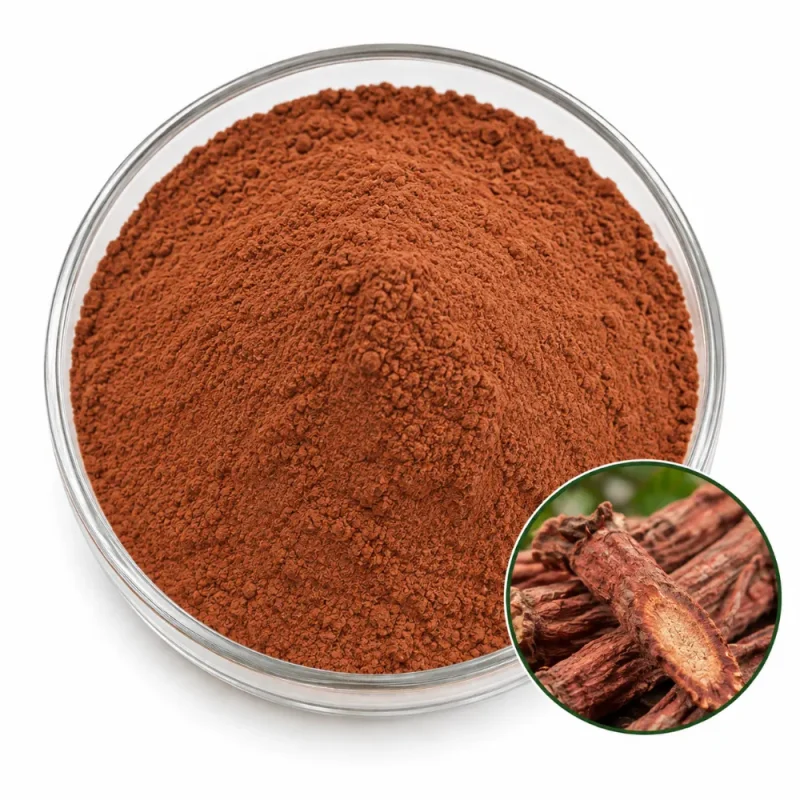
Salvia miltiorrhiza Extract 5–20% Tanshinone IIA

Salvia miltiorrhiza extract is prepared from the dried root and rhizome of danshen, Salvia miltiorrhiza Bunge, a perennial of the family Lamiaceae. Ethanol extraction takes up the lipophilic red tanshinones of the root, and the concentrate is dried to a red-brown powder.

Tanshinone IIA is measured by HPLC, with a primary grade of 20% and a lower grade of 5%. The powder is 80 mesh and insoluble in water. The 20% grade suits capsules and softgel suspensions, while the 5% grade suits larger-inclusion blends.

Tanshinone IIA Standardization & Grades

Tanshinone IIA is an abietane diterpenoid with an ortho-quinone ring system, and it is the compound that gives danshen root its red color. It belongs to the lipophilic fraction of the root, which also holds cryptotanshinone, tanshinone I and dihydrotanshinone. The root has a second, water-soluble family of phenolic acids, among them salvianolic acid B, rosmarinic acid and danshensu. Salvia miltiorrhiza extract is standardized here to the lipophilic marker, which is why ethanol, not water, is the extraction solvent.

The botanical entity is Salvia miltiorrhiza Bunge, and the part is the root and rhizome. Other sage species, including the garden sage, are different plants. The same root is supplied as a 10:1 ratio extract with no marker figure, Salvia miltiorrhiza Extract Powder, as milled root, Salvia Miltiorrhiza Root Powder, and as a single compound, Tanshinone IIA 98%.

GradeAssay & MethodWhere It Fits
5% Tanshinone IIAHPLCBlends, larger inclusion
20% Tanshinone IIAHPLCCapsules and softgel suspensions

The 20% grade carries four times the tanshinone IIA per gram, so a capsule reaches its target with a small fill. A Salvia miltiorrhiza extract at this strength is darker and more intensely colored than the 5% grade. The 5% grade is bulkier and gives a more diluted red tone, which suits blends where the root’s color is an advantage and not a problem.

Tanshinone IIA Analysis & Purity Risks

An HPLC assay separates tanshinone IIA from cryptotanshinone, tanshinone I and the remaining lipophilic constituents and reads each peak against a reference standard. The result is a single compound, not a class equivalent. The basis is the dry powder, and a figure cannot be compared with a salvianolic acid or total phenolic result, since those measure a different, water-soluble family.

Because the root holds two chemically distinct families, the second is followed alongside. The data record for this product names salvianolic acid B as a secondary marker, and in an ethanol extract its level depends on the proportion of water in the solvent. It is described here without a number, and a single total cannot represent both fractions.

For identity, the HPLC fingerprint shows the group of red tanshinones that characterizes the root. Other Salvia species lack this group, and the profile separates danshen from sages grown as culinary herbs.

Purity risks follow from the material class. Several southern Chinese Salvia species are used as regional substitutes for danshen, among them Salvia bowleyana, and their tanshinone content differs. The defined part is the root and rhizome, and aerial parts carry almost no tanshinone. Tanshinones are light and heat sensitive, and a lot that was dried hot or stored in light shows a lower figure than the same root dried gently.

Sample preparation is demanding because tanshinones dissolve poorly. The powder is extracted with an organic solvent under sonication, filtered, and injected, and the extract is protected from light during the run, since tanshinone IIA degrades under bright lab lighting and a slow autosampler queue can lower the reading. Samples are therefore prepared in amber glassware.

Typical Specifications

Specification ItemProduct Information
Latin NameSalvia miltiorrhiza
Plant PartRoot & Rhizome
ProcessingEthanol Extraction
Compound ClassQuinones, Polyphenols
Common NameDanshen, Red Sage Root
Ingredient TypeStandardized Extract
Marker Compound(s)Tanshinone IIA
Primary Grade20% Tanshinone IIA (HPLC)
Available Grades5% · 20% Tanshinone IIA (HPLC)
AppearanceRed-Brown powder
Solubility / DispersibilityInsoluble in Water
Quality Parameters
Moisture (LOD)≤5.0%
Total Ash≤5.0%
Particle Size80 mesh
Heavy MetalsLead ≤2 ppm · Arsenic ≤1 ppm · Cadmium ≤1 ppm · Mercury ≤0.1 ppm
MicrobiologyTPC ≤1,000 cfu/g · Yeast & Mold ≤100 cfu/g · E. coli Negative · Salmonella Negative/25 g
Shelf Life24 months in unopened original packaging, cool and dry storage

Applications by Grade

20% Grade in Capsule Fills

The 20% grade of Salvia miltiorrhiza extract reaches its tanshinone target in a small fill. The red-brown powder is dusty and stains hands and equipment, so a closed filling line, dust extraction and a flow agent keep the room clean and the fill weight accurate.

5% Grade in Dry Blends

The 5% grade is blended into dry powders with other root extracts. It colors the whole blend red-brown at modest inclusion, so a trial blend is checked by eye, and it is sieved with the carrier first so that the pigment does not streak.

20% Grade for Softgel Suspensions

The insoluble 20% grade is milled into an oil phase for softgel fills. Tanshinones dissolve slightly in oil and in the presence of lecithin, and the suspension is checked for settling and viscosity before encapsulation.

5% Grade in Tablet Blends

Tablets of the 5% grade need a dry binder and a lubricant. The red pigment can mottle a light tablet, so a pigmented film coat or a darker excipient base gives a uniform look, and disintegration is checked after storage.

20% Grade for Powder Premixes

Premixes carry the 20% grade of Salvia miltiorrhiza extract in a larger dry blend. The extract is not water soluble, so it is sold as a suspended mix to be stirred, and it is not used in clear drinks, where it would settle and stain the glass.

5% Grade in Soft-Chew Bases

Soft chews take the 5% grade as a color- and flavor-contributing ingredient in a large base. Add it after the main cook, because long heating dulls the red, and disperse it in part of the syrup first so that the insoluble particles do not appear as dark specks.

Technical & Quality Considerations

Salvia miltiorrhiza extract is a red-brown powder with a faint herbal, slightly resinous scent. Tanshinone IIA is insoluble in water and only slightly soluble in oil, so aqueous drinks show a fine red suspension that settles on standing. Wetting agents, milling and a viscous carrier improve dispersion. The quinone ring is sensitive to light and to strong reducing or oxidizing conditions, and the red color fades with sunlight, so the powder is packed in opaque liners and kept dark.

Heat has a gradual effect. Prolonged hot-holding of a wet blend degrades tanshinones, and the extract is added late in a thermal process where possible. The phenolic acids that accompany the tanshinones bind iron, which darkens the powder on contact with carbon steel, so stainless surfaces are preferred.

The powder takes up moisture slowly and cakes in humid storage. Compare each lot with a retained sample for color, since the tone moves between orange-red and brown with the drying conditions of the root, and verify fill weight when switching between the two grades.

The red pigment can migrate. Tanshinones are lipophilic and can transfer into plastics, coatings and printed film, so a pack trial with the intended liner is run before launch. Salvia miltiorrhiza extract in a clear bottle or blister also fades faster than in an opaque pack, which is why the finished-product container is chosen with the color in mind.

Packaging & Commercial Supply

Essencefield supports product evaluation, formulation trials, commercial orders, and ongoing ingredient supply. Packaging, storage, and shipping arrangements are determined by product characteristics, order quantity, stability requirements, and destination-market needs.

Supply ItemGeneral Information
SampleAvailable upon request for formulation, testing, and supplier evaluation
Order Quantities100 g · 1 kg · 5 kg · 25 kg · 100 kg · 500 kg · Bulk
Sample Lead TimeTypically 5–7 days after sample confirmation
Production Lead TimeTypically 15–30 days after order and specification confirmation
PackagingSuitable protective inner packaging with bags, cartons, drums, or other appropriate outer packaging
StorageStore in tightly sealed, suitable protective packaging in a cool, dry environment. Protect from moisture, heat, and direct sunlight. Specific storage conditions follow the approved product specification.
DocumentationCOA · Product Specification · TDS · SDS · Applicable declarations (as applicable)

Final order quantities, lead times, packaging, documentation, and shipping arrangements are confirmed according to the selected product and commercial requirements.

Request Ingredient Specifications & Quote

Share your target specification, application, quantity, and documentation needs. We’ll help confirm suitable options, samples, and commercial supply details.