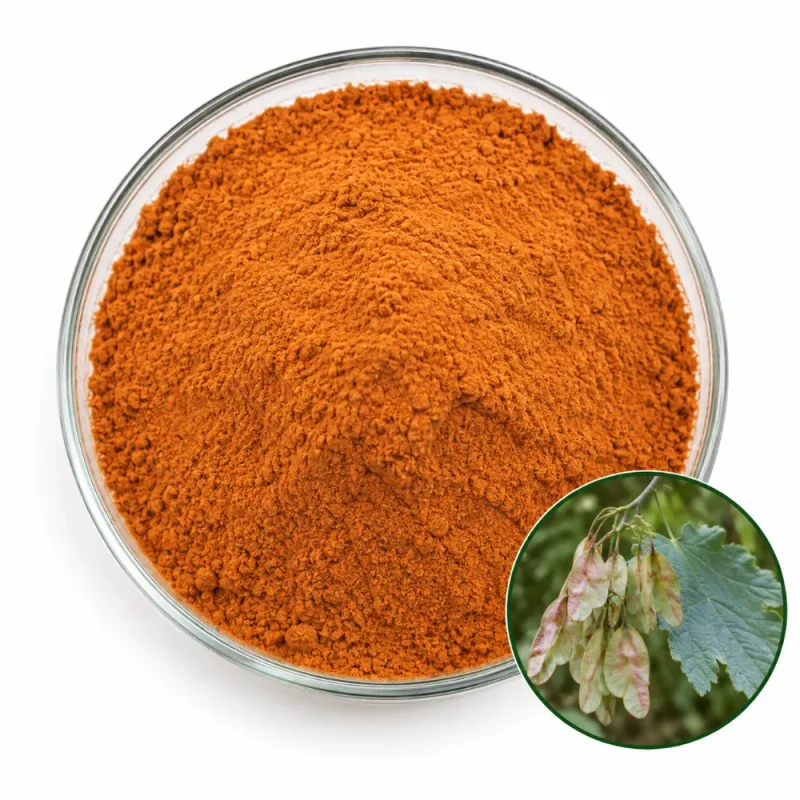
Macleaya Cordata Extract 40–60% Sanguinarine

Macleaya cordata extract is prepared from the whole plant of Macleaya cordata (Willd.) R.Br., the plume poppy of the family Papaveraceae, a tall perennial native to East Asia. Ethanol extraction concentrates the benzophenanthridine alkaloids of the plant, and the concentrate is dried to a light brown powder.

Sanguinarine is measured by HPLC, with a primary grade of 60% and a lower grade of 40%. The powder is 80 mesh and slightly soluble in water. Both grades are high-strength alkaloid extracts for controlled blending and technical formulation work.

Sanguinarine Standardization & Grades

Sanguinarine is a quaternary benzophenanthridine alkaloid, a flat, four-ring cation with a methylenedioxy group at each end. It is the principal alkaloid of the plume poppy, and it accompanies chelerythrine, which is its close analog, together with protopine and allocryptopine. In acidic solution sanguinarine is an orange-red iminium cation, and in neutral to alkaline solution it adds hydroxide to form a colorless pseudo-base. Macleaya cordata extract is standardized to sanguinarine because the compound is the dominant and characteristic alkaloid of the plant.

The botanical entity is Macleaya cordata (Willd.) R.Br., and the part is the whole plant, including the latex-bearing aerial portions and the root. The sap of the plume poppy is orange, and it is the source of the alkaloid color. The milled plant is supplied as Macleaya Powder, a different material that carries the alkaloids at a far lower level. The related species Macleaya microcarpa is a separate plant with a different alkaloid ratio.

GradeAssay & MethodWhere It Fits
40% SanguinarineHPLCPremixes, controlled blending
60% SanguinarineHPLCHigh-strength premix, small charge

The 60% grade of Macleaya cordata extract carries half as much again as the 40% grade per gram. Both are high-strength alkaloid extracts, so the handling is controlled, the weighing is done in a contained area, and the inclusion rate is set from the stated sanguinarine content of the lot. Neither is meant for use as a bulk ingredient.

The extract is made from dried, milled plant that is extracted under acidic conditions, because the alkaloid is a salt in acid and dissolves well. The concentrate is purified by partition and precipitation, which removes the fiber and sugars of the plant and leaves a powder rich in alkaloid salts.

Sanguinarine Analysis & Purity Risks

An HPLC assay separates sanguinarine from chelerythrine, protopine and allocryptopine and reads it as a distinct peak against a reference standard. The assay quantifies one named alkaloid and not a class, and the basis is dry weight. Because sanguinarine is cationic and sticks to column silanols, the mobile phase is acidic and carries an ion-pairing or buffering agent, and the peak shape is part of the system check.

The form of the alkaloid affects the figure. The iminium cation and the pseudo-base have different retention and absorbance, and in neutral solution they equilibrate. The sample is prepared in an acidic solvent so that the whole alkaloid is read in one form. A figure obtained at neutral pH can read lower for that reason. A sanguinarine figure cannot be added to chelerythrine, and it cannot be converted into a total alkaloid value.

For identity, the fingerprint shows the typical pair of orange-red alkaloids and the protopine group, which separate the plume poppy from other poppies and from bloodroot, Sanguinaria canadensis, whose rhizome also contains sanguinarine but is a different plant.

Purity risks follow from the material class. Sanguinarine is a biologically potent and toxic compound, and its handling, labeling and permitted use differ by country. This is a technical specification and not a statement of suitability for any market. The whole plant is the defined part, and lots made from other poppies are not accepted. Residual solvent and heavy-metal control matter for a concentrated alkaloid extract of a plant that grows in disturbed soil.

Root and aerial parts differ in their alkaloid balance. The latex of the stem and the root hold the highest levels, while the leaf holds less. The whole plant is therefore processed together after drying and milling. The ratio of sanguinarine to chelerythrine in Macleaya cordata extract is read from the chromatogram, which confirms that the lot matches the retained reference.

Typical Specifications

Specification ItemProduct Information
Latin NameMacleaya cordata
Plant PartWhole Plant
ProcessingEthanol Extraction
Compound ClassAlkaloids
Common NamePlume Poppy, Macleaya
Ingredient TypeStandardized Extract
Marker Compound(s)Sanguinarine
Primary Grade60% Sanguinarine (HPLC)
Available Grades40% · 60% Sanguinarine (HPLC)
AppearanceLight Brown powder
Solubility / DispersibilitySlightly Soluble in Water
Quality Parameters
Moisture (LOD)≤5.0%
Total Ash≤5.0%
Particle Size80 mesh
Heavy MetalsLead ≤2 ppm · Arsenic ≤1 ppm · Cadmium ≤1 ppm · Mercury ≤0.1 ppm
MicrobiologyTPC ≤1,000 cfu/g · Yeast & Mold ≤100 cfu/g · E. coli Negative · Salmonella Negative/25 g
Shelf Life24 months in unopened original packaging, cool and dry storage

Applications by Grade

60% Grade for Contained Premixes

The 60% grade is blended into a premix with a bulking carrier in a contained area. The dust is irritating and the powder is potent, so the weighing station has extraction, operators wear protection, and the premix is made in at least two dilution steps.

40% Grade in Controlled Dry Blends

The 40% grade is diluted into dry blends with a bulking carrier. Because the working quantity is small, the blend is made in a closed mixer, and the homogeneity of the finished premix is checked by sampling at several points.

60% Grade for Technical Formulation Trials

Formulation trials use the 60% grade of Macleaya cordata extract to study stability and compatibility. The orange-red alkaloid changes color with pH, so trials record the pH, the light exposure and the vessel material, and the HPLC pattern is compared before and after each condition.

40% Grade for Granulated Carriers

Granulated carriers take the 40% grade of Macleaya cordata extract by dry mixing and light granulation. Compaction is gentle, and the granule is packed in opaque, moisture-barrier liners, because the alkaloid is light sensitive and the granule surface takes up humidity.

Technical & Quality Considerations

Macleaya cordata extract is a light brown powder with a faint, bitter, acrid character. Water solubility is limited and changes with pH. In acidic solution the alkaloid is present as a salt and dissolves to an orange solution, while toward neutral and alkaline pH the colorless pseudo-base forms and the solution turns hazy as the base separates. Dissolution is therefore carried out under controlled pH.

Sanguinarine is sensitive to light and to reducing agents. The orange form is reduced to a colorless dihydro derivative by reducing agents such as ascorbic acid and sulfite, and the color of a formula changes. Opaque, sealed liners protect the powder, and contact with strong reducing agents is avoided. The alkaloid also binds some plastics and glass surfaces, so low-binding vessels are used in dilute solutions.

The powder takes up moisture and can clump in humid storage. Keep it in tightly closed, opaque liners with desiccant, away from heat. Compare each lot with a retained sample for color and solution behavior, and take a new check weight whenever the line is restarted with a different grade, since the two powders differ in bulk.

Because the powder is potent and colored, cleaning validation is part of the use of the extract. Residual orange alkaloid on stainless steel is visible and measurable, and the rinse and swab limits are set on the basis of the HPLC peak, so that a following product is not contaminated by carry-over.

Packaging & Commercial Supply

Essencefield supports product evaluation, formulation trials, commercial orders, and ongoing ingredient supply. Packaging, storage, and shipping arrangements are determined by product characteristics, order quantity, stability requirements, and destination-market needs.

Supply ItemGeneral Information
SampleAvailable upon request for formulation, testing, and supplier evaluation
Order Quantities100 g · 1 kg · 5 kg · 25 kg · 100 kg · 500 kg · Bulk
Sample Lead TimeTypically 5–7 days after sample confirmation
Production Lead TimeTypically 15–30 days after order and specification confirmation
PackagingSuitable protective inner packaging with bags, cartons, drums, or other appropriate outer packaging
StorageStore in tightly sealed, suitable protective packaging in a cool, dry environment. Protect from moisture, heat, and direct sunlight. Specific storage conditions follow the approved product specification.
DocumentationCOA · Product Specification · TDS · SDS · Applicable declarations (as applicable)

Final order quantities, lead times, packaging, documentation, and shipping arrangements are confirmed according to the selected product and commercial requirements.

Request Ingredient Specifications & Quote

Share your target specification, application, quantity, and documentation needs. We’ll help confirm suitable options, samples, and commercial supply details.