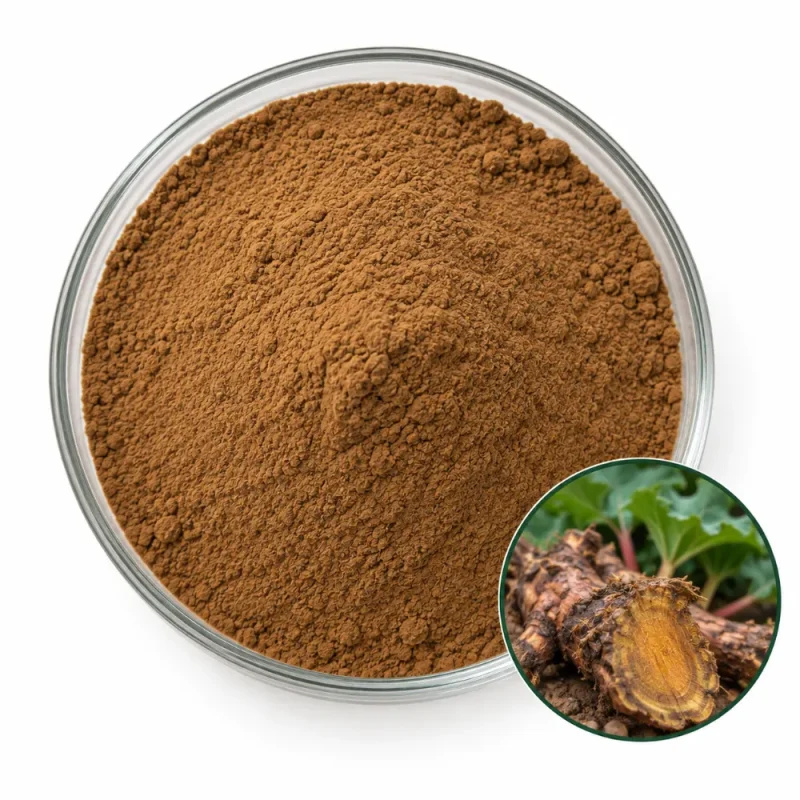
Rhubarb Extract ≥5% Total Anthraquinones

Rhubarb extract is prepared from the root and rhizome of Rheum palmatum, the Chinese medicinal rhubarb, and not from the red leaf stalks of the garden rhubarb used in cooking. Ethanol extraction takes up the anthraquinones of the root, and the liquor is dried to a yellow-brown powder.

The grade is a minimum of 5% total anthraquinones by UV, a colorimetric total. The powder is 80 mesh and insoluble in water. A single grade is supplied, which suits capsules, tablets and dry botanical blends that need a defined anthraquinone fraction in a strongly colored powder.

Anthraquinone Standardization & Grades

Anthraquinones are three-ring aromatic quinones that give rhubarb root its yellow-orange color. The main members are rhein, emodin, aloe-emodin, chrysophanol and physcion, and they occur both as free aglycones and as glycosides. The root also holds tannins and the dianthrone glycosides called sennosides. The grade reports total anthraquinones and not one compound. The botanical entity is Rheum palmatum L., a plant of the Polygonaceae, and the part used is the dried root and rhizome of the medicinal rhubarb.

The grade is a minimum, so lots reach or exceed the figure. The choice is between rhubarb materials, not between tiers. The root is also supplied as a 10:1 ratio extract, the Rhubarb Root Extract Powder, which carries no marker figure, and the purified anthraquinones are listed as Chrysophanol 98% and Physcion 98%. Danthron is a different compound of the same family that is mostly synthetic and is not a main constituent of the root. Culinary rhubarb, grown for its stalks, is a separate crop and not a source of this extract. Rhubarb extract at a minimum of 5% is a defined fraction of a root that holds many other constituents, and rhubarb extract of this kind is dosed by its anthraquinone figure, not by root weight. The name rhubarb alone does not tell which plant or which part was used.

Anthraquinone Analysis & Purity Risks

The total is measured by UV. This is a colorimetric method: free and combined anthraquinones are brought into a common form, usually by hydrolysis and oxidation, and the absorbance of the colored product is read against a reference anthraquinone, often rhein. The result is expressed on that reference. It is not an HPLC result, and it cannot be converted into a figure for emodin, rhein or any other single member.

The procedure decides what is counted. A method that includes the hydrolysis step reports the glycosides together with the free aglycones, while a method without it reports only the free forms, and the two give very different percentages for the same extract. The reference compound also matters, since each anthraquinone has its own absorptivity. A figure is comparable only with one measured the same way.

HPLC is used beside the UV total to show the pattern. A rhubarb root chromatogram has a recognizable set of rhein, emodin, aloe-emodin, chrysophanol and physcion peaks, and the relative sizes identify the species and the part. Sample preparation is demanding, because the powder must be fully hydrolyzed and the color protected from light.

For rhubarb, purity risks follow from the plant. Medicinal rhubarb is the root of Rheum palmatum, Rheum tanguticum and Rheum officinale, and the culinary stalk rhubarb has far lower anthraquinone content. The first identity checks are a stated species and the root as the plant part. The regulatory status of anthraquinone-containing botanicals differs between markets, which is a planning topic in its own right.

Typical Specifications

Specification ItemProduct Information
Latin NameRheum palmatum
Plant PartRoot & Rhizome
ProcessingEthanol Extraction
Compound ClassQuinones
Common NameRhubarb, Chinese Rhubarb, Da Huang
Ingredient TypeStandardized Extract
Marker Compound(s)Total anthraquinones (rhein, emodin, aloe-emodin, chrysophanol, physcion and their glycosides)
Primary Grade≥5% Total Anthraquinones (UV)
AppearanceYellow-Brown powder
Solubility / DispersibilityInsoluble in Water
Quality Parameters
Moisture (LOD)≤5.0%
Total Ash≤5.0%
Particle Size80 mesh
Heavy MetalsLead ≤2 ppm · Arsenic ≤1 ppm · Cadmium ≤1 ppm · Mercury ≤0.1 ppm
MicrobiologyTPC ≤1,000 cfu/g · Yeast & Mold ≤100 cfu/g · E. coli Negative · Salmonella Negative/25 g
Shelf Life24 months in unopened original packaging, cool and dry storage

Applications by Grade

Single Grade for Compact Capsules

The grade fills capsules and tablets with a defined anthraquinone fraction. The yellow-brown powder is insoluble in water, cohesive and strongly staining, so a glidant helps hopper flow and dedicated tools keep the color off other products.

Root Extract in Tablet Blends

Tablets need an absorbent filler and a dry binder, because the lipophilic quinone fraction softens compacts and sticks to punches. A film coat holds the color in, since the yellow-orange pigment migrates into moist tablet cores.

Root Extract in Dry Botanical Blends

Dry blends combine the powder with other root extracts. Pre-blend it with part of the carrier, and keep the blend away from alkaline ingredients, which shift the yellow-orange pigment to red-violet and leave a visible stain.

Root Extract in Softgel Fills

Softgel fills carry the powder as a milled suspension in oil, where the quinone fraction partly dissolves and tints the oil orange. Particle size and a suspending agent decide whether the fill stays uniform through storage.

Root Extract in Stick Packs

For rhubarb, stick packs carry the powder at a low fill with a flow agent and a fine carrier. The powder is insoluble in water and gives a yellow-brown suspension, so a suspension aid and a note to stir are needed, and the stain on the cup is strong.

Root Extract in Film-Coated Tablets

Film-coated tablets use an opaque coat to isolate the colored core and to protect the quinones from light. Check the coat for pinholes and test the color of the tablet face after a week in a humid room.

Technical & Quality Considerations

The extract is a yellow-brown powder with a faint, earthy odor and a bitter, astringent taste. The anthraquinones are strongly colored pH indicators. They are yellow to orange in neutral and acidic conditions and shift to red and violet in alkaline ones, so alkaline excipients leave visible color changes.

Fold the rhubarb extract into a portion of the carrier before the final mix. The strong color stains plastic and steel, so use dedicated scoops and schedule clean-down time after a rhubarb run.

Anthraquinones are reasonably stable at normal processing temperatures but fade slowly in light, so keep the drum sealed and opaque in a cool, dry store. Compare each lot with a retained sample for color, odor and the anthraquinone pattern in the chromatogram. A test of the powder in the final blend, including any alkaline ingredient, shows whether the color holds through shelf life. A retained sample from each lot, tested again near the end of shelf life, shows whether the packaging holds the anthraquinone reading and the color together, and rhubarb powder that has taken up moisture should be sieved and rechecked before use.

Rhubarb extract is strongly colored, so any pale component in a blend will show yellow-brown streaks if mixing is poor, and a mixing-time study on the real equipment shows how long the blend needs to look uniform.

Packaging & Commercial Supply

Essencefield supports product evaluation, formulation trials, commercial orders, and ongoing ingredient supply. Packaging, storage, and shipping arrangements are determined by product characteristics, order quantity, stability requirements, and destination-market needs.

Supply ItemGeneral Information
SampleAvailable upon request for formulation, testing, and supplier evaluation
Order Quantities100 g · 1 kg · 5 kg · 25 kg · 100 kg · 500 kg · Bulk
Sample Lead TimeTypically 5–7 days after sample confirmation
Production Lead TimeTypically 15–30 days after order and specification confirmation
PackagingSuitable protective inner packaging with bags, cartons, drums, or other appropriate outer packaging
StorageStore in tightly sealed, suitable protective packaging in a cool, dry environment. Protect from moisture, heat, and direct sunlight. Specific storage conditions follow the approved product specification.
DocumentationCOA · Product Specification · TDS · SDS · Applicable declarations (as applicable)

Final order quantities, lead times, packaging, documentation, and shipping arrangements are confirmed according to the selected product and commercial requirements.

Request Ingredient Specifications & Quote

Share your target specification, application, quantity, and documentation needs. We’ll help confirm suitable options, samples, and commercial supply details.