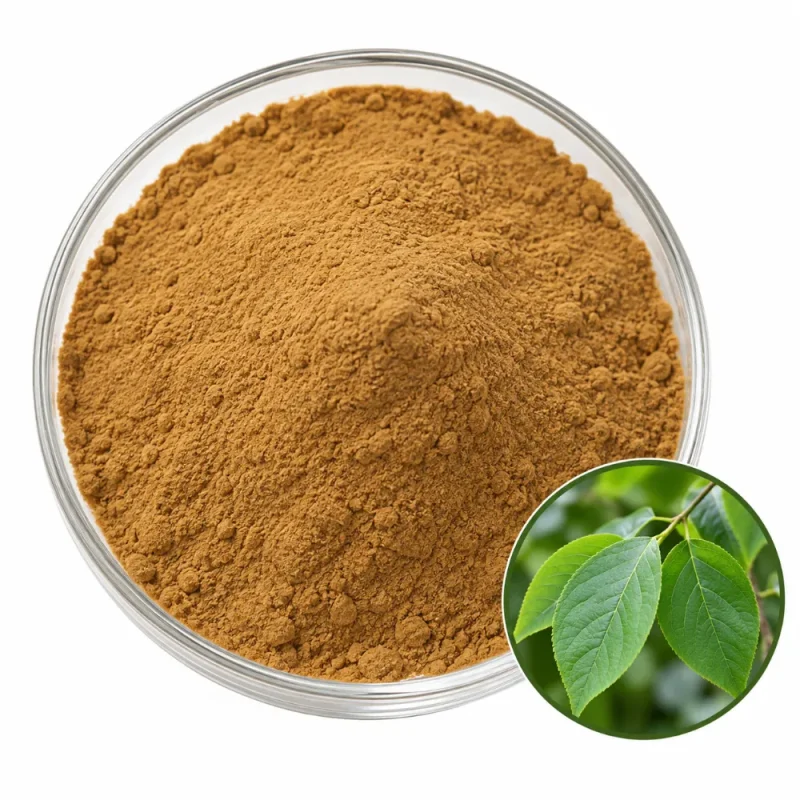
Eucommia Leaf Extract 5–50% Chlorogenic Acid

The leaves of Eucommia ulmoides, the hardy rubber tree, are the only source of this extract, and its bark, a separate traditional drug with a different chemistry, is not used. Ethanol extraction concentrates the caffeoylquinic acids of the leaf, and the liquor is dried to a green, water-soluble powder.

The primary grade is 50% chlorogenic acid by HPLC, with 5% as the lower end of the range. The powder is 80 mesh. The 50% grade serves capsules, tablets and drink sticks that need a compact dose, while the 5% grade suits tea-style blends and beverages in which the leaf character and color should remain visible.

Chlorogenic Acid Standardization & Grades

Chlorogenic acid is an ester of caffeic acid with quinic acid and the leading phenolic acid of eucommia leaf. It is the standardization target because it is abundant in the leaf, dissolves well in water and can be resolved cleanly by HPLC. The botanical entity is Eucommia ulmoides Oliv., and the part used is the leaf. The same leaf also holds the iridoid aucubin, flavonoid glycosides and a small amount of the rubber-like polymer that gives the tree its common name.

GradeAssay & MethodWhere It Fits
5% Chlorogenic AcidHPLCTea-style blends and beverage bases
50% Chlorogenic AcidHPLCCapsules, tablets and drink sticks

Grade choice follows dose, fill weight and how much leaf matrix a formula should carry. The 50% grade holds ten times the chlorogenic acid per gram of the 5% grade, so it reaches a target in a small fill. The 5% grade retains the aucubin, flavonoids and polysaccharides of the leaf and adds body and color to a beverage. The unstandardized sibling is the Eucommia Leaf Extract Powder, and the purified compounds are Chlorogenic Acid 98% and the iridoid Aucubin 98%.

A chlorogenic acid percentage does not say which isomers were counted, and eucommia leaf extract contains related caffeoylquinic acids besides the main 5-O isomer. Buyers who compare quotes should ask whether the figure is the single named peak or a sum of isomers, and which part of the tree was used.

The two grades also behave differently in water. The 50% powder dissolves into a more strongly colored, more astringent solution, so a drink formula usually needs flavor masking, while the 5% grade is closer to a leaf infusion in taste and appearance. Because the leaf matrix carries sugars and polysaccharides at the lower grade, that powder is also more hygroscopic, and its storage and handling need a little more care than the concentrated powder.

Chlorogenic Acid Analysis & Purity Risks

Both grades are measured by HPLC. The column separates chlorogenic acid from its isomers and from caffeic acid, each peak is identified by retention time and UV spectrum, and the named peak is quantified against a reference standard. A UV total phenol reading counts every compound that responds to the reagent and is not comparable with an HPLC chlorogenic acid result.

The fingerprint of the leaf shows chlorogenic acid beside aucubin, geniposidic acid and a group of flavonol glycosides. Chlorogenic acid is an ester, so it hydrolyzes into caffeic and quinic acid at high pH or after long heating, and it can also shift between its positional isomers. A lot with more caffeic acid and less chlorogenic acid has therefore seen harsher handling than one with a clean ester peak.

Sample preparation is simple but needs care: the powder is dissolved in acidified water or a water and alcohol mixture, filtered and injected promptly. Standing the solution at neutral pH or in warm conditions causes isomerization and loss, so figures from solutions that were stored for a day are not comparable with fresh ones.

Purity risks follow from the botany. The bark of eucommia is a separate raw material with a lignan-rich profile, so a bark extract is not a substitute. Chlorogenic acid itself is common to coffee, artichoke and many other plants, so a figure on its own does not prove the species. Aucubin and the leaf fingerprint help confirm that the source is eucommia leaf.

Typical Specifications

Specification ItemProduct Information
Latin NameEucommia ulmoides
Plant PartLeaf & Herb
ProcessingEthanol Extraction
Compound ClassPolyphenols
Common NameEucommia, Hardy Rubber Tree Leaf
Ingredient TypeStandardized Extract
Marker Compound(s)Chlorogenic acid (5-O-caffeoylquinic acid of Eucommia ulmoides leaf)
Primary Grade50% Chlorogenic Acid (HPLC)
Available Grades5% · 50% Chlorogenic Acid (HPLC)
AppearanceGreen powder
Solubility / DispersibilityWater Soluble
Quality Parameters
Moisture (LOD)≤5.0%
Total Ash≤5.0%
Particle Size80 mesh
Heavy MetalsLead ≤2 ppm · Arsenic ≤1 ppm · Cadmium ≤1 ppm · Mercury ≤0.1 ppm
MicrobiologyTPC ≤1,000 cfu/g · Yeast & Mold ≤100 cfu/g · E. coli Negative · Salmonella Negative/25 g
Shelf Life24 months in unopened original packaging, cool and dry storage

Applications by Grade

50% Grade for Compact Capsules

The 50% grade supplies a chlorogenic acid target in a small capsule fill. The green powder is hygroscopic once the bag is opened, so a dry room and a quick transfer keep it free-flowing, and fill-weight checks should start each run.

50% Grade in Drink Sticks

Because the powder is water soluble, the high grade dissolves in a single stir and keeps the dose per stick small. The solution is clear to slightly hazy and greenish brown, with an astringent edge that lemon or apple flavors balance.

5% Grade for Tea-Style Blends

At 5% the extract is dosed by weight in leaf blends and instant tea mixes, where it adds color, body and the mild bitterness of eucommia leaf. Pair it with mint or citrus peel, and blend in small dry lots so the fine green powder does not segregate.

5% Grade for Beverage Bases

Acidic beverage bases take the lower grade well, since chlorogenic acid is most stable at a low pH. A fully dissolved eucommia leaf extract gives a clear green-brown tone, though added iron or a metal-contact step can turn the color darker.

50% Grade in Tablet Blends

Tablets of the high grade need a dry binder, because a hygroscopic water-soluble powder softens compacts in humid rooms. Run a compression trial on the full blend and check hardness after storage, using moisture-protective film coating if the tablets are stored in a humid place.

Technical & Quality Considerations

The extract is a green powder with a faint herbal odor and a bitter, astringent taste. It is water soluble, so it dissolves into a clear to slightly cloudy solution whose color deepens with concentration. Chlorogenic acid is stable in acidic solution and in dry form, but it loses its ester linkage at high pH or after long heating, giving caffeic and quinic acid and a change in both color and taste.

Phenolic compounds react with iron to form dark complexes, so avoid iron vessels and mix in stainless steel or glass. The sugar-free powder still absorbs moisture, which lowers flow and promotes caking, so open drums only briefly and re-seal them. For scale-up, sieve the powder, pre-blend it with a portion of the carrier and compare each lot with a retained sample for color. Keep the drum away from heat and light, because green pigments fade and brown tones increase slowly.

In ready-to-drink formats, heat treatment is the main risk to the marker. A short pasteurization step loses little chlorogenic acid, but a long hold at a neutral or higher pH converts part of it to isomers and caffeic acid, so acidify the base first and add the eucommia leaf extract late in the process. A filter after dissolution removes the small insoluble fraction that can otherwise settle as a sediment on the bottle shoulder during storage.

Packaging & Commercial Supply

Essencefield supports product evaluation, formulation trials, commercial orders, and ongoing ingredient supply. Packaging, storage, and shipping arrangements are determined by product characteristics, order quantity, stability requirements, and destination-market needs.

Supply ItemGeneral Information
SampleAvailable upon request for formulation, testing, and supplier evaluation
Order Quantities100 g · 1 kg · 5 kg · 25 kg · 100 kg · 500 kg · Bulk
Sample Lead TimeTypically 5–7 days after sample confirmation
Production Lead TimeTypically 15–30 days after order and specification confirmation
PackagingSuitable protective inner packaging with bags, cartons, drums, or other appropriate outer packaging
StorageStore in tightly sealed, suitable protective packaging in a cool, dry environment. Protect from moisture, heat, and direct sunlight. Specific storage conditions follow the approved product specification.
DocumentationCOA · Product Specification · TDS · SDS · Applicable declarations (as applicable)

Final order quantities, lead times, packaging, documentation, and shipping arrangements are confirmed according to the selected product and commercial requirements.

Request Ingredient Specifications & Quote

Share your target specification, application, quantity, and documentation needs. We’ll help confirm suitable options, samples, and commercial supply details.