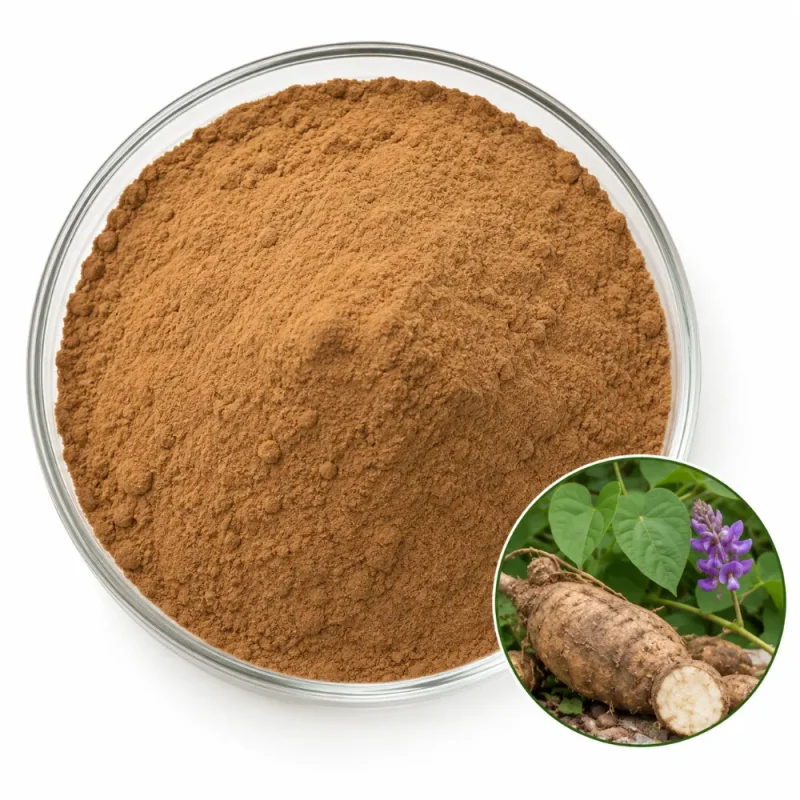
Indian Kudzu Extract 2–3% Flavonoids

Indian kudzu extract is prepared from the tuberous root of Pueraria tuberosa, the vidari kand of Ayurvedic practice, and not from the Chinese kudzu Pueraria lobata or from the unrelated plants sometimes sold under the same Sanskrit name. Ethanol extraction concentrates the flavonoids of the tuber, and the liquor is dried to a light brown powder.

The primary grade is 3% flavonoids by UV, with 2% as the lower end of a narrow range. The powder is 80 mesh and slightly soluble in water. The two grades differ by a modest step, so the choice between them is made on dose planning and cost per serving, not on a change of format.

Flavonoid Standardization & Grades

Flavonoids in Indian kudzu tuber are mainly isoflavonoids and related pterocarpans, among them puerarin, daidzein, genistein and tuberosin. The page standardizes to the summed flavonoid class instead of a single compound, because the tuber carries several structures that respond together in a colorimetric assay. The botanical entity is Pueraria tuberosa (Roxb. ex Willd.) DC., and the part used is the tuber, which the master data groups with roots and rhizomes.

GradeAssay & MethodWhere It Fits
2% FlavonoidsUVDry blends dosed by weight
3% FlavonoidsUVCapsules and tablets with moderate fill

Because the range is narrow, the grades are close in potency: the 3% grade holds half as much flavonoid again per gram as the 2% grade. The higher grade gives a smaller fill in capsules and tablets, while the lower grade keeps more of the starchy, sweetish tuber matrix and suits blends where bulk is acceptable. The same plant is also supplied as the unstandardized Pueraria Tuberosa Extract Powder, and the Chinese species is covered separately by the puerarin-graded Kudzu Root Extract 10–40% Puerarin.

Buyers who compare Indian kudzu extract quotes should check the species before the percentage. A total flavonoid figure of 2–3% is far lower than the puerarin grades of the Chinese plant. The two numbers describe different measurements on different raw materials, so they cannot be set side by side.

An Indian kudzu extract at this strength is a broad-matrix product, in which flavonoids are a small fraction of a mostly carbohydrate extract. That composition explains the sweetish taste and the hygroscopic behavior of the powder, and it is the reason the page describes the figure as a floor for the class, not as a purity claim.

Flavonoid Analysis & Purity Risks

Both grades are measured by UV, a spectrophotometric method that reads the whole flavonoid class at once and gives a single summed value. It is calibrated against one reference flavonoid, so the number depends on which compound the laboratory uses as the standard. An HPLC result for puerarin or daidzein counts individual peaks, which is a different measurement, and the two cannot be converted into each other.

Because isoflavones and pterocarpans absorb in a similar window, the UV reading includes both groups. Sugars and starch do not absorb and do not interfere, but pigments and some phenolic acids do, so a darker powder can give a higher reading without a real increase in flavonoids. Sample preparation uses an alcohol solvent, followed by filtration and dilution into the working range of the instrument.

Method comparability is a practical concern for Indian kudzu extract. A supplier that calibrates against rutin and another that calibrates against a different flavonoid can report different numbers for the same powder. A quoted figure is meaningful only when the reference compound is named. The same reference should be used for every lot of Indian kudzu extract that is released.

Purity risks follow from the botany and the trade. The Sanskrit name vidari kand is applied to more than one tuber, and Ipomoea digitata is a known substitute in Ayurvedic trade, while Pueraria lobata and Pueraria mirifica are different species with their own chemistry. A species statement, a tuber as the stated part and a stable chromatographic fingerprint protect identity better than a single total flavonoid figure.

Typical Specifications

Specification ItemProduct Information
Latin NamePueraria tuberosa
Plant PartRoot & Rhizome
ProcessingEthanol Extraction
Compound ClassFlavonoids, Polyphenols
Common NameIndian Kudzu, Vidari Kand, Indian Kudzu Tuber
Ingredient TypeStandardized Extract
Marker Compound(s)Total flavonoids (isoflavonoids and pterocarpans of Pueraria tuberosa tuber)
Primary Grade3% Flavonoids (UV)
Available Grades2% · 3% Flavonoids (UV)
AppearanceLight Brown powder
Solubility / DispersibilitySlightly Soluble in Water
Quality Parameters
Moisture (LOD)≤5.0%
Total Ash≤5.0%
Particle Size80 mesh
Heavy MetalsLead ≤2 ppm · Arsenic ≤1 ppm · Cadmium ≤1 ppm · Mercury ≤0.1 ppm
MicrobiologyTPC ≤1,000 cfu/g · Yeast & Mold ≤100 cfu/g · E. coli Negative · Salmonella Negative/25 g
Shelf Life24 months in unopened original packaging, cool and dry storage

Applications by Grade

3% Grade for Capsule Fills

The 3% grade reaches a flavonoid target with a smaller capsule fill than the 2% grade. The light brown powder is sweetish and hygroscopic, so a dry filling room and a flow agent keep the hopper steady, and fill weights should be checked at the start of each run.

3% Grade in Tablet Blends

Tablets of the higher grade need a dry binder, since the carbohydrate-rich powder takes up moisture and softens compacts in humid rooms. Run a compression trial on the full blend, check hardness after storage, and consider a film coat that protects against moisture uptake.

2% Grade for Dry Herbal Blends

At 2% the extract is dosed by weight in dry herbal compounds, where it sits beside other root and tuber powders. Pre-mix it with a bulking agent so the fine powder spreads evenly, because a slightly soluble, sticky powder tends to form small lumps in the blend.

2% Grade for Powder Sachets

Sachets of the lower grade combine the extract with a sweetener and flavor. The tuber matrix gives a mild, starchy sweetness that carries well in malt or vanilla bases, and the slight solubility leaves a fine sediment, which suits shake-before-use formats.

3% Grade in Bar Premixes

Bar premixes use the higher grade at a modest inclusion, blended into the dry fraction before the binder syrup is added. The light brown powder blends invisibly into oat, date and nut bases, and its mild flavor does not compete with the other ingredients.

Technical & Quality Considerations

The extract is a light brown powder with a faint earthy odor and a mildly sweet, slightly bitter taste. It is slightly soluble in water, so a solution looks cloudy and tan, with a fine sediment on standing. The carbohydrate matrix absorbs moisture readily, which lowers flow and promotes caking, so open drums only briefly and re-seal them with the liner in place.

Isoflavones are stable in dry form and in neutral to mildly acidic mixes, but their glycosides can hydrolyze under strong acid or enzyme action, which changes the polarity of the extract. Phenolic compounds also darken in contact with iron, so mix in stainless steel and avoid carbon-steel scoops. At production scale, a screening step ahead of the blender breaks up the soft lumps that form when the tuber matrix has taken up moisture. A retained sample from each lot gives a color and flow reference for later comparison.

Humidity control during storage is the main quality lever for this Indian kudzu extract. Store the drum in a cool, dry room away from heat sources, avoid temperature swings that cause condensation inside the drum, and use the material in the order it was received. A desiccant sachet inside secondary containers helps when partly used bags are kept for several weeks.

Packaging & Commercial Supply

Essencefield supports product evaluation, formulation trials, commercial orders, and ongoing ingredient supply. Packaging, storage, and shipping arrangements are determined by product characteristics, order quantity, stability requirements, and destination-market needs.

Supply ItemGeneral Information
SampleAvailable upon request for formulation, testing, and supplier evaluation
Order Quantities100 g · 1 kg · 5 kg · 25 kg · 100 kg · 500 kg · Bulk
Sample Lead TimeTypically 5–7 days after sample confirmation
Production Lead TimeTypically 15–30 days after order and specification confirmation
PackagingSuitable protective inner packaging with bags, cartons, drums, or other appropriate outer packaging
StorageStore in tightly sealed, suitable protective packaging in a cool, dry environment. Protect from moisture, heat, and direct sunlight. Specific storage conditions follow the approved product specification.
DocumentationCOA · Product Specification · TDS · SDS · Applicable declarations (as applicable)

Final order quantities, lead times, packaging, documentation, and shipping arrangements are confirmed according to the selected product and commercial requirements.

Request Ingredient Specifications & Quote

Share your target specification, application, quantity, and documentation needs. We’ll help confirm suitable options, samples, and commercial supply details.