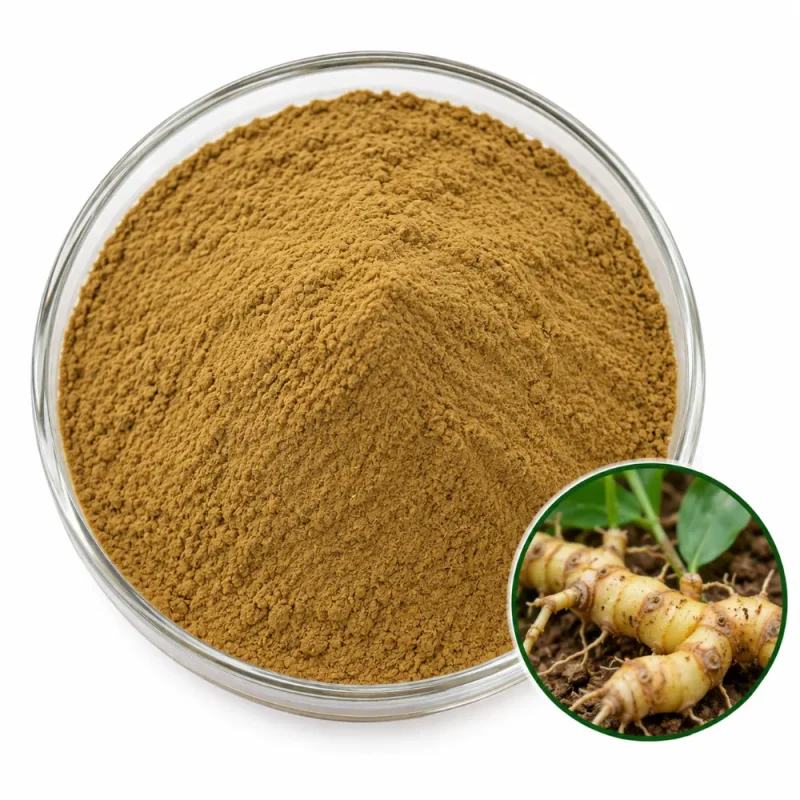
Polygonatum Odoratum Extract 5–20% Steroidal Saponins

The rhizome of Polygonatum odoratum, the fragrant Solomon’s seal known as yu zhu, is the only source of this extract, which does not draw on Siberian Solomon’s seal (huang jing) or on the berries and aerial parts. Ethanol extraction concentrates the saponin fraction of the rhizome, and the liquor is dried to a light brown, water-soluble powder.

The primary grade is 20% steroidal saponins by UV, with 5% as the lower end of the range. The powder is 80 mesh. The 20% grade serves capsules and drink sticks with a small fill, while the 5% grade suits tea-style blends and bars in which the mucilaginous rhizome matrix is part of the appeal.

Saponin Standardization & Grades

Steroidal saponins are glycosides of a steroid skeleton, here of the spirostanol and furostanol types, and they are the standardization target because they separate this rhizome from a plain polysaccharide extract. The botanical entity is Polygonatum odoratum (Mill.) Druce, and the part used is the rhizome, which the master data groups with roots and rhizomes. Most of the weight of the rhizome is carbohydrate, so even a modest saponin figure represents a meaningful enrichment.

GradeAssay & MethodWhere It Fits
5% Steroidal SaponinsUVTea blends, bars and whole-matrix premixes
20% Steroidal SaponinsUVCapsules and drink sticks with small fill

Grade choice follows dose, fill weight and the character of the mucilage. The 20% grade holds four times the saponin load per gram of the 5% grade, so a capsule reaches its target in a smaller fill. The 5% grade retains more of the rhizome polysaccharides, which thicken and sweeten a drink slightly and make the powder more hygroscopic. Siblings from the same plant are the unstandardized Polygonatum Odoratum Extract Powder and the milled Polygonatum odoratum Rhizome Powder.

Buyers who compare Polygonatum odoratum extract quotes should check the species first, because a Polygonatum odoratum extract and a huang jing extract are different ingredients. Several Polygonatum species are called Solomon’s seal, and the saponin profile of Polygonatum sibiricum is not the same as that of the fragrant species. Percentages from different species and different methods describe different materials and cannot be placed side by side.

Saponin Analysis & Purity Risks

Both grades are measured by UV, a colorimetric method that reacts the saponins with an acid reagent and reads the color developed. The result is a summed value calibrated against one saponin reference, so it depends on that choice of standard. An HPLC profile of individual spirostanol peaks would be a different measurement, and the two cannot be converted into each other.

This rhizome presents a specific analytical trap. It is rich in polysaccharides, and carbohydrates also give color with strong acid reagents, so a poorly cleaned sample can read high. A well-run method removes the sugars first, usually by partitioning the saponins into an organic solvent, and a lot with a very high UV reading and a sticky, sugar-like appearance should be viewed with caution.

The fingerprint of the rhizome shows a group of related saponin peaks and a large early-eluting sugar band. The ratio of saponin to sugar also explains why the extract dissolves easily in water despite its steroidal core: the glycosides and the polysaccharides carry the solid into solution.

For the higher grade, the interference problem is smaller, because the sugar fraction has been largely removed, and a clean light brown powder reading near the nominal value is a reasonable sign that the cleanup worked. For the lower grade, the sugars remain, and a validated sugar-removal step is what keeps the Polygonatum odoratum extract result honest.

Purity risks follow from the botany. Polygonatum sibiricum, Polygonatum kingianum and Polygonatum cyrtonema are all used as huang jing and differ from the fragrant species in size and chemistry. Other plants with similar rhizomes, such as Polygonatum humile, appear in local trade. A named species, the rhizome as the stated part and a stable fingerprint protect identity better than the percentage.

Typical Specifications

Specification ItemProduct Information
Latin NamePolygonatum odoratum
Plant PartRoot & Rhizome
ProcessingEthanol Extraction
Compound ClassSaponins
Common NameFragrant Solomon’s Seal, Yu Zhu
Ingredient TypeStandardized Extract
Marker Compound(s)Steroidal saponins (spirostanol and furostanol glycosides of Polygonatum odoratum rhizome)
Primary Grade20% Steroidal Saponins (UV)
Available Grades5% · 20% Steroidal Saponins (UV)
AppearanceLight Brown powder
Solubility / DispersibilityWater Soluble
Quality Parameters
Moisture (LOD)≤5.0%
Total Ash≤5.0%
Particle Size80 mesh
Heavy MetalsLead ≤2 ppm · Arsenic ≤1 ppm · Cadmium ≤1 ppm · Mercury ≤0.1 ppm
MicrobiologyTPC ≤1,000 cfu/g · Yeast & Mold ≤100 cfu/g · E. coli Negative · Salmonella Negative/25 g
Shelf Life24 months in unopened original packaging, cool and dry storage

Applications by Grade

20% Grade for Compact Capsules

The 20% grade delivers a saponin target in a small capsule fill. The light brown powder is hygroscopic, so a dry filling room and a flow agent keep the hopper steady, and the fill weight should be checked at the start of each run and after any pause.

20% Grade in Drink Sticks

Because the powder is water soluble, the high grade dissolves into a lightly foaming, tan liquid in one stir. The saponin foams on shaking, so recommend gentle stirring, and add a citrus or honey flavor to cover the faint bitter edge of the rhizome.

5% Grade for Tea-Style Blends

At 5% the extract is dosed by weight in herbal tea mixes, where its mucilage gives a softer mouthfeel and a mild sweetness. Pair it with chrysanthemum, goji or jujube, which suit the traditional profile of the rhizome, and blend in small lots to avoid segregation.

5% Grade for Bar Premixes

Bar premixes use the lower grade at a moderate inclusion, blended into the dry fraction before the binder syrup is added. The polysaccharide-rich powder absorbs syrup, so adjust binder level and test hardness after storage, since the bar may firm over time.

5% Grade for Gummy Premixes

Gummies can carry the lower grade added after the cook, which spares the saponins from long heat. The mucilage thickens the mass slightly, so check viscosity and depositing behavior, and expect a faint tan color in pale fruit bases.

Technical & Quality Considerations

The extract is a light brown powder with a faint sweet, herbal odor and a mildly bitter, slightly sticky taste. It is water soluble, so a solution looks clear to slightly hazy, tan and slightly viscous because of the polysaccharides, and shaking produces a foam that fades slowly. Steroidal saponins are chemically stable at neutral pH and in dry form, but strong acid cleaves the sugar units and strong alkali opens the furostanol ring.

The sugar and mucilage content makes the powder hygroscopic, so open drums only briefly and re-seal them with the liner in place. The powder cakes in humid rooms and forms lumps that are hard to break once wetted. At production scale, break up caked material with a screen before it enters the blender and pre-mix the powder with a portion of the carrier. Compare each lot with a retained sample for color, flow and foaming behavior, and record the water content at receipt, since the mucilage-rich powder changes weight as it takes up moisture.

In ready-to-drink formats, saponin foam can complicate filling, so test an anti-foam strategy early. A Polygonatum odoratum extract added to a hot base dissolves quickly but may thicken on cooling, which is why viscosity should be checked at the filling temperature and again at room temperature before the formula is finalized.

Packaging & Commercial Supply

Essencefield supports product evaluation, formulation trials, commercial orders, and ongoing ingredient supply. Packaging, storage, and shipping arrangements are determined by product characteristics, order quantity, stability requirements, and destination-market needs.

Supply ItemGeneral Information
SampleAvailable upon request for formulation, testing, and supplier evaluation
Order Quantities100 g · 1 kg · 5 kg · 25 kg · 100 kg · 500 kg · Bulk
Sample Lead TimeTypically 5–7 days after sample confirmation
Production Lead TimeTypically 15–30 days after order and specification confirmation
PackagingSuitable protective inner packaging with bags, cartons, drums, or other appropriate outer packaging
StorageStore in tightly sealed, suitable protective packaging in a cool, dry environment. Protect from moisture, heat, and direct sunlight. Specific storage conditions follow the approved product specification.
DocumentationCOA · Product Specification · TDS · SDS · Applicable declarations (as applicable)

Final order quantities, lead times, packaging, documentation, and shipping arrangements are confirmed according to the selected product and commercial requirements.

Request Ingredient Specifications & Quote

Share your target specification, application, quantity, and documentation needs. We’ll help confirm suitable options, samples, and commercial supply details.