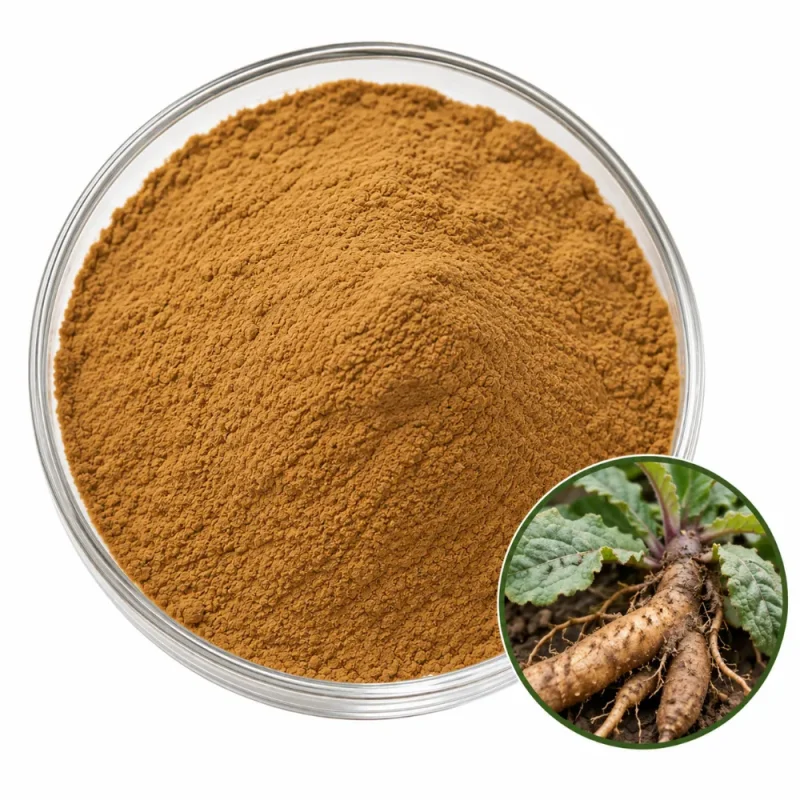
Rehmannia Glutinosa Extract 5–30% Iridoid Glycosides

Rehmannia glutinosa extract is prepared from the dried root of Rehmannia glutinosa, the sheng di huang of Chinese herbal practice, and not from the steamed and darkened shu di huang or from the leaves. Ethanol extraction concentrates the iridoid glycosides of the root, and the liquor is dried to a brown, water-soluble powder.

The primary grade is 30% iridoid glycosides by HPLC, with 5% as the lower end of the range. The powder is 80 mesh. The 30% grade serves capsules and drink sticks with a limited fill weight, while the 5% grade suits blends in which the sweet, sticky root matrix remains part of the product.

Iridoid Standardization & Grades

Iridoid glycosides are the bitter-sweet, sugar-bearing monoterpenoids that characterize rehmannia root, and catalpol is the most abundant of them. The grade sums the named iridoids of the root, including catalpol, aucubin, ajugol and the rehmanniosides, because HPLC resolves each of them and because no single compound describes the profile. The botanical entity is Rehmannia glutinosa (Gaertn.) Libosch. ex Fisch. & C.A.Mey., and the part used is the root, which the master data groups with roots and rhizomes.

GradeAssay & MethodWhere It Fits
5% Iridoid GlycosidesHPLCWhole-root blends and sachets
30% Iridoid GlycosidesHPLCCapsules and drink sticks with small fill

Grade choice follows dose, fill weight and the amount of root matrix a formula should keep. The 30% grade carries six times the iridoid load per gram of the 5% grade, so a capsule reaches its target in a much smaller fill. The 5% grade retains the oligosaccharides, amino acids and phenylethanoid glycosides of the root and is therefore sweeter, stickier and bulkier. Neighbors of the same root include the Prepared Rehmannia Root Extract Powder, the Radix Rehmanniae Extract Powder and the milled Rehmannia Root Powder.

Processing is the most important identity point. The raw dried root and the steamed prepared root are different drugs, and steaming lowers the catalpol content strongly while darkening the root. A rehmannia extract that carries a catalpol or iridoid figure should come from the unprepared root, and buyers who compare quotes should ask which of the two was extracted.

Iridoid Analysis & Purity Risks

Both grades are measured by HPLC, which separates catalpol, aucubin and the other iridoids on a reversed-phase column, identifies each peak by retention time and UV spectrum, and quantifies the named peaks against reference standards. Iridoids absorb weakly and at short wavelength, so the method needs a clean baseline and careful integration. A UV total or a colorimetric glycoside test counts every compound that reacts and is not comparable with the HPLC sum.

The chromatographic fingerprint of rehmannia root has a catalpol peak early in the run, followed by the other iridoids and the phenylethanoid glycoside acteoside later. Iridoid glycosides are unstable to acid and to glycosidases: the sugar is lost, the aglycone is reactive and polymerizes to dark pigments. A lot with a weak iridoid pattern and a dark color has therefore usually seen heat, acid or enzymatic damage during processing.

The sample must be prepared promptly. The Rehmannia glutinosa powder is dissolved in water or a dilute alcohol, filtered and injected, because iridoid solutions left standing in the autosampler lose catalpol. The result depends on the time between preparation and injection, which is why a laboratory should hold it constant for every rehmannia extract sample.

Purity risks follow from the botany and processing. The prepared root, steamed with wine and darkened, is a separate ingredient with a lower iridoid content, and the fresh root is another material again. Rehmannia glutinosa has near relatives in the genus, and other dark roots can be sold under the name. A species name, the unprepared dried root and a fingerprint protect identity better than one percentage.

Typical Specifications

Specification ItemProduct Information
Latin NameRehmannia glutinosa
Plant PartRoot & Rhizome
ProcessingEthanol Extraction
Compound ClassIridoids, Terpenoids
Common NameRehmannia, Chinese Foxglove Root, Sheng Di Huang
Ingredient TypeStandardized Extract
Marker Compound(s)Iridoid glycosides, mainly catalpol (iridoids of Rehmannia glutinosa root)
Primary Grade30% Iridoid Glycosides (HPLC)
Available Grades5% · 30% Iridoid Glycosides (HPLC)
AppearanceBrown powder
Solubility / DispersibilityWater Soluble
Quality Parameters
Moisture (LOD)≤5.0%
Total Ash≤5.0%
Particle Size80 mesh
Heavy MetalsLead ≤2 ppm · Arsenic ≤1 ppm · Cadmium ≤1 ppm · Mercury ≤0.1 ppm
MicrobiologyTPC ≤1,000 cfu/g · Yeast & Mold ≤100 cfu/g · E. coli Negative · Salmonella Negative/25 g
Shelf Life24 months in unopened original packaging, cool and dry storage

Applications by Grade

30% Grade for Compact Capsules

The 30% grade delivers an iridoid target in a small capsule fill. The brown powder is strongly hygroscopic, so a dry filling room and a quick transfer from the sealed liner protect flow, and capsule weights should be checked at the start of each run and after any stoppage.

30% Grade in Drink Sticks

Because the Rehmannia glutinosa powder is water soluble, the high grade dissolves into a clear brown solution with a bitter-sweet, slightly caramel taste. Pair it with date, ginger or citrus flavors, and use a moisture-barrier stick film, since the open powder takes up water quickly.

5% Grade for Herbal Sachet Blends

At 5% the extract is dosed by weight in dry herbal blends, where the oligosaccharides add sweetness and body to the infusion. Blend in small lots with a drying agent, because the sticky powder clumps against other dry ingredients and is hard to redistribute afterward.

5% Grade for Bar Premixes

Bar premixes use the lower grade at a moderate inclusion, blended into the dry fraction before the syrup goes on. The hygroscopic matrix absorbs syrup and can stiffen the bar, so adjust the binder level and test hardness after a week of storage.

30% Grade in Tablet Blends

Tablets of the high grade need a dry binder and a moisture-protective film coat, since the Rehmannia glutinosa powder softens in humid rooms. Run a compression trial on the full blend, and check the hardness of tablets that have been stored open for several hours.

Technical & Quality Considerations

The extract is a brown powder with a sweet, slightly roasted odor and a bitter-sweet taste. It is water soluble, so it dissolves into a clear to slightly hazy brown solution whose color deepens on standing. Catalpol is a stable solid when dry but degrades in solution at low pH and when heated for long, which darkens the liquid and lowers the iridoid content.

Phenolic and amino compounds in the root can brown through reactions with sugars during heating, so hold temperatures and times down in any wet process. Iron and copper darken the solution quickly, so mix in stainless steel. At production scale, store the sealed drum in a cool dry room, open it only for the time needed to weigh, and screen any caked powder before it enters the blender.

Sticky powders cause equipment problems, and a rehmannia extract is no exception. Hoppers, screw feeders and sieves should be cleaned between runs, and a moisture check on arriving lots tells you whether additional drying agent is needed in the formula. Compare each lot with a retained sample for color, odor and flow, and record the date the drum was opened.

Incoming checks for Rehmannia glutinosa extract focus on color, sweetness and moisture. A dark, almost black powder with a burnt odor suggests heat damage or a prepared root, and a pale powder with little sweetness suggests a diluted lot. Compare the HPLC pattern with the retained sample, looking for the early catalpol peak, and question any rehmannia glutinosa extract whose iridoid peaks are weak beside a large group of late brown pigments.

Packaging & Commercial Supply

Essencefield supports product evaluation, formulation trials, commercial orders, and ongoing ingredient supply. Packaging, storage, and shipping arrangements are determined by product characteristics, order quantity, stability requirements, and destination-market needs.

Supply ItemGeneral Information
SampleAvailable upon request for formulation, testing, and supplier evaluation
Order Quantities100 g · 1 kg · 5 kg · 25 kg · 100 kg · 500 kg · Bulk
Sample Lead TimeTypically 5–7 days after sample confirmation
Production Lead TimeTypically 15–30 days after order and specification confirmation
PackagingSuitable protective inner packaging with bags, cartons, drums, or other appropriate outer packaging
StorageStore in tightly sealed, suitable protective packaging in a cool, dry environment. Protect from moisture, heat, and direct sunlight. Specific storage conditions follow the approved product specification.
DocumentationCOA · Product Specification · TDS · SDS · Applicable declarations (as applicable)

Final order quantities, lead times, packaging, documentation, and shipping arrangements are confirmed according to the selected product and commercial requirements.

Request Ingredient Specifications & Quote

Share your target specification, application, quantity, and documentation needs. We’ll help confirm suitable options, samples, and commercial supply details.