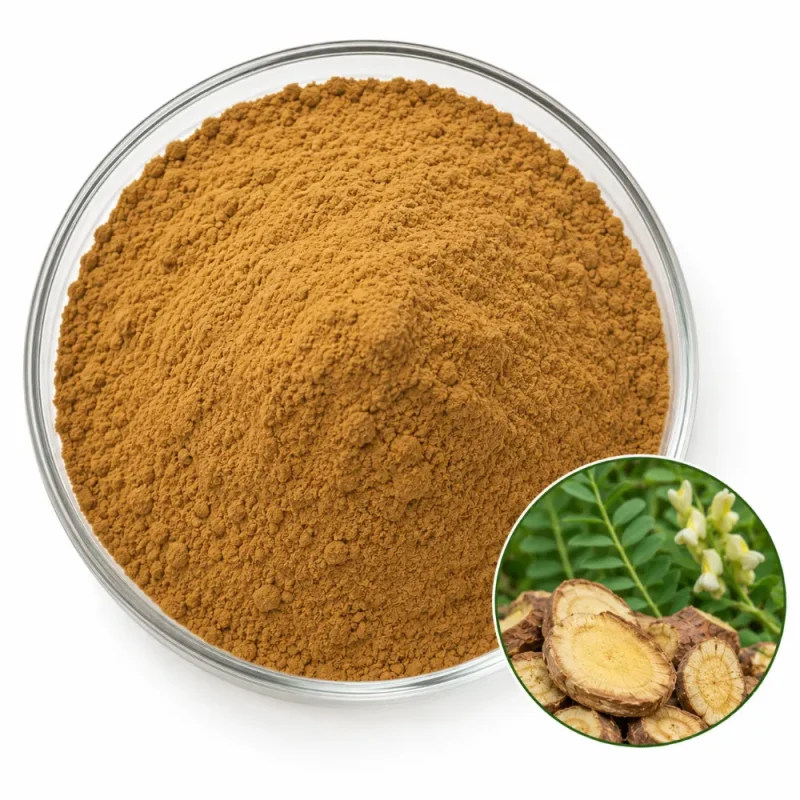
Sophora flavescens Extract 10–50% Total Alkaloids

The dried root of Sophora flavescens, the bitter kushen of Chinese herbal practice, is the only source of this extract, which uses neither the seed pods nor the flowers and has no connection to the ornamental Japanese pagoda tree. Ethanol extraction concentrates the quinolizidine alkaloids of the root, and the liquor is dried to a light brown powder.

The primary grade is 50% total alkaloids, with 10% as the lower end of the range. The powder is 80 mesh and slightly soluble in water. The 50% grade serves capsules and tablets with a small fill weight, while the 10% grade suits dry compounds in which the whole root matrix is wanted.

Alkaloid Standardization & Grades

The alkaloids of kushen root are quinolizidine alkaloids, a family built on two fused six-membered rings that share a nitrogen atom. The main members are matrine and oxymatrine, which differ by one oxygen on the nitrogen, together with sophocarpine, sophoridine and other close relatives. The page standardizes to the sum of this class, because the root always carries several of them. The botanical entity is Sophora flavescens Aiton, and the part used is the root.

GradeAssay & MethodWhere It Fits
10% Total AlkaloidsTotal alkaloid basisDry compounds keeping the root matrix
50% Total AlkaloidsTotal alkaloid basisCapsules and tablets with small fill

The choice between grades depends on dose, fill weight and the root matrix that the blend can carry. The 50% grade holds five times the alkaloid load per gram of the 10% grade, so it reaches a target in a smaller fill. The 10% grade keeps more of the prenylated flavonoids, such as kurarinone, and the sugars and starch of the root, which makes it bulkier and slightly sweeter. Siblings from the same plant are the unstandardized Sophora Flavescens Extract Powder and the purified Matrine and Oxymatrine.

A total alkaloid percentage can be produced by several routes, such as an acid-base gravimetric separation, a titration, a colorimetric reaction or a chromatographic sum, and the numbers from these routes are not interchangeable. Buyers who compare Sophora flavescens extract quotes should ask what the figure counts and how it was obtained, as well as which part of the plant was used.

Because quinolizidine alkaloids are bioactive at small doses, the alkaloid content per gram is also a safety and labeling parameter. A formulator who knows the grade can set the fill weight with a margin. The 50% grade needs particular care when it is blended into large mixes at low inclusion.

Alkaloid Analysis & Purity Risks

The analytical story of this extract starts with the class, not a single peak. A total alkaloid reading counts every basic nitrogen compound that is extracted under the method conditions. It includes matrine, oxymatrine and their relatives together, and it is not comparable with an HPLC value for one named alkaloid. The two kinds of figure measure different things and should not be converted into each other.

The root fingerprint shows two dominant alkaloid peaks, oxymatrine and matrine, followed by sophocarpine and smaller members. Oxymatrine is the N-oxide of matrine and can be reduced to matrine during processing. The ratio of the two peaks reveals how gently the root was handled. A lot with a large matrine peak and a small oxymatrine peak has usually seen heat or reducing conditions.

Alkaloids dissolve as salts in acid and as free bases in organic solvent, which is why sample preparation, the acidity of the extraction medium and the final pH determine how much of the class is recovered into the reading. A well-run method uses a consistent acid-base cycle and a fixed solvent volume for every lot.

Purity risks follow from the botany. Other Sophora species are also sold as roots under the same common name, among them Sophora alopecuroides and Sophora tonkinensis, and their alkaloid patterns differ. The flowers and pods of Sophora japonica are a separate drug rich in rutin. A species statement, the root as the stated part and a chromatographic fingerprint protect identity better than a total percentage.

Typical Specifications

Specification ItemProduct Information
Latin NameSophora flavescens
Plant PartRoot & Rhizome
ProcessingEthanol Extraction
Compound ClassAlkaloids
Common NameSophora Flavescens, Kushen, Bitter Sophora Root
Ingredient TypeStandardized Extract
Marker Compound(s)Total alkaloids (quinolizidine alkaloids, mainly matrine and oxymatrine, of Sophora flavescens root)
Primary Grade50% Total Alkaloids
Available Grades10% · 50% Total Alkaloids
AppearanceLight Brown powder
Solubility / DispersibilitySlightly Soluble in Water
Quality Parameters
Moisture (LOD)≤5.0%
Total Ash≤5.0%
Particle Size80 mesh
Heavy MetalsLead ≤2 ppm · Arsenic ≤1 ppm · Cadmium ≤1 ppm · Mercury ≤0.1 ppm
MicrobiologyTPC ≤1,000 cfu/g · Yeast & Mold ≤100 cfu/g · E. coli Negative · Salmonella Negative/25 g
Shelf Life24 months in unopened original packaging, cool and dry storage

Applications by Grade

50% Grade for Compact Capsules

The 50% grade delivers an alkaloid target in a small capsule fill. Because the powder is potent, weigh it in a ventilated station, pre-dilute it with a flow carrier to make metering practical, and verify content uniformity on the first capsules of every run.

50% Grade in Tablet Blends

Tablets of the high grade combine the extract with a dry binder and an absorbent, since the bitter, slightly sticky powder softens compacts. Mix it at low inclusion in a geometric dilution so that the potent powder is spread evenly, and check hardness after storage.

10% Grade for Dry Herbal Compounds

At 10% the extract is dosed by weight in dry herbal compounds beside other root powders. The bitterness is intense even at low inclusion, so blend in a pre-mix with a bulking agent and screen the mix to break up lumps before filling.

10% Grade for Granule Premixes

Granule premixes carry the lower grade with a binder and a strong flavor system. Kushen is among the most bitter botanicals, so the formulation depends on masking. A taste trial on the finished granule is more informative than a trial on the raw powder.

50% Grade in Enteric-Coated Capsules

A delayed-release shell can keep the bitter powder from contacting the mouth and the stomach lining. Check that the powder is dry before filling, because moisture softens the coating, and use a controlled humidity room during encapsulation of the high grade.

Technical & Quality Considerations

The extract is a light brown powder with a faint earthy odor and an intensely bitter taste. It is slightly soluble in water, so a solution looks cloudy and tan, and solubility rises in acid because the alkaloids form salts. In alkaline conditions the free bases separate and the liquid clouds further, which is a useful reminder that the physical form of the alkaloid depends on pH.

Quinolizidine alkaloids are stable in dry form, but oxymatrine can be reduced to matrine under heat and reducing agents, which changes the alkaloid profile without much change in the total figure. Phenolic flavonoids in the root darken in light and in contact with iron. At production scale, use dedicated scoops, weigh the potent powder in a ventilated area and clean the mixer thoroughly afterward. The bitter residue carries over to the next product.

Storage is simple but important: keep the drum closed, cool and dry, away from light and heat. Compare each Sophora flavescens extract lot with a retained sample for color, odor and flow, and keep records of the date the drum was opened, since the open powder slowly takes up moisture and loses flow.

A Sophora flavescens extract should be judged first by its taste and color. An intensely bitter, light brown powder with a faint earthy odor is typical, while a dark, sticky lot suggests heat damage or a high sugar load. Retain a sample of each Sophora flavescens extract lot, and compare the matrine and oxymatrine peaks of later lots with it, since a change in their ratio is the quickest sign of different handling.

Packaging & Commercial Supply

Essencefield supports product evaluation, formulation trials, commercial orders, and ongoing ingredient supply. Packaging, storage, and shipping arrangements are determined by product characteristics, order quantity, stability requirements, and destination-market needs.

Supply ItemGeneral Information
SampleAvailable upon request for formulation, testing, and supplier evaluation
Order Quantities100 g · 1 kg · 5 kg · 25 kg · 100 kg · 500 kg · Bulk
Sample Lead TimeTypically 5–7 days after sample confirmation
Production Lead TimeTypically 15–30 days after order and specification confirmation
PackagingSuitable protective inner packaging with bags, cartons, drums, or other appropriate outer packaging
StorageStore in tightly sealed, suitable protective packaging in a cool, dry environment. Protect from moisture, heat, and direct sunlight. Specific storage conditions follow the approved product specification.
DocumentationCOA · Product Specification · TDS · SDS · Applicable declarations (as applicable)

Final order quantities, lead times, packaging, documentation, and shipping arrangements are confirmed according to the selected product and commercial requirements.

Request Ingredient Specifications & Quote

Share your target specification, application, quantity, and documentation needs. We’ll help confirm suitable options, samples, and commercial supply details.