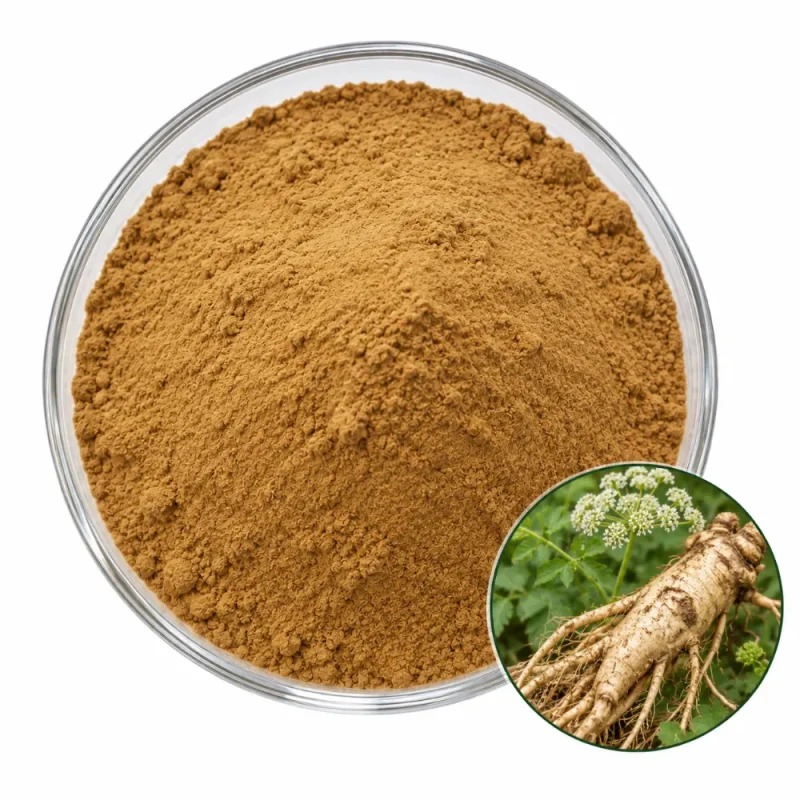
Angelica Dahurica Extract 5–30% Total Coumarins

Dahurian angelica, Angelica dahurica, supplies the dried root used for this extract, which is the bai zhi of Chinese herbal practice and not the dang gui root, the du huo root or the purple-flowered qian hu root of related angelicas. Ethanol extraction concentrates the furanocoumarins of the root, and the liquor is dried to a light brown powder.

The primary grade is 30% total coumarins by UV, with 5% as the lower end of the range. The powder is 80 mesh and insoluble in water. The 30% grade serves capsules and softgels with a small fill weight, while the 5% grade suits dry compounds that keep more of the starchy root matrix.

Coumarin Standardization & Grades

Coumarins are benzopyrone derivatives, and the roots of the carrot family are especially rich in furanocoumarins, in which a furan ring is fused to the coumarin core. Bai zhi contains imperatorin, isoimperatorin, byakangelicin, oxypeucedanin and phellopterin among others. The grade sums the coumarin class, because the root always carries several of them. The botanical entity is Angelica dahurica (Hoffm.) Benth. & Hook.f. ex Franch. & Sav., and the part used is the root.

GradeAssay & MethodWhere It Fits
5% Total CoumarinsUVDry compounds keeping the root matrix
30% Total CoumarinsUVCapsules and softgels with small fill

Grade choice follows dose, fill weight and the amount of root starch a formula should keep. The 30% grade carries six times the coumarin load per gram of the 5% grade, so a capsule reaches its target with a smaller fill. The 5% grade keeps the starch, volatile oil fragments and polysaccharides of the root and is bulkier and paler. Siblings from the same root are the unstandardized Angelica Dahurica Root Extract Powder, the milled Angelica Dahurica Root Powder and the purified Imperatorin 98%.

A second group, the imperatorin and isoimperatorin pair, is recorded in the data as a secondary marker and is described here without numbers. Buyers who compare Angelica dahurica extract quotes should check whether the figure is a UV class total or an HPLC value for named furanocoumarins, because the first is always larger than the second and the two cannot be converted.

Furanocoumarins deserve a handling remark. They are photoactive compounds, and contact with the powder followed by strong sunlight can irritate the skin of workers, which is why gloves and covered skin are used when the concentrated powder is handled in volume.

Coumarin Analysis & Purity Risks

Both grades are measured by UV, a spectrophotometric method that reads the coumarin class at a characteristic absorption maximum after the sample has been dissolved and diluted. The result is a summed value calibrated against a reference coumarin, so the choice of reference changes the number. An HPLC profile of imperatorin and isoimperatorin is a different measurement and cannot be converted into it.

Absorption at coumarin wavelengths is not exclusive to coumarins. Other conjugated compounds, including chromones and some flavonoids, absorb in the same window and add to the total, so a pigmented or poorly cleaned sample reads high. A well-run method uses a defined cleanup, and the reading is cross-checked with a chromatographic fingerprint.

The fingerprint of the root shows several furanocoumarin peaks in the later part of the run, among them imperatorin, isoimperatorin, oxypeucedanin and phellopterin. The proportions vary with the cultivar and the processing, and a lot whose profile departs strongly from the usual pattern may come from a related species or from a different plant part.

Purity risks follow from the botany. Angelica dahurica is closely related to Angelica pubescens, Angelica sinensis and Angelica decursiva, and all four are called angelica, though they are separate drugs with different coumarin patterns. A species statement, the root as the stated part and a chromatographic profile protect identity better than a total percentage.

Typical Specifications

Specification ItemProduct Information
Latin NameAngelica dahurica
Plant PartRoot & Rhizome
ProcessingEthanol Extraction
Compound ClassCoumarins, Polyphenols
Common NameDahurian Angelica, Bai Zhi
Ingredient TypeStandardized Extract
Marker Compound(s)Total coumarins (furanocoumarins including imperatorin and isoimperatorin of Angelica dahurica root)
Primary Grade30% Total Coumarins (UV)
Available Grades5% · 30% Total Coumarins (UV)
AppearanceLight Brown powder
Solubility / DispersibilityInsoluble in Water
Quality Parameters
Moisture (LOD)≤5.0%
Total Ash≤5.0%
Particle Size80 mesh
Heavy MetalsLead ≤2 ppm · Arsenic ≤1 ppm · Cadmium ≤1 ppm · Mercury ≤0.1 ppm
MicrobiologyTPC ≤1,000 cfu/g · Yeast & Mold ≤100 cfu/g · E. coli Negative · Salmonella Negative/25 g
Shelf Life24 months in unopened original packaging, cool and dry storage

Applications by Grade

30% Grade for Compact Capsules

The 30% grade delivers a coumarin target in a small capsule fill. The light brown powder is fine and slightly waxy, so a flow agent helps the hopper feed evenly, and capsule weights should be checked at the start of each run and again after any pause.

30% Grade in Oil-Based Softgels

Furanocoumarins dissolve in oil far better than in water, so softgel fills disperse the 30% grade in a carrier oil. Mill the powder fine and stir during encapsulation, since insoluble particles settle in the feed line and shift the dose between capsules.

5% Grade for Dry Herbal Compounds

At 5% the extract is dosed by weight in dry herbal compounds, where the root’s starchy matrix sits beside other root powders. Pre-mix it with a bulking agent so the fine powder spreads evenly, and screen the blend to break small lumps before filling.

5% Grade for Tablet Blends

Tablets of the lower grade compress well because of the starch, though the waxy volatile fraction can stick to punches. A dry binder and an absorbent help, and a short compression trial with a hardness check after storage confirms the formula.

30% Grade in Granule Premixes

Granules carry the high grade with a binder and a flavor system. The aromatic, slightly numbing root note is partly covered by mint or citrus, and the insoluble powder should be wetted evenly to avoid specks of concentrated material in the finished granule.

Technical & Quality Considerations

The extract is a light brown powder with a distinctive aromatic, slightly sweet and resinous odor and a bitter, mildly numbing taste. It is insoluble in water, so it does not dissolve in drink bases and settles as a fine sediment. Furanocoumarins dissolve in ethanol, in oils and in some surfactant systems, and the choice of carrier decides how they behave in the product.

Coumarins are chemically stable in dry form, but furanocoumarins are sensitive to ultraviolet light, which degrades them and changes the chromatogram, so protect the powder and any clear-packaged finished product from light. At production scale, handle the Angelica dahurica extract with gloves and in a ventilated station, and pre-mix it with a portion of the carrier before it enters the main blender.

Waxy residues persist on equipment, so wash with warm detergent or an ethanol cleaner and dedicate scoops where possible. Compare each lot with a retained sample for color, odor and flow, record the date the drum was opened and keep the drum closed, cool and away from light. The aromatic odor transfers to neighboring products, so store this powder away from delicate flavors.

An Angelica dahurica extract is checked by aroma and by the furanocoumarin fingerprint. A warm, resinous odor is typical, and a flat smell suggests loss of the volatile fraction. Keep a retained sample of each Angelica dahurica extract lot, store it away from light, and compare the imperatorin and isoimperatorin peaks of later lots with it, since both are the first to fade under strong illumination.

Packaging & Commercial Supply

Essencefield supports product evaluation, formulation trials, commercial orders, and ongoing ingredient supply. Packaging, storage, and shipping arrangements are determined by product characteristics, order quantity, stability requirements, and destination-market needs.

Supply ItemGeneral Information
SampleAvailable upon request for formulation, testing, and supplier evaluation
Order Quantities100 g · 1 kg · 5 kg · 25 kg · 100 kg · 500 kg · Bulk
Sample Lead TimeTypically 5–7 days after sample confirmation
Production Lead TimeTypically 15–30 days after order and specification confirmation
PackagingSuitable protective inner packaging with bags, cartons, drums, or other appropriate outer packaging
StorageStore in tightly sealed, suitable protective packaging in a cool, dry environment. Protect from moisture, heat, and direct sunlight. Specific storage conditions follow the approved product specification.
DocumentationCOA · Product Specification · TDS · SDS · Applicable declarations (as applicable)

Final order quantities, lead times, packaging, documentation, and shipping arrangements are confirmed according to the selected product and commercial requirements.

Request Ingredient Specifications & Quote

Share your target specification, application, quantity, and documentation needs. We’ll help confirm suitable options, samples, and commercial supply details.