
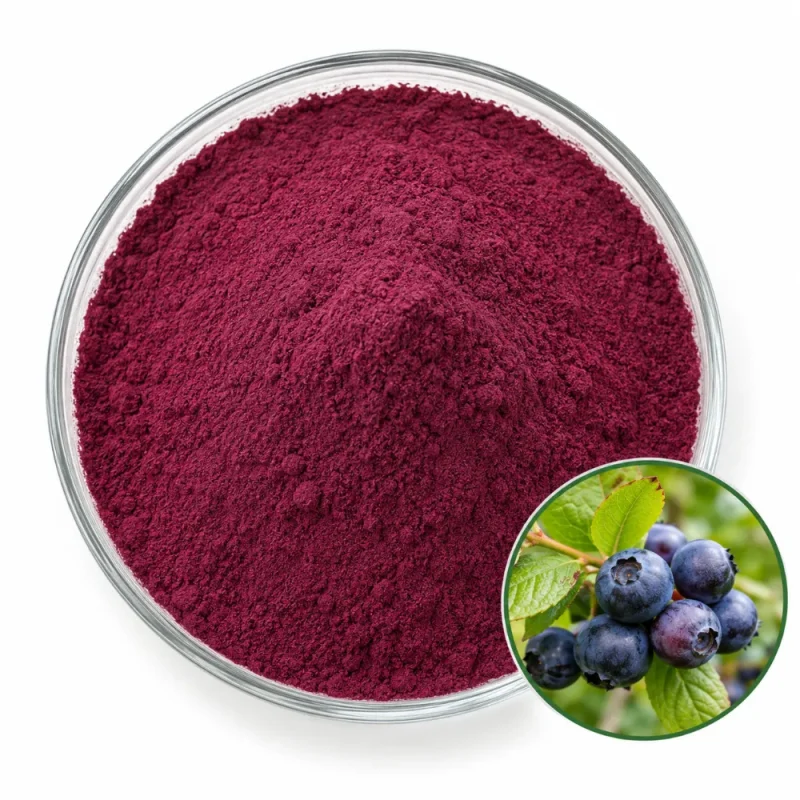
Anthocyanin Standardization & Grades
Anthocyanins are the water-soluble pigments behind the red, purple and blue colors of berries. Bilberry holds a broad set of about fifteen anthocyanins, built on five aglycones, namely delphinidin, cyanidin, petunidin, peonidin and malvidin, each combined with glucose, galactose or arabinose. The page standardizes to the summed class, because the fruit carries many related pigments. The botanical entity is Vaccinium myrtillus L., and the part used is the fruit.
| Grade | Assay & Method | Where It Fits |
|---|---|---|
| 10% Anthocyanins | UV (pH differential) | Beverage bases and gummy premixes |
| 25% Anthocyanins | UV (pH differential) | Capsules and drink sticks with small fill |
The grades differ in color strength and fill weight, so the dose per serving decides which one fits. The 25% grade carries two and a half times the pigment load per gram of the 10% grade, so it reaches a target in a smaller fill. It also colors a base intensely at low inclusion. The 10% grade keeps more of the berry sugars and fruit acids and gives a softer, more diluted color. The same berry is also supplied under its own name as the single-grade Bilberry Extract 25% Anthocyanins and the ratio-based Bilberry Extract Powder, while the related species is graded in Lingonberry Extract 10–25% Anthocyanins.
The difference from the single-grade bilberry extract is range and wording: two strengths are offered under a berry-anthocyanin name, so buyers who need to match an existing formula should compare the grade rather than the title. Buyers who compare quotes should also check the species behind a berry anthocyanin label, because blueberry, bilberry and lingonberry have different pigment profiles and prices.
The pH differential method counts only monomeric anthocyanins and cannot name individual pigments, so the figure is a pigment value and not a total polyphenol value. A formulator who needs a defined delphinidin share should request an HPLC profile alongside the UV figure.


