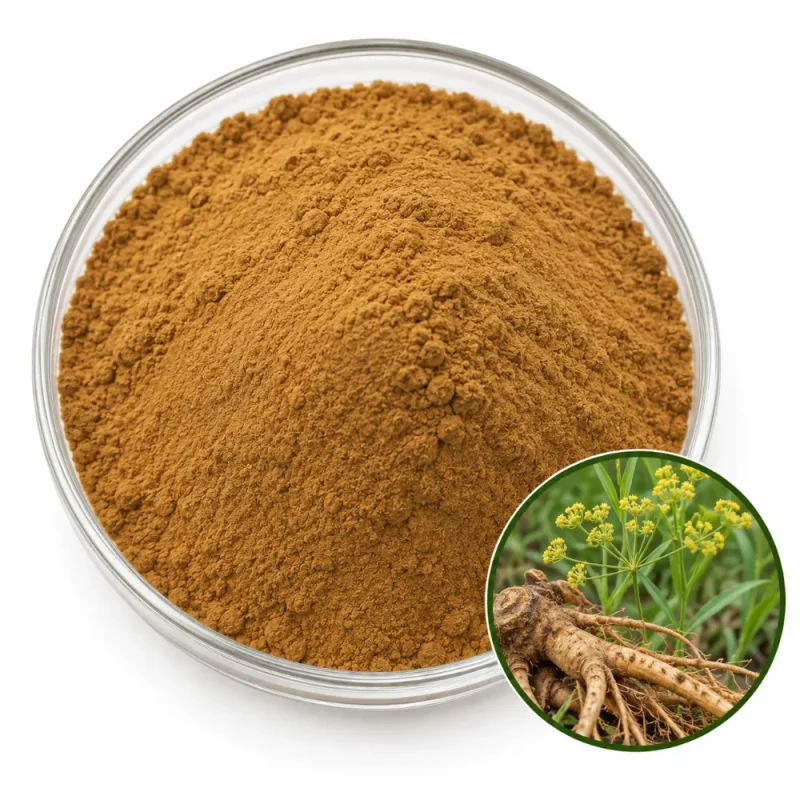
Bupleurum Chinense Extract 5–40% Saikosaponins

Chai hu, the root of Bupleurum chinense, is the source of this extract, which does not use the roots of the narrow-leaved southern bupleurum or of the toxic large-leaved bupleurum that is occasionally mistaken for it. Ethanol extraction concentrates the triterpenoid saponins of the root, and the liquor is dried to a light brown, water-soluble powder.

The primary grade is 40% saikosaponins by UV, with 5% as the lower end of the range. The powder is 80 mesh. The 40% grade serves capsules and drink sticks with a small fill, while the 5% grade suits tea-style blends and dry compounds that keep more of the root matrix and its volatile fraction.

Saikosaponin Standardization & Grades

Saikosaponins are oleanane-type triterpenoid saponins with an unusual 13,28-epoxy bridge, and they are the signature compounds of the genus. Saikosaponin A, C and D are the best known members. The grade sums the saikosaponin class, because the root carries several of them and because colorimetric analysis reads them together. Defined grades for saikosaponin A and D are recorded in the data and are described here without numbers. The botanical entity is Bupleurum chinense DC., and the part used is the root.

GradeAssay & MethodWhere It Fits
5% SaikosaponinsUVTea-style blends and dry compounds
40% SaikosaponinsUVCapsules and drink sticks with small fill

Pick the grade by dose, fill weight and the root matrix a formula should retain. The 40% grade carries eight times the saponin load per gram of the 5% grade, so a capsule reaches its target in a much smaller fill. The 5% grade retains the sugars, sterols and volatile fraction of the root and gives a darker, sweeter and more aromatic powder. Siblings from the same root are the unstandardized Bupleurum Root Extract Powder, the milled Bupleurum Root Powder and the purified Saikosaponin A 98%.

Saikosaponins are chemically fragile, and this affects how the figure is read. Acid converts saikosaponins A and D into their rearranged isomers, so an acidic extraction or a low-pH wet process can lower the content of the named compounds and raise that of the artifacts. A UV class total is less affected, since the rearranged compounds remain saponins.

Buyers who compare bupleurum extract quotes should check the species and the compound behind the percentage. Several bupleurum species are sold as chai hu, and a UV class figure, an HPLC value for saikosaponin A and D, and a pharmacopoeial sum of three saikosaponins are three different statements.

Saikosaponin Analysis & Purity Risks

Both grades are read by UV, a colorimetric method in which saponins react with an acid reagent and the color that develops is measured at a fixed wavelength against a reference compound. The result is a summed value, and the choice of reference changes the number. An HPLC profile of saikosaponins A, C and D is a different measurement and cannot be converted into the UV figure.

The method responds to other compounds, notably sugars and sterols, and chai hu root contains both. A well-run method partitions the saponins into an organic solvent before the reaction, which removes most of the interference. The preparation also needs to avoid strong acid in the early steps, because acid damage to the saikosaponins would change the profile before it is measured.

The fingerprint of the root shows saikosaponin A and D as the larger peaks and saikosaponin C earlier, with several minor glycosides. A profile in which the rearranged saikosaponin B-type peaks are large indicates that the root or the Bupleurum chinense extract has seen acid or heat, which is useful information for judging how gently the material was handled.

Purity risks follow from the botany. Bupleurum scorzonerifolium is the legitimate second source of chai hu in Chinese practice, while Bupleurum longiradiatum, the large-leaved species, is a different plant and is not accepted as chai hu because it is toxic. Roots look alike once cut and dried, which makes a species name and a fingerprint important.

Typical Specifications

Specification ItemProduct Information
Latin NameBupleurum chinense
Plant PartRoot & Rhizome
ProcessingEthanol Extraction
Compound ClassSaponins
Common NameBupleurum, Chinese Thoroughwax, Chai Hu
Ingredient TypeStandardized Extract
Marker Compound(s)Saikosaponins (oleanane-type saponins of Bupleurum chinense root)
Primary Grade40% Saikosaponins (UV)
Available Grades5% · 40% Saikosaponins (UV)
AppearanceLight Brown powder
Solubility / DispersibilityWater Soluble
Quality Parameters
Moisture (LOD)≤5.0%
Total Ash≤5.0%
Particle Size80 mesh
Heavy MetalsLead ≤2 ppm · Arsenic ≤1 ppm · Cadmium ≤1 ppm · Mercury ≤0.1 ppm
MicrobiologyTPC ≤1,000 cfu/g · Yeast & Mold ≤100 cfu/g · E. coli Negative · Salmonella Negative/25 g
Shelf Life24 months in unopened original packaging, cool and dry storage

Applications by Grade

40% Grade for Compact Capsules

The 40% grade delivers a saponin target in a very small capsule fill. Being fine and slightly hygroscopic, the light brown powder should be pre-diluted with a flow carrier for accurate metering, handled in a dry room and checked for fill weight at the start of each run.

40% Grade in Drink Sticks

Since the powder is water soluble, the high grade goes into solution quickly and gives a tan, lightly foaming liquid. Saponins foam on shaking, so recommend gentle stirring, and keep the base neutral or only slightly acidic, since strong acid alters saikosaponins.

5% Grade for Herbal Tea Blends

At 5% the Bupleurum chinense extract is dosed by weight in herbal tea mixes, where the root’s mild bitterness and aroma blend with peony, licorice or mint. Blend in small dry lots so that the sticky powder does not settle at the bottom of the bag.

5% Grade for Dry Herbal Compounds

Dry compounds take the lower grade together with other root powders. Pre-mix it with a bulking agent and screen the blend before filling, because the sugar-rich powder absorbs moisture and forms lumps that are difficult to break down.

40% Grade in Tablet Blends

High-grade tablets need a dry binder and a film coat that blocks moisture, as the saponin powder weakens compacts when humidity rises. A compression trial on the finished blend, followed by a hardness check after storage in the target climate, settles the formula.

Technical & Quality Considerations

The extract is a light brown powder with a faint aromatic, slightly sweet odor and a bitter taste. A water solution of the Bupleurum chinense powder is tan and clear to slightly hazy, and it foams readily when shaken. The foam is stable and slow to collapse, which complicates filling lines, so an anti-foam strategy should be tested early for liquid formats.

Saikosaponins are sensitive to acid, which opens the epoxy bridge and gives rearranged isomers, and to long heating in aqueous solution. Keep wet processes close to neutral pH and avoid long hot holds. At production scale, screen the Bupleurum chinense extract before dosing and pre-mix it with a portion of the carrier, since the powder cakes in humid rooms.

Hygroscopicity is the main handling issue for the 5% grade. Open drums briefly, re-seal them with the liner in place and keep them cool and dry. Check every lot against a retained sample for color, odor, foaming behavior and flow, and note the date the drum was opened so that older lots are used first.

A Bupleurum chinense extract is checked by foam, taste and the saikosaponin pattern. A stable foam and a bitter-sweet taste are typical, and large rearranged B-type peaks show that acid or heat acted on the lot. Keep a retained sample of each Bupleurum chinense extract lot, and compare the saikosaponin A and D peaks of later lots with it as a handling indicator.

Packaging & Commercial Supply

Essencefield supports product evaluation, formulation trials, commercial orders, and ongoing ingredient supply. Packaging, storage, and shipping arrangements are determined by product characteristics, order quantity, stability requirements, and destination-market needs.

Supply ItemGeneral Information
SampleAvailable upon request for formulation, testing, and supplier evaluation
Order Quantities100 g · 1 kg · 5 kg · 25 kg · 100 kg · 500 kg · Bulk
Sample Lead TimeTypically 5–7 days after sample confirmation
Production Lead TimeTypically 15–30 days after order and specification confirmation
PackagingSuitable protective inner packaging with bags, cartons, drums, or other appropriate outer packaging
StorageStore in tightly sealed, suitable protective packaging in a cool, dry environment. Protect from moisture, heat, and direct sunlight. Specific storage conditions follow the approved product specification.
DocumentationCOA · Product Specification · TDS · SDS · Applicable declarations (as applicable)

Final order quantities, lead times, packaging, documentation, and shipping arrangements are confirmed according to the selected product and commercial requirements.

Request Ingredient Specifications & Quote

Share your target specification, application, quantity, and documentation needs. We’ll help confirm suitable options, samples, and commercial supply details.