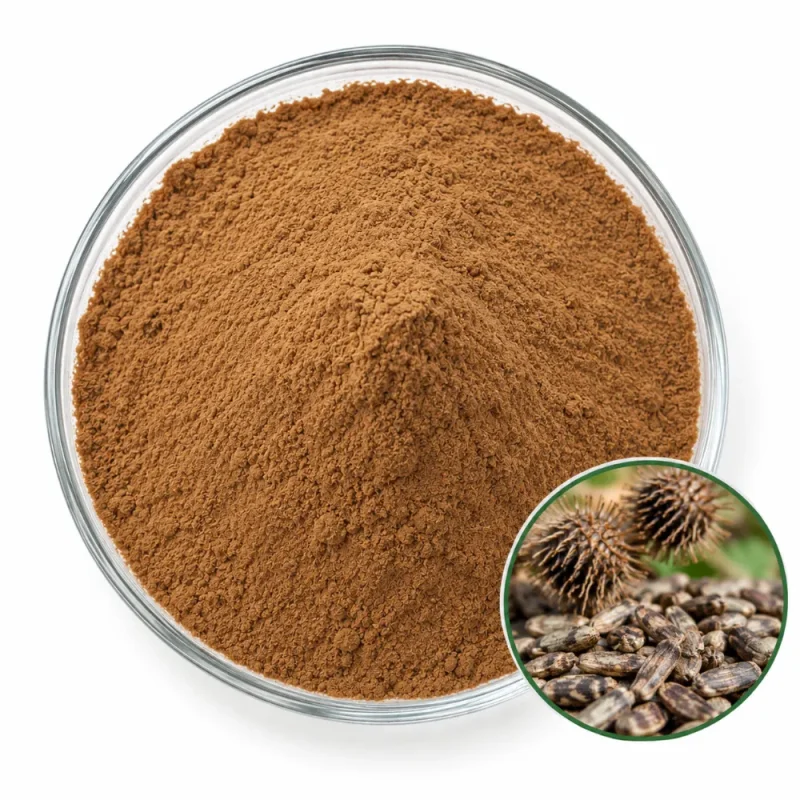
Burdock Seed Extract 10–40% Arctiin

Burdock seed extract is prepared from the ripe fruits, commonly called seeds, of Arctium lappa, the greater burdock, which are the niu bang zi of Chinese herbal practice, and not from the burdock root eaten as a vegetable or from the burs of cocklebur. Ethanol extraction concentrates the lignan glycoside arctiin, and the liquor is dried to a light brown powder.

The primary grade is 40% arctiin by HPLC, with 10% as the lower end of the range. The powder is 80 mesh and slightly soluble in water. The 40% grade serves capsules and tablets with a small fill weight, while the 10% grade suits dry blends that keep more of the seed matrix and its fatty oil.

Arctiin Standardization & Grades

Arctiin is the glucoside of arctigenin, a dibenzylbutyrolactone lignan, and it is the dominant bioactive compound of burdock seed. The grade is defined by arctiin because it is abundant, stable in the dry state and resolved cleanly by HPLC. The seed also contains the aglycone arctigenin, other lignans such as matairesinol and lappaol, and a large amount of fatty oil. The botanical entity is Arctium lappa L., and the part used is the seed.

GradeAssay & MethodWhere It Fits
10% ArctiinHPLCDry blends keeping the seed matrix
40% ArctiinHPLCCapsules and tablets with small fill

Grade choice follows dose, fill weight and the amount of seed oil and protein a formula should carry. The 40% grade carries four times the arctiin load per gram of the 10% grade, so a capsule reaches its target in a smaller fill, and the powder is paler and drier. The 10% grade retains more of the fatty oil and protein and is darker, oilier and more prone to oxidation. Siblings from the same seed are the unstandardized Burdock Seed Extract Powder, the milled Burdock Seed Powder and the purified aglycone Arctigenin 98%.

Seed and root are two separate burdock raw materials. The root is rich in inulin-type fructans and caffeoylquinic acids and contains almost no arctiin, whereas the seed is rich in lignans and oil. Buyers who compare burdock extract quotes should check the part before anything else, since an arctiin figure belongs only to the seed.

The difference between arctiin and arctigenin is a matter of the sugar. Arctiin is the glucoside and arctigenin the aglycone obtained when an enzyme or acid removes the glucose, and the two have different solubility, taste and handling. A formulator needing the aglycone should consider the purified compound, not this grade.

Arctiin Analysis & Purity Risks

Both grades are measured by HPLC, which separates arctiin from arctigenin, matairesinol and the other lignans on a reversed-phase column, identifies each peak by retention time and UV spectrum and quantifies arctiin against a reference standard. A UV total lignan or phenol reading counts all absorbing compounds and is not comparable with the HPLC value for arctiin.

The fingerprint of the seed extract has arctiin as the largest peak, arctigenin as a smaller later-eluting peak and several minor lignans around them. Glucosidases in the seed hydrolyze arctiin to arctigenin when the crushed seed is moist or fermented, so a lot with a large arctigenin peak and a reduced arctiin peak has seen enzymatic action or acid. The ratio of the two peaks therefore reveals handling.

The sample is taken up in methanol or ethanol, sonicated and filtered. Because the seed contains a large amount of fatty oil, a defatting step with a nonpolar solvent improves the baseline and column life, and a sample that was not cleaned can foul the column and give unstable retention times.

Purity risks follow from the botany. Arctium minus and Arctium tomentosum are related burdocks that are also called burdock, and the spiny burs of cocklebur (Xanthium) look similar to burdock fruits in the trade. A named species, the seed as the stated part and an arctiin-led fingerprint protect identity better than a percentage.

Typical Specifications

Specification ItemProduct Information
Latin NameArctium lappa
Plant PartSeed & Grain
ProcessingEthanol Extraction
Compound ClassLignans, Polyphenols
Common NameBurdock Seed, Greater Burdock, Niu Bang Zi
Ingredient TypeStandardized Extract
Marker Compound(s)Arctiin (lignan glucoside of Arctium lappa seed)
Primary Grade40% Arctiin (HPLC)
Available Grades10% · 40% Arctiin (HPLC)
AppearanceLight Brown powder
Solubility / DispersibilitySlightly Soluble in Water
Quality Parameters
Moisture (LOD)≤5.0%
Total Ash≤5.0%
Particle Size80 mesh
Heavy MetalsLead ≤2 ppm · Arsenic ≤1 ppm · Cadmium ≤1 ppm · Mercury ≤0.1 ppm
MicrobiologyTPC ≤1,000 cfu/g · Yeast & Mold ≤100 cfu/g · E. coli Negative · Salmonella Negative/25 g
Shelf Life24 months in unopened original packaging, cool and dry storage

Applications by Grade

40% Grade for Compact Capsules

The 40% grade delivers an arctiin target in a small capsule fill. The light brown powder is fine and slightly cohesive, so a flow agent helps the hopper feed evenly, and capsule weights should be checked at the start of each run and again after any pause.

40% Grade in Tablet Blends

Tablets of the high grade need a dry binder and an absorbent, since residual seed oil softens compacts and sticks to punches. Keep lubricant levels modest, run a compression trial on the full blend and check hardness after storage.

10% Grade for Dry Herbal Compounds

At 10% the extract is dosed by weight in dry herbal compounds, where the seed’s nutty, bitter character sits beside other seed and root powders. Pre-mix it with a bulking agent, because the oily powder lumps, and store blends cool.

10% Grade for Powder Sticks

Sticks carry the lower grade with a flavor and sweetener base. The powder is slightly soluble, so it forms a tan haze, and a citrus or honey flavor covers the bitter, oily edge. Recommend stirring in warm water to disperse the lignan glycoside.

40% Grade in Oil-Based Softgels

Lignans dissolve better in oil than in water, so softgel fills disperse the 40% grade in a carrier oil. Mill the powder fine and stir during encapsulation, since insoluble particles settle in the feed line and change the content between capsules.

Technical & Quality Considerations

The extract is a light brown powder with a mild nutty odor and a bitter taste. It is slightly soluble in water, so a solution looks cloudy and tan, and arctiin dissolves better in warm water and in alcohol than in cold water. The residual seed oil of the lower grade can rise as a faint film on a drink, which suits shake-before-use formats.

Arctiin is stable in dry form, but acid and enzymes remove the glucose and leave arctigenin, which changes solubility and taste. Residual seed lipids oxidize in air and light, so protect the powder from both and keep it cool. At production scale, screen the burdock seed extract before dosing and pre-mix it with a portion of the carrier, since the oily powder can lump.

Judge each lot against a retained sample for color, smell and flow. A rancid or sharp odor points to oxidation of the seed oil and should be checked before release. Keep the drum closed, cool and dry, record the date it was opened and clean equipment with warm detergent, because oily residues do not rinse off with cold water.

A burdock seed extract is checked by odor, taste and the arctiin to arctigenin ratio. A mild nutty smell is typical, and a rancid note shows oxidized seed oil. Keep a retained sample of each burdock seed extract lot, and compare the arctiin peak with its aglycone arctigenin in later lots, since a rising arctigenin peak shows that enzymes or acid removed the sugar.

Packaging & Commercial Supply

Essencefield supports product evaluation, formulation trials, commercial orders, and ongoing ingredient supply. Packaging, storage, and shipping arrangements are determined by product characteristics, order quantity, stability requirements, and destination-market needs.

Supply ItemGeneral Information
SampleAvailable upon request for formulation, testing, and supplier evaluation
Order Quantities100 g · 1 kg · 5 kg · 25 kg · 100 kg · 500 kg · Bulk
Sample Lead TimeTypically 5–7 days after sample confirmation
Production Lead TimeTypically 15–30 days after order and specification confirmation
PackagingSuitable protective inner packaging with bags, cartons, drums, or other appropriate outer packaging
StorageStore in tightly sealed, suitable protective packaging in a cool, dry environment. Protect from moisture, heat, and direct sunlight. Specific storage conditions follow the approved product specification.
DocumentationCOA · Product Specification · TDS · SDS · Applicable declarations (as applicable)

Final order quantities, lead times, packaging, documentation, and shipping arrangements are confirmed according to the selected product and commercial requirements.

Request Ingredient Specifications & Quote

Share your target specification, application, quantity, and documentation needs. We’ll help confirm suitable options, samples, and commercial supply details.