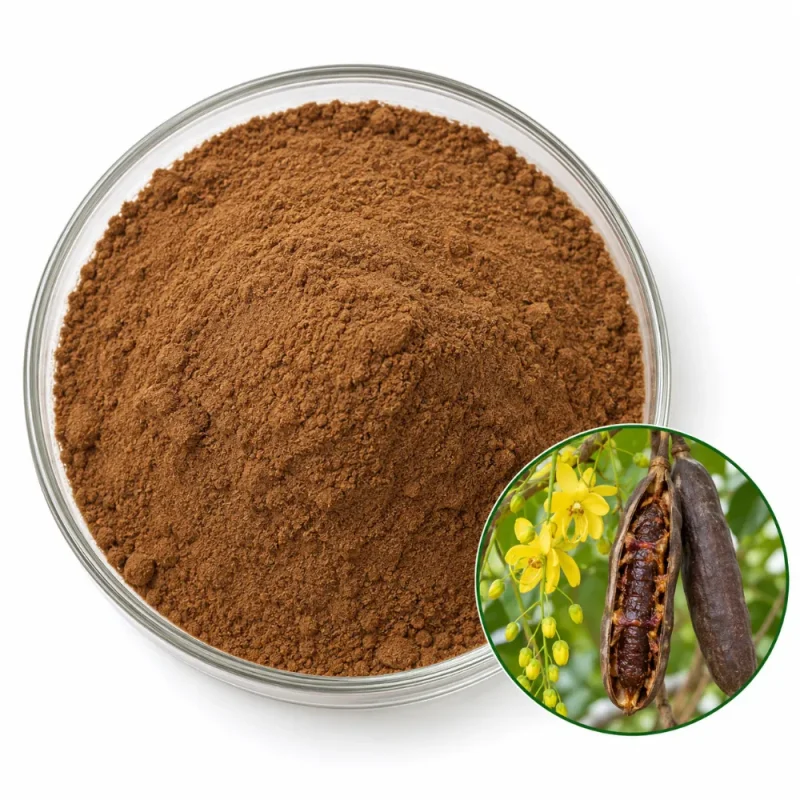
Cassia fistula Extract 5–10% Mucilage

Cassia fistula extract starts from the fruit of Cassia fistula, the golden shower tree, which forms long dark pods whose pulp lies between the seeds. Water extraction takes up the soluble mucilage and sugars of that pulp, and the liquor is dried to a light brown, water-dispersible powder.

The mucilage content is a gravimetric class figure with no named method, with a primary grade of 10% and a lower grade of 5%. The powder is 80 mesh. The 10% grade serves viscous drink powders and capsule blends, while the 5% grade serves bars and premixes in which the pulp matrix is the main body.

Mucilage Standardization & Grades

Mucilage here means the water-swellable polysaccharide fraction of the pod pulp, a mix of galactose, arabinose and uronic-acid-containing polymers that hydrates into a viscous gel. The botanical entity is Cassia fistula L. The extract is standardized to this fraction because it is the functional, physical property of the pulp. The sugars and polyphenols that come with it are not stated as markers.

GradeAssay & MethodWhere It Fits
5% MucilageClass figure, no named methodBars and powder premixes
10% MucilageClass figure, no named methodViscous drink powders, capsule blends

Grade choice follows body and dispersibility. The 10% grade builds more viscosity per gram in a drink, while the 5% grade is a looser, less sticky solid that is easier to blend dry. Cassia fistula is also supplied as a 10:1 ratio extract with no marker figure, the Cassia fistula Extract Powder. The standardized extract is the row to use when a mucilage figure has to appear in the specification of a Cassia fistula extract.

Mucilage Analysis & Purity Risks

No single-compound assay applies to mucilage, because the fraction is a heterogeneous polysaccharide mixture and not one molecule. The figure is therefore a class value defined by a fractionation step, in which the water-soluble polysaccharide is precipitated, usually by adding alcohol, and then dried and weighed. The number depends on the precipitation conditions, so it is comparable only with another figure from the same procedure, and it cannot be turned into an HPLC or UV equivalent.

Identity is supported by sugar-composition analysis and by the viscosity behavior of a hydrated sample. A chromatographic profile of the monosaccharides released after hydrolysis shows the galactose-to-arabinose pattern of the pulp, and a rheology check shows whether a hydrated solution is shear-thinning as expected.

Purity risks follow from the material class. The pulp is confused with the leaf, bark and seed of the same tree and with the pods of other Cassia and Senna species, whose anthraquinone-type constituents differ. Because the fruit pulp also carries sugars and tannin-type phenolics, a high gravimetric figure can include non-mucilage polysaccharide, so the stated part and the fractionation method matter more than the percentage alone. Pods are also sticky, and poorly dried pulp invites mold, which is why moisture is controlled tightly.

Pulp handling shapes the result before any laboratory step. The pods are split and the black pulp is scraped from between the seeds. Seed fragments, pod wall and fiber can end up in the feed if separation is incomplete, and each of them changes the polysaccharide balance of the final Cassia fistula extract. Soaking time, extraction temperature and concentration also decide how much mucilage stays intact. Long, hot extraction shortens the chains and lowers the body they give in a drink.

Typical Specifications

Specification ItemProduct Information
Latin NameCassia fistula
Plant PartFruit & Berry
ProcessingWater Extraction
Common NameCassia Fistula, Golden Shower Tree, Indian Laburnum
Ingredient TypeStandardized Extract
Marker Compound(s)Mucilage (water-swellable polysaccharide fraction of the pod pulp)
Primary Grade10% Mucilage
Available Grades5% · 10% Mucilage
AppearanceLight Brown powder
Solubility / DispersibilityWater Dispersible
Quality Parameters
Moisture (LOD)≤5.0%
Total Ash≤5.0%
Particle Size80 mesh
Heavy MetalsLead ≤2 ppm · Arsenic ≤1 ppm · Cadmium ≤1 ppm · Mercury ≤0.1 ppm
MicrobiologyTPC ≤1,000 cfu/g · Yeast & Mold ≤100 cfu/g · E. coli Negative · Salmonella Negative/25 g
Shelf Life24 months in unopened original packaging, cool and dry storage

Applications by Grade

10% Grade in Viscous Drink Powders

The 10% grade builds body in a stirred drink because the mucilage hydrates into a gel. Disperse it into a dry sugar or a dry thickener first, then pour into cold water while stirring, or lumps form at the surface.

5% Grade in Bar Premixes

In bars the 5% grade acts as a binding, slightly sticky component that holds dry particles together. Blend it into the dry fraction before the syrup is added, and test chew and moisture pickup after storage.

10% Grade in Capsule Blends

The 10% grade swells on contact with water, so a capsule blend is built with a dry flow agent and a moisture-tight pack. Check disintegration and dissolution after storage, because the swelling polymer can slow shell breakdown.

5% Grade in Sachet Premixes

Sachets of the 5% grade carry the extract at a higher gram weight, diluted with a bulking carrier. The label should call for stirring into water, because the powder disperses rather than dissolves and settles if left standing.

10% Grade for Gummy Bases

Gummies can take the 10% grade as a partial texturizer. The mucilage adds chew and raises viscosity of the cooked base, so adjust the gelling agent downward and trial small casts before scaling. Watch for stickiness in the depositor.

5% Grade in Instant Drink Mixes

Instant mixes use the 5% grade for gentle body without a heavy gel. It disperses best when pre-blended with sugar or maltodextrin, and the finished sachet should be tested for clumping after storage in humid conditions.

Technical & Quality Considerations

Cassia fistula extract is a light brown, fine powder with a mild, sweet, fruit-like odor. It is dispersible in water, forming a slightly viscous, brown, hazy dispersion rather than a clear solution, and the viscosity rises with concentration and falls on prolonged heating or at low pH, where the polysaccharide chains hydrolyze. Hot water speeds hydration but makes lumps form more readily, so a cool or room-temperature dispersion with stirring gives a more even gel.

For scale-up, premix the powder with sugar or another dry diluent in a ratio near one to five, and add it through a vortex or an in-line inductor in liquid lines. The fine powder dusts and cakes in humid air because the polysaccharide absorbs water quickly, so use sealed drums, desiccant liners and a dry packing room. High-shear mixers can shear the polymer and reduce body, which is why low-shear mixing is preferred.

Hydrated mucilage supports microbial growth, so aqueous intermediates should be used within a defined hold time or protected by pH and water activity. Compare each lot with a retained sample for viscosity under a standard test, color and flow before release.

Taste and color also deserve a trial. The pulp carries sugars and tannin-type phenolics, so the dispersion has a mild sweetness with a slightly astringent finish. The brown color deepens when the dispersion is heated with protein, through Maillard browning. In dairy-based or plant-protein drinks the mucilage can also interact with proteins and change body, so a small pilot batch at the target pH should come before scale-up. Cool, dry storage in sealed drums keeps the powder free-flowing.

Packaging & Commercial Supply

Essencefield supports product evaluation, formulation trials, commercial orders, and ongoing ingredient supply. Packaging, storage, and shipping arrangements are determined by product characteristics, order quantity, stability requirements, and destination-market needs.

Supply ItemGeneral Information
SampleAvailable upon request for formulation, testing, and supplier evaluation
Order Quantities100 g · 1 kg · 5 kg · 25 kg · 100 kg · 500 kg · Bulk
Sample Lead TimeTypically 5–7 days after sample confirmation
Production Lead TimeTypically 15–30 days after order and specification confirmation
PackagingSuitable protective inner packaging with bags, cartons, drums, or other appropriate outer packaging
StorageStore in tightly sealed, suitable protective packaging in a cool, dry environment. Protect from moisture, heat, and direct sunlight. Specific storage conditions follow the approved product specification.
DocumentationCOA · Product Specification · TDS · SDS · Applicable declarations (as applicable)

Final order quantities, lead times, packaging, documentation, and shipping arrangements are confirmed according to the selected product and commercial requirements.

Request Ingredient Specifications & Quote

Share your target specification, application, quantity, and documentation needs. We’ll help confirm suitable options, samples, and commercial supply details.