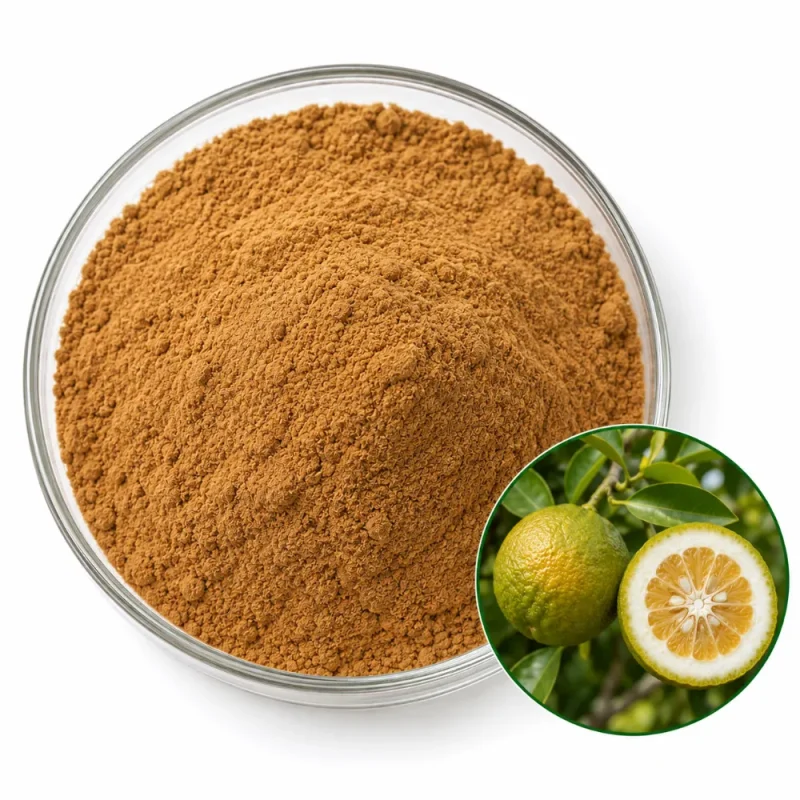
Citrus aurantium Extract 6–30% Synephrine

The fruit of Citrus aurantium, the bitter orange, is the only part used in this extract, and the leaf, flower and root are excluded. Ethanol extraction takes up the protoalkaloid synephrine together with the citrus flavanone glycosides, and the concentrate is dried to a light yellow powder.

Synephrine is measured by HPLC, with a primary grade of 30% and a lower grade of 6%. The powder is 80 mesh and slightly soluble in water. The 30% grade fits capsules and tablets that need a small fill, while the 6% grade suits blends in which the citrus matrix is wanted at higher inclusion.

Synephrine Standardization & Grades

Synephrine is a phenylethanolamine protoalkaloid, and in bitter orange it occurs almost entirely as the para isomer, p-synephrine. It is accompanied in small amounts by octopamine, tyramine, N-methyltyramine and hordenine. The botanical entity is Citrus × aurantium L., and the Citrus aurantium extract is standardized to synephrine because it is the defining alkaloid of the fruit and because HPLC resolves it cleanly from the flavanone glycosides, the limonoids and the sugars of the extract.

GradeAssay & MethodWhere It Fits
6% SynephrineHPLCBlends with higher inclusion rates
30% SynephrineHPLCCapsules and tablets, small fill weight

Grade choice for Citrus aurantium extract follows dose and fill weight. The 30% grade carries five times the synephrine of the 6% grade per gram, so a capsule reaches its target in a compact fill, while the 6% grade is bulkier and keeps more of the fruit’s flavanone matrix. Bitter orange is also supplied as a 10:1 ratio extract with no marker figure, the Bitter Orange Extract Powder, and the related citrus flavonoids are available as the single compounds Diosmin 98% and Diosmetin 98%. Synephrine content is restricted or controlled for some uses in some regions, so the grade and the label wording of a finished product are matters for regulatory review before launch.

Synephrine Analysis & Purity Risks

HPLC separates synephrine from the other amines of the fruit on a reversed-phase or ion-pair system and quantifies it against a reference standard, with UV detection at a low wavelength. The result is p-synephrine specifically. A UV reading would count other phenolic amines and flavonoids, and neither a gravimetric alkaloid total nor a UV figure can be converted into the HPLC value.

The isomer matters. M-synephrine, also called phenylephrine, is a different compound with a different pharmacological profile, and bitter orange is known to contain the para form with at most trace amounts of the meta form. A method that separates the isomers is part of a sound identity statement, and a peak at the phenylephrine position would be a reason to question the material.

For identity, the fingerprint of the fruit is read beside synephrine. Hesperidin, naringin, neohesperidin and poncirin form the flavanone cluster, and these companions separate bitter orange from sweet orange, where the amine pattern and the flavanone balance differ. The bioflavonoid-rich grades are a separate product type.

Purity risks follow from the botanical group. Bitter orange is easily confused with sweet orange and with other citrus fruits by name, and synthetic synephrine can be blended into a natural extract to lift a figure. Isotope testing and the companion flavanone pattern are two ways to check origin, and the stated part, the species and the isomer matter more than one percentage.

Sample preparation needs an acidic, polar extraction that keeps the amines dissolved, followed by filtration of the viscous citrus matrix. Detection is sensitive, so the powder is diluted into the working range of the curve.

Fruit stage is a further variable. Bitter orange is often collected young, when the fruit is small and green, and cut into slices before drying, because the amine content of the fruit is highest at that stage and falls as it ripens. A Citrus aurantium extract made from fully ripe fruit therefore reaches a lower synephrine figure from the same weight of raw material, and the flavanone balance shifts as well. Drying temperature after harvest matters too, since slow drying in humid air allows enzymatic and microbial loss of the amines.

Typical Specifications

Specification ItemProduct Information
Latin NameCitrus aurantium
Plant PartFruit & Berry
ProcessingEthanol Extraction
Compound ClassAlkaloids
Common NameBitter Orange, Seville Orange
Ingredient TypeStandardized Extract
Marker Compound(s)p-Synephrine
Primary Grade30% Synephrine (HPLC)
Available Grades6% · 30% Synephrine (HPLC)
AppearanceLight Yellow powder
Solubility / DispersibilitySlightly Soluble in Water
Quality Parameters
Moisture (LOD)≤5.0%
Total Ash≤5.0%
Particle Size80 mesh
Heavy MetalsLead ≤2 ppm · Arsenic ≤1 ppm · Cadmium ≤1 ppm · Mercury ≤0.1 ppm
MicrobiologyTPC ≤1,000 cfu/g · Yeast & Mold ≤100 cfu/g · E. coli Negative · Salmonella Negative/25 g
Shelf Life24 months in unopened original packaging, cool and dry storage

Applications by Grade

30% Grade for Compact Capsules

The 30% grade of Citrus aurantium extract reaches a synephrine target in a small fill, which suits compact capsules. The powder is hygroscopic and sticky, so fill in a dry room, add a flow agent and seal the capsules in a desiccated bottle.

6% Grade in Powder Blends

The 6% grade of Citrus aurantium extract is bulky enough to carry in powder blends at a practical gram weight. Add it in stages to a free-flowing carrier, since the sticky citrus matrix can form lumps that segregate in a large blender.

30% Grade in Tablet Blends

Tablets of the 30% grade need a dry binder and a glidant, because the hygroscopic powder softens in humid air. A film coat limits moisture pickup and covers the bitter taste, and hardness should be checked after storage.

6% Grade in Stick-Pack Drink Powders

Stick packs of the 6% grade give a pale yellow, bitter-citrus cup. Sweetener and acid systems with orange or grapefruit notes cover the bitterness, and a foil laminate with low moisture transmission keeps the Citrus aurantium powder free-flowing.

30% Grade in Sachet Dilutions

Sachets of the 30% grade call for stepwise dilution with a bulking carrier so that the filler can weigh an accurate dose. Check the dilution uniformity on a test batch, since small amounts of a concentrated alkaloid segregate easily.

6% Grade for Contract Blending

Contract blenders use the 6% grade in multi-ingredient powders where the citrus flavanones are wanted. The yellow powder tints pale blends and carries a bitter note, so schedule it after dark products and clean the line before a pale run.

Technical & Quality Considerations

The extract is a light yellow powder with a bitter citrus-peel odor. It is slightly soluble in water, so a solution turns hazy pale yellow, with part of the synephrine salt dissolved and the flavanones largely in suspension. Synephrine itself is a water-soluble amine, and it dissolves better at acidic pH where it is protonated.

Synephrine is reasonably stable to heat and light, while the phenolic hydroxyl makes it sensitive to oxidation at high pH and in the presence of iron or copper. Alkaline mineral premixes can brown the powder. The flavanone glycosides, especially hesperidin and naringin, crystallize slowly from supersaturated solutions, so clear beverages with a high inclusion rate can form a fine haze or sediment during shelf life.

At scale, the bitter orange powder is sieved, premixed with part of the carrier and checked by weighing the first fills. Keep drums sealed with a desiccant and store cool, away from direct light. Because the powder is sticky, cleaning intervals on sieves and hoppers should be shorter than for dry plant powders, and dust collection should be set to prevent a film from forming on filters.

Taste and color deserve a short trial in any liquid format. Citrus aurantium extract is distinctly bitter, because limonoids and flavanone glycosides add to the bitterness of the amines, and a sweetener alone does not cover it. Acid, citrus oils and a small share of salt are the usual tools. The pale yellow tone intensifies at higher pH, so a neutral beverage looks more golden than an acidic one, and light-protective packaging keeps the tone steady through shelf life.

Packaging & Commercial Supply

Essencefield supports product evaluation, formulation trials, commercial orders, and ongoing ingredient supply. Packaging, storage, and shipping arrangements are determined by product characteristics, order quantity, stability requirements, and destination-market needs.

Supply ItemGeneral Information
SampleAvailable upon request for formulation, testing, and supplier evaluation
Order Quantities100 g · 1 kg · 5 kg · 25 kg · 100 kg · 500 kg · Bulk
Sample Lead TimeTypically 5–7 days after sample confirmation
Production Lead TimeTypically 15–30 days after order and specification confirmation
PackagingSuitable protective inner packaging with bags, cartons, drums, or other appropriate outer packaging
StorageStore in tightly sealed, suitable protective packaging in a cool, dry environment. Protect from moisture, heat, and direct sunlight. Specific storage conditions follow the approved product specification.
DocumentationCOA · Product Specification · TDS · SDS · Applicable declarations (as applicable)

Final order quantities, lead times, packaging, documentation, and shipping arrangements are confirmed according to the selected product and commercial requirements.

Request Ingredient Specifications & Quote

Share your target specification, application, quantity, and documentation needs. We’ll help confirm suitable options, samples, and commercial supply details.