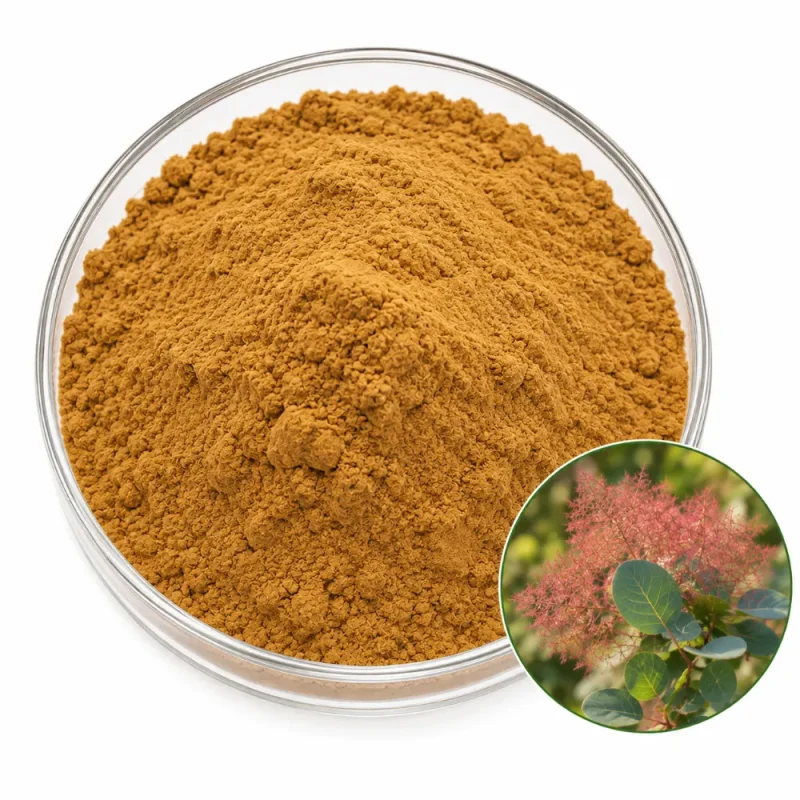
Cotinus coggygria Extract 1–50% Fisetin-type

The heartwood of Cotinus coggygria, the smoke tree, is the only part used in this extract, and the leaf, flower and the plumed fruit stalks are excluded. Ethanol extraction takes up the flavonoids of the wood, chiefly fisetin and its relatives, and the concentrate is dried to a light brown powder.

Fisetin is measured by HPLC, with a primary grade of 50% and a lower grade of 1%. The powder is 80 mesh and insoluble in water. The 50% grade fits capsules and tablets that need a small fill, while the 1% grade fits blends and carrier-based fills in which the wood matrix is wanted at higher inclusion.

Fisetin Standardization & Grades

Fisetin is a flavonol, 3,3′,4′,7-tetrahydroxyflavone, and it is the defining compound of Cotinus wood, the material long used as the dye known as young fustic. The wood also carries fustin, butin and sulfuretin, a group of related flavanonols and aurones that give the fisetin-type profile. The botanical entity is Cotinus coggygria Scop., and the extract is standardized to fisetin because it is the single, measurable compound that separates this wood from other woody flavonoid sources.

GradeAssay & MethodWhere It Fits
1% FisetinHPLCBlends and carrier-based fills, higher inclusion
50% FisetinHPLCCapsules and tablets, small fill weight

Grade choice follows dose and fill weight. The 50% grade carries fifty times the fisetin of the 1% grade per gram, so a capsule reaches its target with a fraction of the powder, while the 1% grade is a bulky, wood-like solid that behaves more like a milled botanical. Cotinus is also supplied as a 10:1 ratio extract without a marker figure, the Cotinus Coggygria Extract Powder, and as a single compound, Fisetin 98%. The standardized extract is the row to use when a fisetin figure has to appear in the specification of the Cotinus coggygria extract.

Fisetin Analysis & Purity Risks

HPLC separates fisetin from its relatives on a reversed-phase column and quantifies the peak against a reference standard, with UV detection at a wavelength where the flavonol absorbs strongly. The result is fisetin specifically. A UV flavonoid total would count the other phenolics of the wood, and neither a UV figure nor a gravimetric figure can be converted into the HPLC value. The label fisetin-type refers to the profile that fisetin leads, not to a total.

For identity, the fingerprint of the wood is read beside fisetin. Fustin, sulfuretin and butin appear as neighboring peaks, and the pattern is characteristic of Cotinus wood. Because fisetin is a catechol-type flavonol, the chromatogram also shows oxidation products if the sample has been stored in air, which is a quality signal of its own.

Purity risks follow from the botanical group. Fisetin occurs in several plants, among them the lacquer tree and the sumacs, and Cotinus belongs to the same family as those species. Some members of that family carry skin-sensitizing alkylphenols of the urushiol type, so a stated species and a stated wood part matter. Cotinus wood is also sold as a dye, and material intended for dyeing is not the same lot as one intended for ingredients.

Sample preparation uses a polar organic solvent that dissolves the flavonol, with an acidified mobile phase to keep peaks sharp. Samples are protected from light and injected promptly, because fisetin oxidizes in solution.

Raw material handling also matters. The wood is cut, chipped and dried before extraction, and the heartwood is the source of fisetin, while sapwood carries much less. Dust and bark residue from chipping add ash and non-target phenolics, which is why debarked heartwood gives a cleaner extract.

Typical Specifications

Specification ItemProduct Information
Latin NameCotinus coggygria
Plant PartBark & Stem
ProcessingEthanol Extraction
Compound ClassFlavonoids, Polyphenols
Common NameSmoke Tree, Young Fustic
Ingredient TypeStandardized Extract
Marker Compound(s)Fisetin
Primary Grade50% Fisetin (HPLC)
Available Grades1% · 50% Fisetin (HPLC)
AppearanceLight Brown powder
Solubility / DispersibilityInsoluble in Water
Quality Parameters
Moisture (LOD)≤5.0%
Total Ash≤5.0%
Particle Size80 mesh
Heavy MetalsLead ≤2 ppm · Arsenic ≤1 ppm · Cadmium ≤1 ppm · Mercury ≤0.1 ppm
MicrobiologyTPC ≤1,000 cfu/g · Yeast & Mold ≤100 cfu/g · E. coli Negative · Salmonella Negative/25 g
Shelf Life24 months in unopened original packaging, cool and dry storage

Applications by Grade

50% Grade for Compact Capsules

The 50% grade of Cotinus coggygria extract reaches a fisetin target in a very small fill, which suits compact capsules. The flavonol powder is fine and electrostatic, so a flow agent and an anti-static dosing path keep fill weights steady.

1% Grade in Carrier-Based Fills

The 1% grade is bulky enough to carry in blends and carrier-based fills at a practical gram weight. Mix it in stages with a free-flowing carrier, because a low-density wood powder segregates when it is dumped into a large blender at once.

50% Grade in Tablet Blends

Tablets of the 50% grade need a dry binder and a disintegrant, because flavonol-rich powders compact into hard tablets that dissolve slowly. A film coat limits dust, and disintegration should be checked after storage. Use a polished punch face, because the fine flavonol powder can film on tooling during long runs.

1% Grade in Sachet Premixes

Sachets of the 1% grade dilute the extract with a bulking carrier so the filler can weigh an accurate dose. The powder is insoluble, so the label should advise stirring, and a fine grind avoids visible specks in the cup.

50% Grade in Lipid-Based Fills

Where a liquid or semi-solid capsule is wanted, the 50% grade is dispersed in an oil or lecithin carrier. Mill it fine first, and keep the fill under gentle agitation during dispensing to avoid settling. Fisetin darkens in oils that contain peroxides, so choose a fresh, antioxidant-stabilized carrier.

1% Grade for Contract Blending

Contract blenders place the 1% grade in multi-ingredient powders where a wood-derived matrix is wanted. The yellow-brown dust tints pale blends, so schedule it after dark products and purge the line before a pale run.

Technical & Quality Considerations

Cotinus coggygria extract is a light brown to yellow-brown powder with a faint, woody odor. With no solubility in water, a liquid product of this extract relies on a suspension system or an oil carrier. Fisetin dissolves in ethanol and in lipid phases but hardly in water, which is why a lipid dispersion gives better uniformity than an aqueous mix.

Fisetin is sensitive to light, air and metal ions. The catechol group on the B ring oxidizes slowly and chelates iron and copper to form dark complexes, so contact with iron-containing minerals turns the powder gray to olive. Stainless contact surfaces, low-iron fillers and light-protective packaging limit the change, and a short stability trial with the intended excipients shows early whether a combination is sound.

Scale-up of Cotinus coggygria extract calls for a fine screen and a premix with part of the carrier. A drum that will be stored for months is better flushed with nitrogen and kept cool, because the flavonol oxidizes in air. The wood matrix absorbs water slowly, so a desiccant liner is useful in humid regions.

Dust control follows from the fine, tinting powder. Charge the extract through a closed system or under local extraction and wipe balances after each weighing, because the yellow-brown dust shows clearly on white surfaces and carries into adjacent runs.

Poor solubility is the central formulation constraint for Cotinus coggygria extract. Fisetin dissolves only slightly in water, so absorption from a plain powder depends on particle size and on the vehicle. Fine milling, a lecithin or surfactant wetting agent, and a lipid carrier all help in capsules, and a stabilizer such as gellan keeps the particles suspended in a drink. The 1% grade, with its wood matrix, wets more easily than the 50% grade, which tends to float.

Packaging & Commercial Supply

Essencefield supports product evaluation, formulation trials, commercial orders, and ongoing ingredient supply. Packaging, storage, and shipping arrangements are determined by product characteristics, order quantity, stability requirements, and destination-market needs.

Supply ItemGeneral Information
SampleAvailable upon request for formulation, testing, and supplier evaluation
Order Quantities100 g · 1 kg · 5 kg · 25 kg · 100 kg · 500 kg · Bulk
Sample Lead TimeTypically 5–7 days after sample confirmation
Production Lead TimeTypically 15–30 days after order and specification confirmation
PackagingSuitable protective inner packaging with bags, cartons, drums, or other appropriate outer packaging
StorageStore in tightly sealed, suitable protective packaging in a cool, dry environment. Protect from moisture, heat, and direct sunlight. Specific storage conditions follow the approved product specification.
DocumentationCOA · Product Specification · TDS · SDS · Applicable declarations (as applicable)

Final order quantities, lead times, packaging, documentation, and shipping arrangements are confirmed according to the selected product and commercial requirements.

Request Ingredient Specifications & Quote

Share your target specification, application, quantity, and documentation needs. We’ll help confirm suitable options, samples, and commercial supply details.