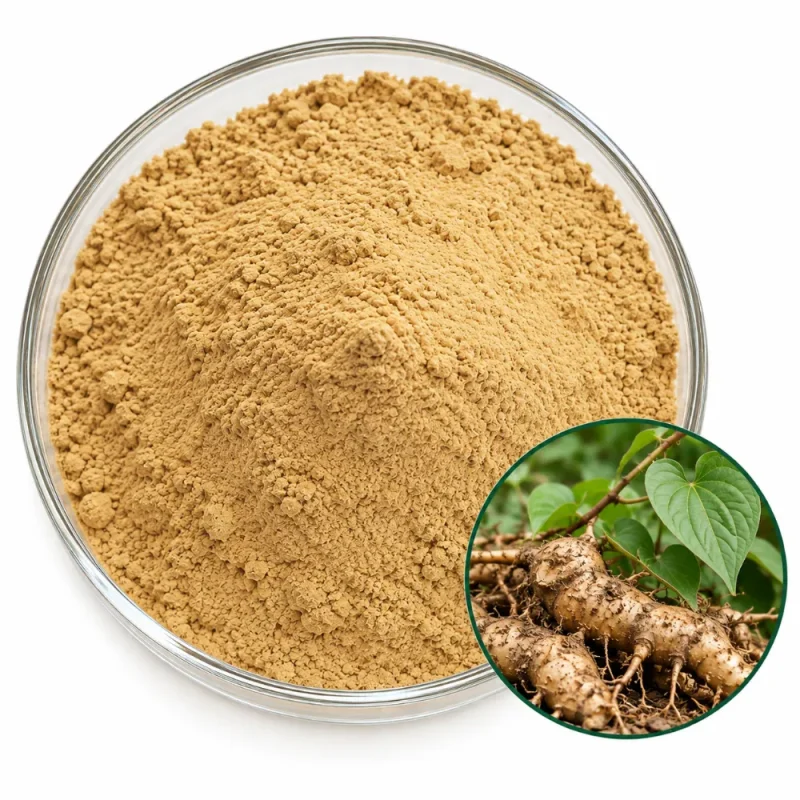
Dioscorea Nipponica Extract 20–80% Steroidal Saponins

The dried rhizome of Dioscorea nipponica, the Japanese mountain yam known in the Chinese trade as chuan shan long, is the only part used in this extract, and the leaf, vine and bulbils are excluded. Ethanol extraction takes up the steroidal saponins of the rhizome, and the concentrate is dried to a light brown powder.

Total steroidal saponins are measured by UV, with a primary grade of 80% and a lower grade of 20%. The powder is 80 mesh and water soluble. The 80% grade fits capsules and tablets that need a small fill, while the 20% grade fits drink powders and blends in which the rhizome matrix is wanted.

Steroidal Saponin Standardization & Grades

Steroidal saponins are glycosides of a spirostanol or furostanol aglycone, and in Dioscorea nipponica the aglycone is mainly diosgenin. Dioscin, gracillin and pseudoprotodioscin are the main glycosides, and a UV assay adds them into one number. The botanical entity is Dioscorea nipponica Makino, and the extract is standardized to this class because the saponins are the defining fraction of the rhizome and the ones that separate it from starchy edible yams.

GradeAssay & MethodWhere It Fits
20% Steroidal SaponinsUVDrink powders and blends, higher inclusion
80% Steroidal SaponinsUVCapsules and tablets, small fill weight

Grade choice follows dose and fill weight. The 80% grade carries four times the saponin load of the 20% grade per gram, so a capsule reaches its target with far less powder, while the 20% grade is bulkier, lighter in color and easier to dissolve in a beverage. There is also a 10:1 ratio extract of Dioscorea nipponica with no marker figure, the Dioscorea Nipponica Extract Powder. The data also records a 98% isolate, which belongs to the phytochemicals range. The standardized extract is the row to use when a saponin figure has to appear in the specification.

Steroidal Saponin Analysis & Purity Risks

A UV assay for steroidal saponins uses a color reaction, typically with vanillin and a strong acid, in which the spirostanol skeleton gives a red to purple product read at a fixed wavelength against a reference. The result is expressed as an equivalent of a reference saponin or of diosgenin, and the choice of reference moves the number. A UV total cannot be converted into an HPLC value for dioscin.

For identity, an HPLC fingerprint of the rhizome is read beside the total. Dioscin and gracillin are the characteristic peaks, and the data lists dioscin as the secondary marker, followed in the fingerprint without a figure here. Because saponins absorb weakly in the UV, detection is by evaporative light scattering or at a low wavelength, and the peak assignment is part of the method definition.

Purity risks follow from the botanical group. The genus holds hundreds of species, and several are traded as yam extracts, among them Dioscorea zingiberensis, grown as an industrial diosgenin source, Dioscorea villosa, the wild yam, and Dioscorea polystachya, the edible Chinese yam with few saponins. For that reason the stated species and the stated rhizome part belong to the identity. A high UV total can also include non-saponin material that reacts in the same assay, which is why the fingerprint matters as much as the percentage.

Sample preparation uses an alcoholic extraction and a reagent blank, because the acid reaction is sensitive to time and temperature. Timing the reaction exactly and reading within a fixed window keep results reproducible.

Raw material handling also matters. The rhizome is dug in autumn, washed, sliced and dried, and starch-rich tissue dilutes the saponin share. A well-dried slice is firm and brown, whereas a damp lot shows mold and a lower saponin content.

Typical Specifications

Specification ItemProduct Information
Latin NameDioscorea nipponica
Plant PartRoot & Rhizome
ProcessingEthanol Extraction
Compound ClassSaponins
Common NameJapanese Mountain Yam, Chuan Shan Long
Ingredient TypeStandardized Extract
Marker Compound(s)Total steroidal saponins (dioscin, gracillin)
Primary Grade80% Steroidal Saponins (UV)
Available Grades20% · 80% Steroidal Saponins (UV)
AppearanceLight Brown powder
Solubility / DispersibilityWater Soluble
Quality Parameters
Moisture (LOD)≤5.0%
Total Ash≤5.0%
Particle Size80 mesh
Heavy MetalsLead ≤2 ppm · Arsenic ≤1 ppm · Cadmium ≤1 ppm · Mercury ≤0.1 ppm
MicrobiologyTPC ≤1,000 cfu/g · Yeast & Mold ≤100 cfu/g · E. coli Negative · Salmonella Negative/25 g
Shelf Life24 months in unopened original packaging, cool and dry storage

Applications by Grade

80% Grade for Compact Capsules

The 80% grade of Dioscorea nipponica extract reaches a saponin target in a very small fill, which suits compact capsules. The powder is hygroscopic and foams on contact with water, so fill in a dry room and seal the capsules in a desiccated bottle.

20% Grade in Drink Powders

The 20% grade dissolves into a clear to slightly hazy brown cup, but the saponins make it foam when stirred or shaken. Stir gently, add an anti-foam such as a food-grade silicone emulsion if the line requires it, and choose a flavor that hides the faint bitterness.

80% Grade in Tablet Blends

Tablets of the 80% grade need a dry binder and a glidant, because saponin-rich powders are sticky and hygroscopic. A film coat limits moisture pickup and hides the bitter taste, and hardness should be rechecked after storage.

20% Grade in Stick-Pack Blends

Stick packs of the 20% grade carry the extract at a practical gram weight. The sugar and saponin content attracts water, so a foil laminate with low moisture transmission keeps the powder free-flowing through shelf life.

20% Grade in Bar Blends

In cold-pressed bars the 20% grade is blended into the dry fraction before the syrup is added. The mild, slightly bitter and earthy taste sits under cocoa, nut and date flavors, and the tan color is invisible in dark bases.

80% Grade in Stepwise Dilutions

Where a dose is small, the 80% grade is diluted in stages with a bulking carrier before it reaches the filler. Verify uniformity on a test batch, since a concentrated saponin at low inclusion segregates easily.

Technical & Quality Considerations

Dioscorea nipponica extract is a light brown powder with a faint, earthy odor and a slightly bitter, astringent taste. It is water soluble, giving a clear to slightly hazy brown solution that foams strongly when shaken, because saponins are natural surfactants. The foam is stable and slow to collapse, which affects mixing, filling and bottling.

Steroidal saponins are stable to moderate heat and to neutral pH, but they hydrolyze under strong acid, losing sugar units and finally releasing diosgenin, which is insoluble and precipitates. Acidic beverages held for a long time can therefore form a fine sediment. Saponins also bind cholesterol-like lipids and can interact with proteins and other surfactants in a formulation, changing foam and clarity.

Scale-up of the extract calls for an anti-foam strategy from the start: low-shear mixing, subsurface addition, deaeration before filling and, where allowed, a food-grade anti-foam. The powder absorbs water quickly and cakes in humid air, so use a dry room, sealed drums and desiccant liners, and store cool and dark.

A short compatibility trial with the other ingredients is worth running. Saponins lower surface tension and can change the dissolution profile of coated tablets and the stability of emulsions, so a pilot lot at the target pH and temperature shows early whether a combination is sound.

Packaging & Commercial Supply

Essencefield supports product evaluation, formulation trials, commercial orders, and ongoing ingredient supply. Packaging, storage, and shipping arrangements are determined by product characteristics, order quantity, stability requirements, and destination-market needs.

Supply ItemGeneral Information
SampleAvailable upon request for formulation, testing, and supplier evaluation
Order Quantities100 g · 1 kg · 5 kg · 25 kg · 100 kg · 500 kg · Bulk
Sample Lead TimeTypically 5–7 days after sample confirmation
Production Lead TimeTypically 15–30 days after order and specification confirmation
PackagingSuitable protective inner packaging with bags, cartons, drums, or other appropriate outer packaging
StorageStore in tightly sealed, suitable protective packaging in a cool, dry environment. Protect from moisture, heat, and direct sunlight. Specific storage conditions follow the approved product specification.
DocumentationCOA · Product Specification · TDS · SDS · Applicable declarations (as applicable)

Final order quantities, lead times, packaging, documentation, and shipping arrangements are confirmed according to the selected product and commercial requirements.

Request Ingredient Specifications & Quote

Share your target specification, application, quantity, and documentation needs. We’ll help confirm suitable options, samples, and commercial supply details.