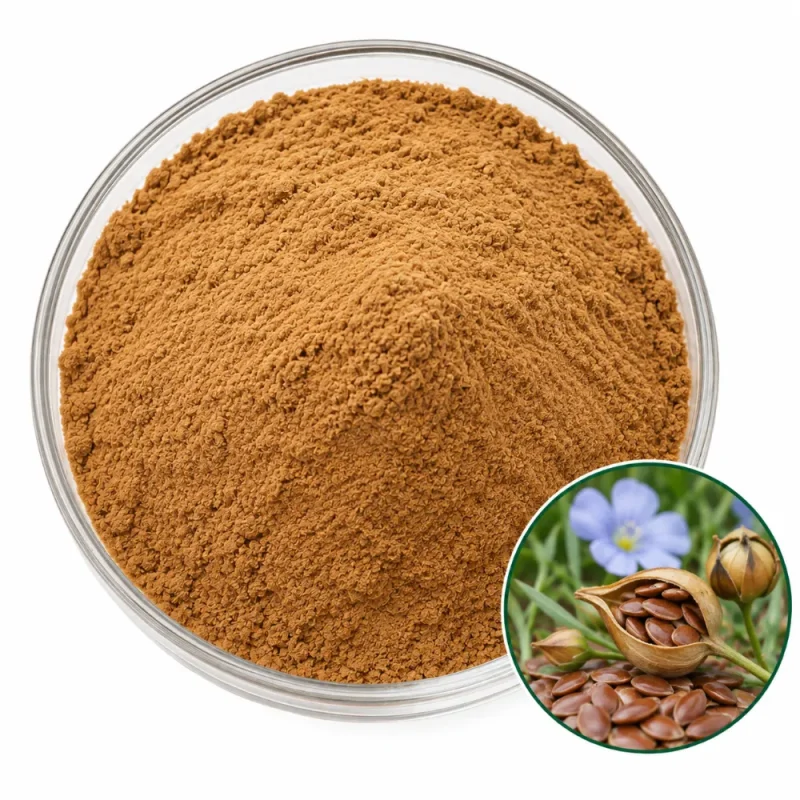
Flaxseed Extract 10–60% SDG Lignans

Flaxseed extract takes the seed of Linum usitatissimum, the common flax, as its only starting material, and the stem fiber and the pressed oil are not used. Ethanol extraction takes up the lignan macromolecule of the hull and cotyledon, and the concentrate is dried to a light yellow powder.

SDG lignans are measured by HPLC, with a primary grade of 60% and a lower grade of 10%. The powder is 80 mesh and water soluble. The 60% grade fits capsules and tablets that need a small fill, while the 10% grade fits drink powders and bar blends.

SDG Lignan Standardization & Grades

SDG is secoisolariciresinol diglucoside, the main lignan of flaxseed. In the seed it does not occur free: it is held in an ester-linked macromolecule with hydroxymethylglutaric acid and with ferulic and coumaric acid glycosides, and an alkaline hydrolysis step releases it for measurement. The botanical entity is Linum usitatissimum L., and the extract is standardized to SDG, with total lignans as the related basis, because SDG is the defining lignan of flax and the compound that HPLC measures cleanly after hydrolysis.

GradeAssay & MethodWhere It Fits
10% SDG LignansHPLCDrink powders and bar blends
60% SDG LignansHPLCCapsules and tablets, small fill weight

Grade choice follows dose and fill weight. The 60% grade carries six times the SDG of the 10% grade per gram, so a capsule reaches its target with a fraction of the powder, while the 10% grade is bulkier, lighter in flavor and easier to dissolve in a beverage. Flax is also supplied as a 10:1 ratio extract with no marker figure, the Flaxseed Extract Powder, as milled seed, the Flaxseed Powder, and as a single compound, Secoisolariciresinol Diglucoside (SDG) 95%. The standardized extract is the row to use when an SDG figure has to appear in the specification of the flaxseed extract.

SDG Lignan Analysis & Purity Risks

HPLC measures SDG after hydrolysis of the ester-linked macromolecule. The sample is treated with alkali to release the lignan, neutralized and injected, and the SDG peak is quantified against a reference standard, with UV detection at 280 nm. The result is SDG released by that hydrolysis. A figure on total lignans includes related compounds and is not the same number, and neither a UV nor a gravimetric figure can be converted into the HPLC value.

For identity, the fingerprint of the seed is read beside SDG. Secoisolariciresinol, the aglycone, and the ferulic and coumaric acid glycosides appear as neighbors, and the data lists a second basis, total lignans, in the fingerprint without a figure here. The ratio of SDG to the other lignans and phenolic acids shows whether the material is flaxseed hull-derived or a different seed.

Purity risks follow from the material class. Flaxseed lignans are concentrated in the hull, so extracts built on whole seed, on defatted meal and on hull fraction carry very different SDG levels. The stated part is therefore part of the identity. Flax is also a source of cyanogenic glycosides, linustatin and neolinustatin, in small amounts, and the extract is refined to reduce them, so a quality statement on cyanogenic glycosides belongs in a release specification when one is available.

Sample preparation depends on complete hydrolysis, which varies with alkali strength, temperature and time. An incomplete hydrolysis lowers the SDG figure, and an overlong one degrades the lignan, so the hydrolysis conditions are part of the method definition.

Raw material handling also matters. Seed is cleaned, dehulled or pressed to remove oil, and the oil-free meal or hull is the extraction feed. Residual oil lowers the extract’s flow and shelf life, and rancid oil gives off-flavors.

Typical Specifications

Specification ItemProduct Information
Latin NameLinum usitatissimum
Plant PartSeed & Grain
ProcessingEthanol Extraction
Compound ClassLignans, Polyphenols
Common NameFlaxseed, Common Flax, Linseed
Ingredient TypeStandardized Extract
Marker Compound(s)SDG (secoisolariciresinol diglucoside) lignans
Primary Grade60% SDG Lignans (HPLC)
Available Grades10% · 60% SDG Lignans (HPLC)
AppearanceLight Yellow powder
Solubility / DispersibilityWater Soluble
Quality Parameters
Moisture (LOD)≤5.0%
Total Ash≤5.0%
Particle Size80 mesh
Heavy MetalsLead ≤2 ppm · Arsenic ≤1 ppm · Cadmium ≤1 ppm · Mercury ≤0.1 ppm
MicrobiologyTPC ≤1,000 cfu/g · Yeast & Mold ≤100 cfu/g · E. coli Negative · Salmonella Negative/25 g
Shelf Life24 months in unopened original packaging, cool and dry storage

Applications by Grade

60% Grade for Compact Capsules

The 60% grade of flaxseed extract reaches an SDG target in a very small fill, which suits compact capsules. The powder is fine and hygroscopic, so fill in a dry room, use a flow agent and seal the capsules in a desiccated bottle.

10% Grade in Drink Powders

The 10% grade dissolves readily into a clear to slightly hazy pale-yellow cup with a mild, nutty-sweet taste. Oat, apple or vanilla bases suit it well, and cool water gives the cleanest dispersion in the cup.

60% Grade in Tablet Blends

Tablets of the 60% grade need a dry binder and a glidant, because the dense lignan powder compacts into hard, slow-dissolving tablets. A coat of film slows moisture pickup, and tablet hardness belongs in the storage test.

10% Grade in Bar Blends

In cold-pressed bars the 10% grade is blended into the dry fraction before the syrup is added. The nutty flavor of flax pairs naturally with seeds, oats and dates, and the pale yellow tone is hidden in most bar bases.

10% Grade in Stick-Pack Blends

Stick packs of the 10% grade carry the flaxseed extract at a practical gram weight per stick. The polar powder attracts water, so a foil laminate with low moisture transmission keeps it free-flowing through shelf life.

60% Grade in Stepwise Dilutions

Where a dose is small, the 60% grade is diluted in stages with a bulking carrier before it reaches the filler. A test batch shows whether the dilution is uniform, since a concentrated powder at low inclusion tends to separate.

Technical & Quality Considerations

Flaxseed extract is a light yellow powder with a faint, nutty odor and a mild, slightly bitter taste. It is water soluble, giving a clear to slightly hazy pale-yellow solution. SDG itself dissolves well in water because of its two sugar units, and the higher grades dissolve faster than the lower ones, which carry more mucilage and protein.

SDG is stable at neutral to mildly acidic pH and at moderate temperature, but the glycosidic bonds hydrolyze under strong acid and prolonged heat. The lower grade also carries flax mucilage, which thickens a solution and slows dissolution, and the small amount of residual lipid can oxidize and give a stale odor in warm storage. Low-oxygen packaging and cool storage keep the powder fresh.

Scale-up begins with a sieve and a premix with part of the carrier, then a weight check on the first fills. Because the polar powder is hygroscopic, run encapsulation and tableting in a controlled-humidity room, and keep drums sealed with a desiccant liner. A closed charging system limits the pale dust in the packing room.

Compatibility with the rest of the formula should be tried on a small scale. Mucilage in the lower grade can raise viscosity in drinks, and proteins may interact with the phenolic acids, so a pilot batch at the target pH and temperature shows early whether a combination is sound.

Packaging & Commercial Supply

Essencefield supports product evaluation, formulation trials, commercial orders, and ongoing ingredient supply. Packaging, storage, and shipping arrangements are determined by product characteristics, order quantity, stability requirements, and destination-market needs.

Supply ItemGeneral Information
SampleAvailable upon request for formulation, testing, and supplier evaluation
Order Quantities100 g · 1 kg · 5 kg · 25 kg · 100 kg · 500 kg · Bulk
Sample Lead TimeTypically 5–7 days after sample confirmation
Production Lead TimeTypically 15–30 days after order and specification confirmation
PackagingSuitable protective inner packaging with bags, cartons, drums, or other appropriate outer packaging
StorageStore in tightly sealed, suitable protective packaging in a cool, dry environment. Protect from moisture, heat, and direct sunlight. Specific storage conditions follow the approved product specification.
DocumentationCOA · Product Specification · TDS · SDS · Applicable declarations (as applicable)

Final order quantities, lead times, packaging, documentation, and shipping arrangements are confirmed according to the selected product and commercial requirements.

Request Ingredient Specifications & Quote

Share your target specification, application, quantity, and documentation needs. We’ll help confirm suitable options, samples, and commercial supply details.