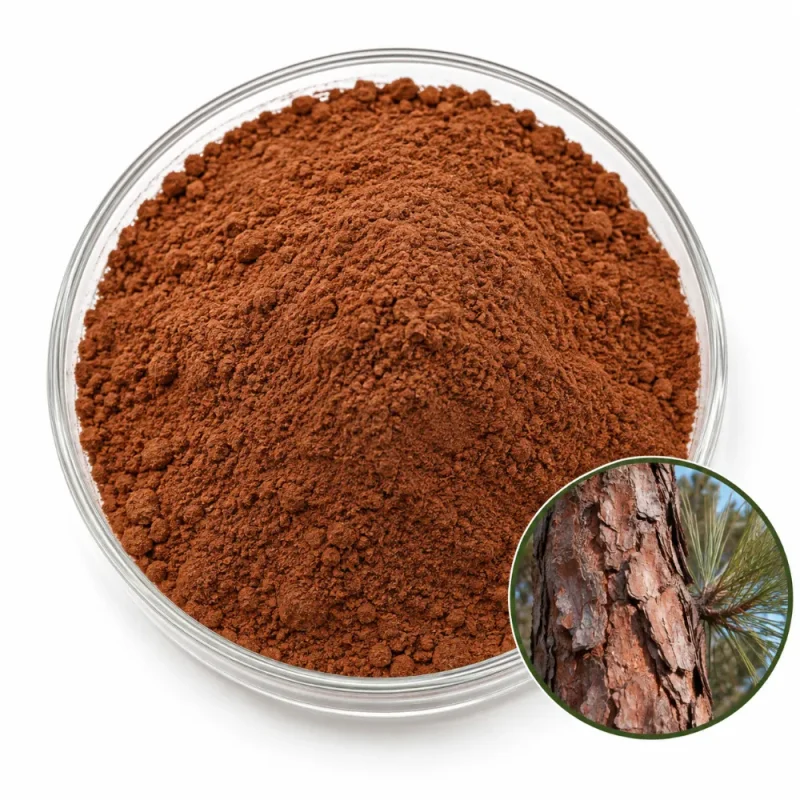
French Maritime Pine Bark Extract ≥65–95% Procyanidins/OPC

French maritime pine bark extract takes the bark of Pinus pinaster, the maritime pine, as its only starting material, and the needles, cones and wood are excluded. Maritime pine bark is stripped, cleaned and milled before ethanol extraction, which takes up the procyanidins and phenolic acids of the bark, and the concentrate is dried to a red-brown powder.

Procyanidins are measured by UV, with a primary grade of 95% and a lower grade of 65%. The powder is 80 mesh and slightly soluble in water. The 95% grade fits capsules and tablets that need a small fill, while the 65% grade fits drink powders and blends.

Procyanidin Standardization & Grades

Procyanidins, also called oligomeric proanthocyanidins or OPC, are chains of catechin and epicatechin units. In maritime pine bark the French maritime pine extract is rich in short procyanidin oligomers and contains monomeric catechin and taxifolin together with phenolic acids such as ferulic and caffeic acid. The botanical entity is Pinus pinaster Aiton, and the French maritime pine extract is standardized to procyanidins because they are the defining, measurable fraction of the bark and the basis on which pine bark ingredients are compared.

GradeAssay & MethodWhere It Fits
65% Procyanidins / OPCUVDrink powders and blends
95% Procyanidins / OPCUVCapsules and tablets, small fill weight

Grade choice follows dose and fill weight. The 95% grade carries about one and a half times the procyanidin load of the 65% grade per gram, so a capsule reaches its target with less powder, while the 65% grade is bulkier, lighter in color and carries more of the bark’s phenolic acids. Maritime pine is also supplied as a higher-purity standardized extract, Pine Bark Extract 95% OPC / Proanthocyanidins, and as a 10:1 ratio extract with no marker figure, the Pine Bark Extract Powder. The French maritime pine bark extract described here is the range grade from 65% to 95%, and the 95% single-grade product is the separate row.

Procyanidin Analysis & Purity Risks

A UV assay for procyanidins uses a color reaction, typically with butanol and acid, in which procyanidin chains cleave and form colored anthocyanidins read at a fixed wavelength against a reference. The result is an equivalent of a reference procyanidin or of cyanidin, and the choice of reference moves the number. An HPLC result counts individual monomers and short oligomers and is lower than a UV total on the same powder, so the two cannot be converted into each other.

For identity, an HPLC fingerprint of the bark is read beside the UV total. Catechin, procyanidin B1, taxifolin and the phenolic acids form the pattern that is characteristic of maritime pine bark, and the proportion of oligomers shows how the French maritime pine extract was prepared. Taxifolin is an especially useful identity marker, because it is a flavanonol that is rare in other bark extracts.

Purity risks follow from the botanical group and the method. Several pine barks are traded as pine bark extract, among them Pinus radiata, Pinus massoniana and Pinus sylvestris, and their procyanidin profiles differ. Grape seed and other sources of procyanidins are also sold under OPC names. The butanol-acid method reads any tannin that cleaves to an anthocyanidin, so a high UV figure does not by itself show that the material is OPC-rich bark. A named species, a stated bark part and a fingerprint protect identity better than one percentage does.

Sample preparation requires a controlled reaction time and temperature, and a reagent blank, because the color develops quickly and fades. Iron salts are often added to the reagent, so trace metals in the sample can change the response.

Raw material handling also matters. Bark is stripped from felled trees, cleaned of resin, wood and soil, and dried at moderate temperature, because heat and oxidation convert procyanidins to brown insoluble polymers. A well-dried bark gives a bright red-brown extract, and a poorly handled lot gives a dull, dark one.

Typical Specifications

Specification ItemProduct Information
Latin NamePinus pinaster
Plant PartBark & Stem
ProcessingEthanol Extraction
Compound ClassPolyphenols
Common NameMaritime Pine Bark, French Maritime Pine
Ingredient TypeStandardized Extract
Marker Compound(s)Procyanidins (oligomeric proanthocyanidins, OPC)
Primary Grade95% Procyanidins / OPC (UV)
Available Grades65% · 95% Procyanidins / OPC (UV)
AppearanceRed-Brown powder
Solubility / DispersibilitySlightly Soluble in Water
Quality Parameters
Moisture (LOD)≤5.0%
Total Ash≤5.0%
Particle Size80 mesh
Heavy MetalsLead ≤2 ppm · Arsenic ≤1 ppm · Cadmium ≤1 ppm · Mercury ≤0.1 ppm
MicrobiologyTPC ≤1,000 cfu/g · Yeast & Mold ≤100 cfu/g · E. coli Negative · Salmonella Negative/25 g
Shelf Life24 months in unopened original packaging, cool and dry storage

Applications by Grade

95% Grade for Compact Capsules

The 95% grade of French maritime pine bark extract reaches a procyanidin target in a small fill, which suits compact capsules. The red-brown powder is fine, tannic and hygroscopic, so fill in a dry room and seal the capsules in a desiccated bottle.

65% Grade in Drink Powders

The 65% grade is bulky enough to carry in stick-pack drink powders. It gives a red-brown, slightly hazy cup with an astringent, resinous taste, so berry, cola or spiced tea flavors help round it in a finished stick.

95% Grade in Tablet Blends

Tablets of the 95% grade need a dry binder and a glidant, because tannin-rich powders compact into dark, hard tablets. A film coat limits dust and covers the astringency, and hardness should be checked after storage.

65% Grade in Gummy Bases

Gummies take the 65% grade in dark berry or cola flavors that hide its color. Add the French maritime pine powder after the main cook, since long heating darkens it, and check that the tannin does not shorten the gel set.

65% Grade in Sachet Premixes

Sachets dilute the 65% grade with a bulking carrier so the filler can weigh an accurate dose. A foil laminate with low moisture transmission keeps the powder free-flowing, since tannin-rich extracts cake once they take up water.

95% Grade in Stepwise Dilutions

Where a dose is small, the 95% grade is diluted in stages with a bulking carrier before it reaches the filler. Verify uniformity on a test batch, because a concentrated tannin powder at low inclusion segregates easily.

Technical & Quality Considerations

French maritime pine bark extract is a red-brown powder with a faint, resinous odor and an astringent taste. It is slightly soluble in water, so a solution turns hazy red-brown, with the lower oligomers largely dissolved and the larger tannin polymers in suspension. Warm water improves dissolution, but a hot solution deepens in color as procyanidins oxidize.

Procyanidins are reactive. They oxidize in air, light and the presence of metal ions, forming darker, polymerized pigments, and they bind proteins, which can haze a clear drink and precipitate in dairy-based formats. Iron gives blue-black complexes, so stainless contact surfaces, low-iron fillers and light-protective packaging keep the shade steady. Acidic, antioxidant-rich bases hold the color better than neutral or alkaline bases.

Moving to scale begins with sieving and a premix with part of the carrier, followed by a weight check on the first fills. Drums are stored sealed and cool with a desiccant liner in humid regions, and a closed charging system limits the red-brown dust that otherwise stains packing-room surfaces.

Astringency is the main sensory limit in liquid formats. Sweeteners, acids and fat soften it, and a pinch of salt reduces the dry feel. Only a taste panel on the final recipe settles the question of astringency.

Packaging & Commercial Supply

Essencefield supports product evaluation, formulation trials, commercial orders, and ongoing ingredient supply. Packaging, storage, and shipping arrangements are determined by product characteristics, order quantity, stability requirements, and destination-market needs.

Supply ItemGeneral Information
SampleAvailable upon request for formulation, testing, and supplier evaluation
Order Quantities100 g · 1 kg · 5 kg · 25 kg · 100 kg · 500 kg · Bulk
Sample Lead TimeTypically 5–7 days after sample confirmation
Production Lead TimeTypically 15–30 days after order and specification confirmation
PackagingSuitable protective inner packaging with bags, cartons, drums, or other appropriate outer packaging
StorageStore in tightly sealed, suitable protective packaging in a cool, dry environment. Protect from moisture, heat, and direct sunlight. Specific storage conditions follow the approved product specification.
DocumentationCOA · Product Specification · TDS · SDS · Applicable declarations (as applicable)

Final order quantities, lead times, packaging, documentation, and shipping arrangements are confirmed according to the selected product and commercial requirements.

Request Ingredient Specifications & Quote

Share your target specification, application, quantity, and documentation needs. We’ll help confirm suitable options, samples, and commercial supply details.