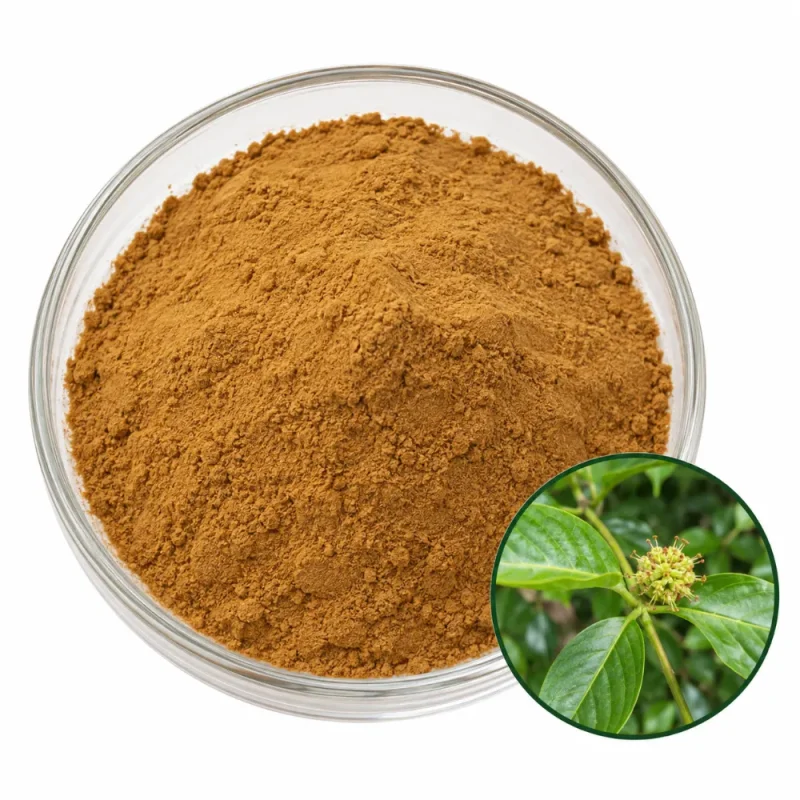
Gambir Extract 10–50% Catechin

Gambir extract is prepared from the leaves and young twigs of Uncaria gambir, a climbing shrub of Southeast Asian lowlands, and the root and bark are not part of the starting material. Ethanol extraction takes up the catechins and condensed tannins of the leaf, and the concentrate is dried to a light brown powder.

Catechin is measured by HPLC, with a primary grade of 50% and a lower grade of 10%. The powder is 80 mesh and slightly soluble in water. The 50% grade fits capsules and tablets that need a small fill, while the 10% grade fits blends and drink powders in which the leaf matrix is wanted.

Catechin Standardization & Grades

Catechin is a flavan-3-ol, and in gambir it is the (+)-catechin form that dominates, with smaller amounts of epicatechin, gambiriin and condensed tannin. The traditional product called gambier is a boiled-down leaf paste, and the ethanol extract described here is a different, more refined preparation. The botanical entity is Uncaria gambir (W.Hunter) Roxb., and the extract is standardized to catechin because it is the single, measurable compound that defines the leaf and the one that HPLC resolves cleanly from the tannin background.

GradeAssay & MethodWhere It Fits
10% CatechinHPLCBlends and drink powders, higher inclusion
50% CatechinHPLCCapsules and tablets, small fill weight

Grade choice follows dose and fill weight. The 50% grade carries five times the catechin of the 10% grade per gram, so a capsule reaches its target with a fraction of the powder, while the 10% grade is bulkier, carries more of the leaf’s tannin and is easier to blend dry. Gambir has no 10:1 extract or milled leaf row in the catalog, so the standardized extract is the form to use whenever a catechin figure has to appear in the specification of a gambir extract.

Catechin Analysis & Purity Risks

HPLC separates catechin and epicatechin on a reversed-phase column and quantifies the peaks against reference standards, with UV detection at 280 nm. The result is catechin specifically, and the choice between catechin alone and the sum of catechin and epicatechin should be stated. A UV total or a Folin-Ciocalteu reading would count the tannins and other phenolics, and neither can be converted into the HPLC value.

For identity, the fingerprint of the leaf is read beside catechin. Epicatechin, gambiriin and procyanidin oligomers appear as neighbors, and the high ratio of (+)-catechin to epicatechin is characteristic of gambir, in contrast to green tea, where epigallocatechin gallate dominates. The pattern helps to separate gambir from other catechin sources.

Purity risks follow from the botanical group. Catechin is sold from many plants, among them green tea, Acacia catechu (black catechu or cutch) and grape seed, and the names catechu and gambir are used for different materials in the trade. Black catechu is a heartwood extract of an Acacia and gambir is a leaf extract of an Uncaria. The stated species and the stated leaf part protect identity better than one percentage does. The tannin background also changes with processing.

Sample preparation uses a polar solvent at room temperature and a short extraction time, because catechins epimerize and oxidize in warm, neutral solution. Samples are acidified, protected from light and injected promptly.

Raw material handling also matters. Leaves and twigs are collected, wilted and dried, or boiled to make the traditional paste, and a heat-treated lot differs from one dried gently. Overheating converts catechin to brown oligomers, and damp storage gives a dull, dark powder.

Typical Specifications

Specification ItemProduct Information
Latin NameUncaria gambir
Plant PartLeaf & Herb
ProcessingEthanol Extraction
Compound ClassCatechins, Flavonoids, Polyphenols
Common NameGambir, Gambier, White Cutch
Ingredient TypeStandardized Extract
Marker Compound(s)Catechin
Primary Grade50% Catechin (HPLC)
Available Grades10% · 50% Catechin (HPLC)
AppearanceLight Brown powder
Solubility / DispersibilitySlightly Soluble in Water
Quality Parameters
Moisture (LOD)≤5.0%
Total Ash≤5.0%
Particle Size80 mesh
Heavy MetalsLead ≤2 ppm · Arsenic ≤1 ppm · Cadmium ≤1 ppm · Mercury ≤0.1 ppm
MicrobiologyTPC ≤1,000 cfu/g · Yeast & Mold ≤100 cfu/g · E. coli Negative · Salmonella Negative/25 g
Shelf Life24 months in unopened original packaging, cool and dry storage

Applications by Grade

50% Grade for Compact Capsules

The 50% grade of gambir extract reaches a catechin target in a small fill, which suits compact capsules. The fine powder is slightly hygroscopic and astringent, so fill in a dry room and seal the capsules in a desiccated bottle.

10% Grade in Drink Powders

The 10% grade is bulky enough to carry in stick-pack drink powders. It gives a light brown, slightly hazy cup with a dry, bitter-sweet taste, and a citrus or tea flavor with a sweetener rounds the astringency.

50% Grade in Tablet Blends

Tablets of the 50% grade need a dry binder and a glidant, because catechin-rich powders compact into hard, slow-dissolving tablets. A film coat limits moisture pickup and covers the astringency, and hardness should be checked after storage.

10% Grade in Gummy Bases

Gummies take the 10% grade as a tannin-rich contributor, and the tannins can shorten the gel set of a pectin or gelatin base. Add the powder late in the cook and trial a small cast to check texture.

10% Grade in Sachet Premixes

The 10% grade goes into sachets on a bulking carrier, which brings the leaf extract to a metered, accurate dose. Foil laminate with low moisture transmission keeps the powder free-flowing, because tannin-rich extracts cake in humid air.

50% Grade in Stepwise Dilutions

For a small dose, the 50% grade is stepped down in stages with a bulking carrier before filling. Run a trial batch and sample it from several points, as low-inclusion concentrates such as this one segregate.

Technical & Quality Considerations

Gambir extract is a light brown powder with a faint, slightly sweet and tannic odor and an astringent, bitter-sweet taste. It is slightly soluble in water, so a solution turns hazy yellow-brown. Catechin dissolves better in hot water than in cold, but it can crystallize out of a cooled concentrated solution as fine needles, so a clear beverage at high inclusion may form a haze or sediment on standing.

Catechin is sensitive to oxidation. In neutral or alkaline media, and in the presence of oxygen, light and metal ions, it oxidizes to brown quinone-derived pigments and condenses to larger oligomers. Contact with iron gives dark complexes. Acidic bases, antioxidant systems such as ascorbic acid, stainless contact surfaces and light-protective packaging keep the shade and the assay steadier.

Scale-up of gambir extract starts with sieving the fine powder and premixing it with part of the carrier, then a weight check on the first fills. Drums are stored sealed and cool, with desiccant liners in humid regions, and a closed charging system limits the fine, astringent dust.

Proteins bind catechin and may haze a clear drink, and tannins also affect the texture of gel systems, so a pilot batch at the target pH shows early whether a combination is sound.

Taste and mouthfeel decide how much gambir extract a drink can carry. Catechin-rich powders taste dry and puckering, and the sensation builds with each sip, so recipes keep the serving small and pair the extract with sweet, fatty or creamy components that coat the palate. In capsules and coated tablets the astringency is irrelevant, and the practical concerns shift to moisture control and to keeping the pale brown shade of the powder consistent from lot to lot.

Packaging & Commercial Supply

Essencefield supports product evaluation, formulation trials, commercial orders, and ongoing ingredient supply. Packaging, storage, and shipping arrangements are determined by product characteristics, order quantity, stability requirements, and destination-market needs.

Supply ItemGeneral Information
SampleAvailable upon request for formulation, testing, and supplier evaluation
Order Quantities100 g · 1 kg · 5 kg · 25 kg · 100 kg · 500 kg · Bulk
Sample Lead TimeTypically 5–7 days after sample confirmation
Production Lead TimeTypically 15–30 days after order and specification confirmation
PackagingSuitable protective inner packaging with bags, cartons, drums, or other appropriate outer packaging
StorageStore in tightly sealed, suitable protective packaging in a cool, dry environment. Protect from moisture, heat, and direct sunlight. Specific storage conditions follow the approved product specification.
DocumentationCOA · Product Specification · TDS · SDS · Applicable declarations (as applicable)

Final order quantities, lead times, packaging, documentation, and shipping arrangements are confirmed according to the selected product and commercial requirements.

Request Ingredient Specifications & Quote

Share your target specification, application, quantity, and documentation needs. We’ll help confirm suitable options, samples, and commercial supply details.