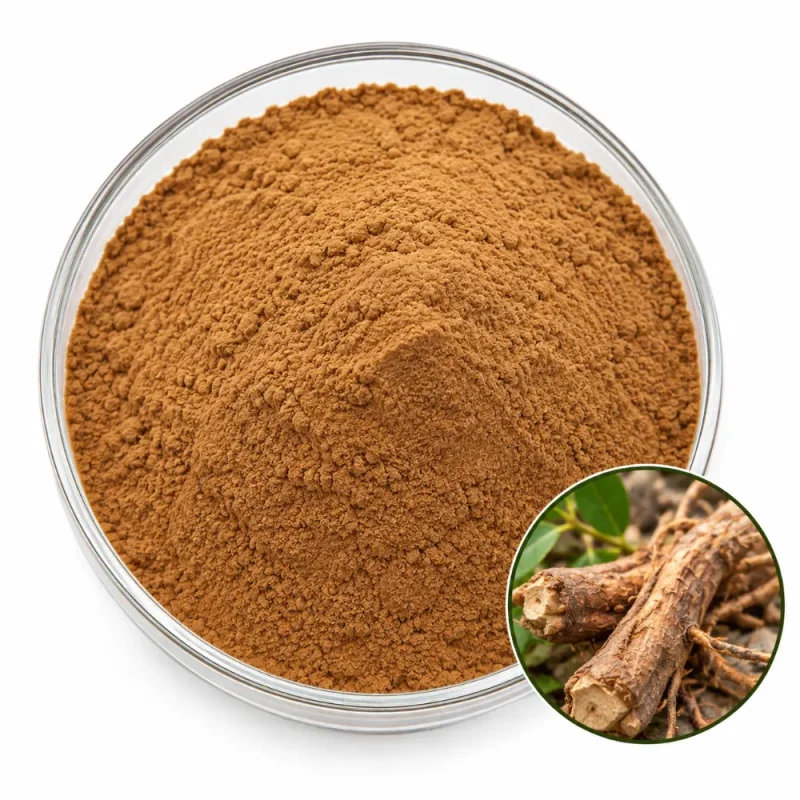
Gentian Root Extract 3–8% Gentiopicroside

The dried root of Gentiana lutea, the yellow gentian of the European mountain meadows, is the only part used in this extract, and the leaf, flower and the similar-looking white hellebore are excluded. Ethanol extraction takes up the bitter secoiridoid glycosides of the root, and the concentrate is dried to a light brown powder.

Gentiopicroside is measured by HPLC, with a primary grade of 8% and a lower grade of 3%. The powder is 80 mesh and water soluble. The 8% grade fits capsules and tablets that need a small fill, while the 3% grade fits drink powders and bitters-style blends in which the root matrix is wanted.

Gentiopicroside Standardization & Grades

Gentiopicroside is a secoiridoid glycoside and the most abundant bitter compound of the gentian root. Amarogentin, which is present in far smaller amounts, is considered one of the most bitter natural substances known, and swertiamarin and sweroside accompany them. The botanical entity is Gentiana lutea L., and the extract is standardized to gentiopicroside because it is the defining, measurable bitter of the root and the compound that HPLC separates cleanly from the sugars of the matrix.

GradeAssay & MethodWhere It Fits
3% GentiopicrosideHPLCDrink powders and bitters-style blends
8% GentiopicrosideHPLCCapsules and tablets, small fill weight

Grade choice follows bitterness, dose and fill weight. The 8% grade carries more than two and a half times the gentiopicroside of the 3% grade per gram, so a capsule reaches its target with less powder, while the 3% grade is bulkier, sweeter and milder in bitterness. Gentian is also supplied as a 10:1 ratio extract with no marker figure, the Gentian Root Extract Powder, a related extract of the yellow species, the Yellow Gentian Extract Powder, and as milled root, the Gentian Root Powder. The standardized extract is the row to use when a gentiopicroside figure has to appear in the specification.

Gentiopicroside Analysis & Purity Risks

HPLC separates gentiopicroside from swertiamarin and sweroside on a reversed-phase column and quantifies the peak against a reference standard, with UV detection at about 270 nm. The result is gentiopicroside specifically. A bitterness value, which is a sensory measure, and a UV total are different measurements, and neither can be converted into the HPLC figure.

For identity, the fingerprint of the root is read beside gentiopicroside. Swertiamarin, sweroside and amarogentin appear as neighboring peaks, and the xanthone gentisin and isogentisin give the root its yellow color. The pattern distinguishes European gentian from the Chinese gentians, whose chemistry is similar in kind but not in proportion.

Purity risks follow from the botanical group, and the best-known case is a safety one. The large yellow-flowered Gentiana lutea grows next to the toxic white hellebore, Veratrum album, whose leaves and roots resemble gentian when young, and mis-collection has been documented. A fingerprint and a stated species protect against this risk. Other gentian species, such as Gentiana scabra and Gentiana macrophylla of Chinese practice, are different materials sold under related names. Wild yellow gentian is also protected in several regions, so the supply is typically from cultivated plants.

Sample preparation uses a polar solvent at moderate temperature, because gentiopicroside is sensitive to enzymatic and acid hydrolysis. Samples are filtered and injected promptly.

Raw material handling also matters. Traditional gentian root is often fermented or dried slowly, which activates enzymes that convert gentiopicroside and give the root its characteristic odor. A rapidly dried root keeps more gentiopicroside, whereas a fermented root shows a lower figure and a stronger aroma.

Typical Specifications

Specification ItemProduct Information
Latin NameGentiana lutea
Plant PartRoot & Rhizome
ProcessingEthanol Extraction
Compound ClassIridoids, Terpenoids
Common NameGentian, Yellow Gentian
Ingredient TypeStandardized Extract
Marker Compound(s)Gentiopicroside
Primary Grade8% Gentiopicroside (HPLC)
Available Grades3% · 8% Gentiopicroside (HPLC)
AppearanceLight Brown powder
Solubility / DispersibilityWater Soluble
Quality Parameters
Moisture (LOD)≤5.0%
Total Ash≤5.0%
Particle Size80 mesh
Heavy MetalsLead ≤2 ppm · Arsenic ≤1 ppm · Cadmium ≤1 ppm · Mercury ≤0.1 ppm
MicrobiologyTPC ≤1,000 cfu/g · Yeast & Mold ≤100 cfu/g · E. coli Negative · Salmonella Negative/25 g
Shelf Life24 months in unopened original packaging, cool and dry storage

Applications by Grade

8% Grade for Compact Capsules

The 8% grade of gentian root extract reaches a gentiopicroside target in a small fill, which suits compact capsules. The hygroscopic, intensely bitter powder should be filled in a dry room, with the shell carrying the taste.

3% Grade in Bitters-Style Drink Powders

The 3% grade dissolves into a clear amber cup with an intensely bitter taste, so it is used in small servings in bitters-style drink powders. Citrus peel, ginger and herbal bases with a sweetener balance the bitterness.

8% Grade in Tablet Blends

Tablets of the 8% grade need a dry binder and a glidant, because the sugar-bearing powder softens in humid air. A film coat covers the strong bitterness, and hardness should be checked after a period of storage.

3% Grade in Sachet Premixes

Sachets of the 3% grade dilute the gentian root extract with a bulking carrier so the filler can weigh an accurate dose in each sachet. Low-moisture-transmission foil laminate holds the powder free-flowing during storage and distribution.

3% Grade in Instant Tea-Style Blends

Instant blends in stick format use the 3% grade with warm spices that match the bitter, earthy character. The gentian extract dissolves readily, so brief stirring in warm water is enough to give an even, uniform cup.

8% Grade in Stepwise Dilutions

Where a dose is small, the 8% grade is diluted in stages with a bulking carrier before it reaches the filler. Verify uniformity on a test batch, because a concentrated bitter powder at low inclusion segregates easily.

Technical & Quality Considerations

Gentian root extract is a light brown powder with a faint, sweet-earthy odor and an extremely bitter taste that persists. It is water soluble, giving a clear to slightly hazy amber solution. Gentiopicroside itself dissolves freely in water because of its sugar unit, and the lower grade also carries root sugars that make the powder tacky.

Gentiopicroside is stable at neutral to mildly acidic pH and moderate temperature, but it hydrolyzes under strong acid or base and in the presence of beta-glucosidase, and the aglycone then rearranges to brown products. Hot-fill and retort processes therefore lower the gentiopicroside figure, and the extract darkens on standing in solution. The xanthones are light sensitive and fade in clear packs.

Scale-up of gentian root extract starts with a sieve and a premix with part of the carrier, then a weight check on the first fills. The sugar-rich powder takes up water quickly and cakes in humid air, so use a dry room, sealed drums and desiccant liners, and store cool and out of direct light.

Taste dominates the design of any liquid format. A few tens of milligrams per serving already read as intensely bitter, so recipes rely on dilution, acid, salt and strong flavors. The final recipe should be judged by a taste panel, not by arithmetic.

Storage of the finished product deserves a note for gentian root extract. Bitter glycoside solutions slowly darken and lose assay when held warm, so liquid concentrates and ready-to-drink formats are better kept cool and acidic, while dry formats protect the compound simply by staying dry. A retained sample from each lot, stored at the intended shelf-life conditions, gives the cleanest answer on how the bitter figure and the color change over time.

Packaging & Commercial Supply

Essencefield supports product evaluation, formulation trials, commercial orders, and ongoing ingredient supply. Packaging, storage, and shipping arrangements are determined by product characteristics, order quantity, stability requirements, and destination-market needs.

Supply ItemGeneral Information
SampleAvailable upon request for formulation, testing, and supplier evaluation
Order Quantities100 g · 1 kg · 5 kg · 25 kg · 100 kg · 500 kg · Bulk
Sample Lead TimeTypically 5–7 days after sample confirmation
Production Lead TimeTypically 15–30 days after order and specification confirmation
PackagingSuitable protective inner packaging with bags, cartons, drums, or other appropriate outer packaging
StorageStore in tightly sealed, suitable protective packaging in a cool, dry environment. Protect from moisture, heat, and direct sunlight. Specific storage conditions follow the approved product specification.
DocumentationCOA · Product Specification · TDS · SDS · Applicable declarations (as applicable)

Final order quantities, lead times, packaging, documentation, and shipping arrangements are confirmed according to the selected product and commercial requirements.

Request Ingredient Specifications & Quote

Share your target specification, application, quantity, and documentation needs. We’ll help confirm suitable options, samples, and commercial supply details.