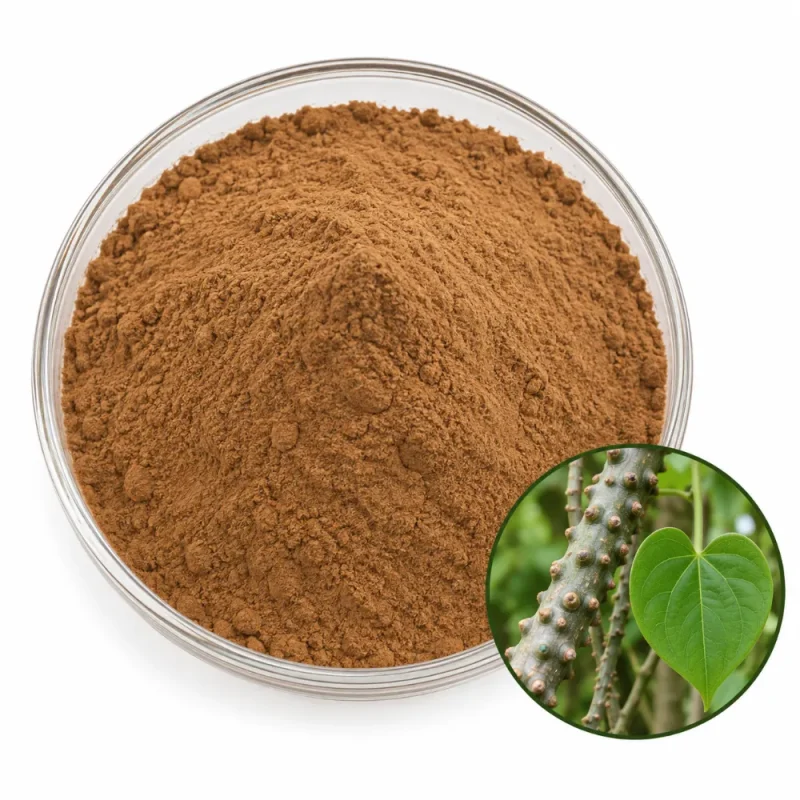
Guduchi Extract 2.5–5% Bitter Principles

Guduchi extract is prepared from the dried stem of Tinospora cordifolia, the heart-leaved moonseed known in Ayurveda as guduchi or giloy, and the leaf, root and fruit are not part of the starting material. Ethanol extraction takes up the diterpenoid lactones, alkaloids and glycosides of the stem, and the concentrate is dried to a light brown powder.

The primary grade is 5% bitter principles, with a 2.5% grade as the lower end, and no named assay method is attached to the grades. The powder is 80 mesh and slightly soluble in water. The 5% grade fits capsules and tablets, while the 2.5% grade fits drink powders and herbal blends.

Bitter Principle Standardization & Grades

Bitter principles is a taste-defined class and not a single compound. In guduchi stem the bitterness comes from diterpenoid lactones such as columbin and tinosporaside, the isoquinoline alkaloids berberine, palmatine, magnoflorine and jatrorrhizine, and a series of glycosides. The botanical entity is Tinospora cordifolia (Willd.) Miers, and the extract is standardized to bitter principles because bitterness is the quality that separates a stem extract from a plain powder and the one that formulators have to manage.

GradeAssay & MethodWhere It Fits
2.5% Bitter PrinciplesClass figure, no named methodHerbal blends, drink powders
5% Bitter PrinciplesClass figure, no named methodCapsules and tablets

Grade choice follows bitterness and fill weight. The 5% grade is the stronger, more concentrated bitter extract and gives a smaller fill, while the 2.5% grade is milder, bulkier and carries more of the stem’s starch and polysaccharide. Guduchi is also supplied as a 10:1 ratio extract with no marker figure, the Tinospora Cordifolia Extract Powder, as milled stem, the Giloy (Tinospora cordifolia) Powder, and as a single alkaloid, Magnoflorine 98%. The standardized extract is the row to use when a bitterness figure has to appear in the specification.

Bitter Principle Analysis & Purity Risks

Bitterness is judged by taste, so the usual figure is a bitterness value, meaning the highest dilution at which a panel still detects bitterness. A chemical proxy such as a summed HPLC peak group for the alkaloids and lactones can also be used. The grade carries no named method, so the figure is read as the bitter-principle level determined by the procedure that accompanies the lot. It cannot be converted into an HPLC value for berberine or compared with a number from a different procedure.

For identity, an HPLC fingerprint of the stem is read beside the bitter figure. Magnoflorine is the dominant alkaloid peak, with palmatine, jatrorrhizine and berberine as neighbors, and the diterpenoid lactones form a later-eluting cluster. The pattern separates guduchi from other Menispermaceae stems that carry related alkaloids.

Purity risks follow from the botanical group. Several climbers of the same family are traded as guduchi or giloy, among them Tinospora crispa and Tinospora sinensis, and their chemistry differs. The stated species and the stated stem part protect identity better than one bitter figure does. Starch from the stem can also make a powder look richer in extract than it is, which is why the extract and the powder are separate products.

Sample preparation for chemical proxies uses extraction into a polar solvent and filtration, with the sample protected from light because alkaloids degrade under strong light. A controlled dilution series and a trained panel are required for sensory work.

Raw material handling also matters. Stems are harvested, cleaned, sliced and shade-dried, and some Ayurvedic preparations use the fresh stem for the starchy sediment called satva. Moisture and mold are a risk in the starch-rich stem, so drying must be prompt and storage dry.

Typical Specifications

Specification ItemProduct Information
Latin NameTinospora cordifolia
Plant PartBark & Stem
ProcessingEthanol Extraction
Compound ClassPolyphenols
Common NameGuduchi, Giloy, Heart-Leaved Moonseed
Ingredient TypeStandardized Extract
Marker Compound(s)Bitter principles (diterpenoid lactones and alkaloids of the stem)
Primary Grade5% Bitter Principles
Available Grades2.5% · 5% Bitter Principles
AppearanceLight Brown powder
Solubility / DispersibilitySlightly Soluble in Water
Quality Parameters
Moisture (LOD)≤5.0%
Total Ash≤5.0%
Particle Size80 mesh
Heavy MetalsLead ≤2 ppm · Arsenic ≤1 ppm · Cadmium ≤1 ppm · Mercury ≤0.1 ppm
MicrobiologyTPC ≤1,000 cfu/g · Yeast & Mold ≤100 cfu/g · E. coli Negative · Salmonella Negative/25 g
Shelf Life24 months in unopened original packaging, cool and dry storage

Applications by Grade

5% Grade for Compact Capsules

The 5% grade of guduchi extract reaches a bitterness target in a small fill, which suits compact capsules. The powder is fine, intensely bitter and slightly hygroscopic, so fill in a dry room and let the shell carry the taste.

2.5% Grade in Herbal Powder Blends

Herbal powder blends carry the 2.5% grade alongside other stem, root and leaf extracts of the Ayurvedic tradition. Add it in stages to a free-flowing carrier, because the starchy, low-density powder segregates in a large blender.

5% Grade in Tablet Blends

The 5% grade in tablets needs a dry binder and a glidant, and a film coat hides the intense bitterness. Check hardness and disintegration after storage, because the starch-bearing powder swells slowly in humid air.

2.5% Grade in Drink Powders

Stick-pack drink powders pair the 2.5% grade of the extract with ginger, lemon and honey flavors that cover the green, bitter character. The cup is hazy and brown, and cool water gives the cleanest dispersion in the cup.

2.5% Grade in Sachet Premixes

Sachets dilute the 2.5% grade with a bulking carrier so the filler can weigh an accurate dose. A foil laminate with low moisture transmission keeps the powder free-flowing, because the starch draws water in humid air.

5% Grade for Contract Blending

Contract blenders place the 5% grade in multi-ingredient powders where a stem matrix is wanted. Bitterness carries across adjacent runs, so a dry purge and dedicated scoops protect the products that follow on the same line.

Technical & Quality Considerations

Guduchi extract is a light brown powder with a faint, earthy odor and an intensely bitter taste. It is slightly soluble in water, so a solution turns hazy yellow-brown, with the alkaloid salts dissolved and the diterpenoid lactones largely in suspension. The yellow color comes mainly from the protoberberine alkaloids and deepens in concentrated solution.

Alkaloids are weak bases, so solubility rises as pH falls, and an acidic beverage dissolves more of the fraction than a neutral one. Berberine and palmatine are light sensitive and fade or darken under strong light, and the diterpenoid lactones hydrolyze under strong base. Starch in the lower grade gelatinizes in hot water and can thicken a drink, and in humid air it makes the powder hygroscopic and prone to caking.

Scale-up of guduchi extract starts with a sieve and a premix with part of the carrier, then a weight check on the first fills. Sealed drums are kept cool and out of direct light, and desiccant liners are added in humid regions. A closed charging system limits the bitter, yellow-staining dust.

Taste is the limiting factor in liquid formats. The extract is among the more bitter botanical ingredients, and strong flavors, acid, salt and sweeteners together are needed to make a drink palatable. For taste, a panel on the final recipe outranks any calculation.

Starch and polysaccharide in the lower grade influence processing. They swell and thicken a drink when it is heated, and they can make a capsule blend cohesive and slow to flow. A pre-blend with a flow agent and a short sieving step directly before filling solve most of the problems. The higher grade is cleaner in this respect and flows better, which is one practical reason for choosing it for capsule lines.

Packaging & Commercial Supply

Essencefield supports product evaluation, formulation trials, commercial orders, and ongoing ingredient supply. Packaging, storage, and shipping arrangements are determined by product characteristics, order quantity, stability requirements, and destination-market needs.

Supply ItemGeneral Information
SampleAvailable upon request for formulation, testing, and supplier evaluation
Order Quantities100 g · 1 kg · 5 kg · 25 kg · 100 kg · 500 kg · Bulk
Sample Lead TimeTypically 5–7 days after sample confirmation
Production Lead TimeTypically 15–30 days after order and specification confirmation
PackagingSuitable protective inner packaging with bags, cartons, drums, or other appropriate outer packaging
StorageStore in tightly sealed, suitable protective packaging in a cool, dry environment. Protect from moisture, heat, and direct sunlight. Specific storage conditions follow the approved product specification.
DocumentationCOA · Product Specification · TDS · SDS · Applicable declarations (as applicable)

Final order quantities, lead times, packaging, documentation, and shipping arrangements are confirmed according to the selected product and commercial requirements.

Request Ingredient Specifications & Quote

Share your target specification, application, quantity, and documentation needs. We’ll help confirm suitable options, samples, and commercial supply details.