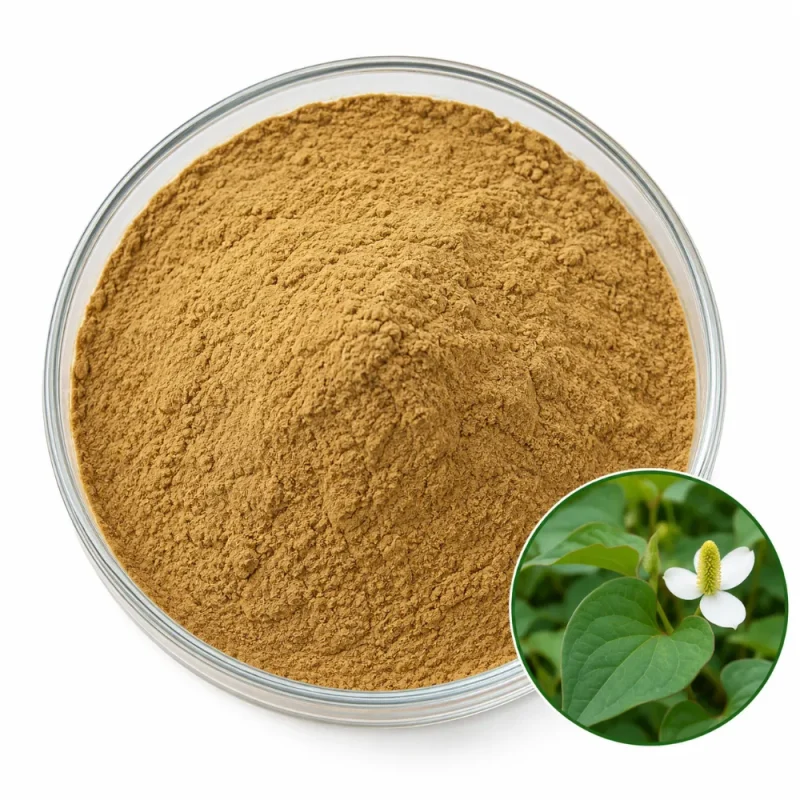
Houttuynia Cordata Extract 5–30% Total Flavonoids

The aerial parts of Houttuynia cordata, the fish mint of East and Southeast Asian kitchens and herbal trade, are extracted with ethanol to give this Houttuynia cordata extract, which is standardized for its flavonoid fraction. It is dried to a light brown powder of 80 mesh that is only slightly soluble in water and keeps the amber flavonoid color of the herb.

Total flavonoids are measured by UV and offered as a 5–30% range, with 30% as the primary grade and 5% as the lower grade. A quercitrin marker is tracked in addition. The lower grade suits tea blends and drink powders, while the higher grade is the one for compact fills where dose per capsule matters.

Flavonoid Standardization & Grades

Houttuynia cordata Thunb. is a member of the lizard-tail family, and its flavonoids are mainly glycosides of quercetin and kaempferol, with quercitrin, isoquercitrin, hyperoside and rutin among the best known. Standardizing to total flavonoids gives buyers one figure for this phenolic fraction. The fresh herb also contains an unstable volatile aldehyde, houttuynin, which is the source of its fishy smell, but this compound is lost on drying and extraction and is not the basis for the grade.

GradeAssay & MethodWhere It Fits
5% Total FlavonoidsUVBlends, larger-fill capsules
30% Total FlavonoidsUVCapsules and tablets, small fill weight

Grade choice follows dose and fill weight. The 30% grade carries six times the flavonoids of the 5% grade per gram, so a capsule reaches its target with a much smaller fill, while the 5% grade is bulkier and easier to blend at gram-level inclusion. The same herb is also supplied as a 10:1 ratio extract without a marker figure, the Houttuynia Extract Powder, as a milled herb, Houttuynia (Fish Mint) Powder, and as a single glycoside, Afzelin 98%.

Flavonoid Analysis & Purity Risks

Total flavonoids by UV are calculated from the absorbance of a colored aluminum complex, which the quercetin and kaempferol glycosides of this herb form readily. The result is a group total expressed against a reference flavonoid, and an HPLC figure for single glycosides will be lower and cannot be converted into the UV number.

The quercitrin marker is a separate, compound-specific measurement. Quercitrin is the rhamnoside of quercetin, so it can be read by HPLC beside the group total. A lot with a high total and a low quercitrin share, or the other way round, shows a different glycoside profile, which is why the pair is read together.

For identity, the fingerprint shows the cluster of quercetin and kaempferol glycosides typical of Houttuynia cordata. The pattern separates a Houttuynia cordata extract from other flavonoid-rich herbs sold in the same grade range, whose main peaks are different glycosides.

Purity risks are tied to the fresh versus dried state of the herb and to species. The volatile fraction changes strongly with drying, so extracts of dried herb differ from extracts of fresh herb, and a pharmacopeial comparison needs the same drug form. Fish mint is sometimes confused with other small ground-cover herbs in the same habitat, so the stated species and the aerial part are part of the identity. A colorimetric total also reads high if rutin or quercetin from another plant has been added, which the fingerprint would show as a foreign peak.

Sample preparation affects the flavonoid result. The glycosides dissolve in aqueous ethanol, and the solution is filtered before reading, because haze from undissolved plant fragments scatters light and raises the absorbance. A blank made from the same solvent corrects the baseline, and the reference compound is dried and weighed fresh for each calibration run.

Typical Specifications

Specification ItemProduct Information
Latin NameHouttuynia cordata
Plant PartLeaf & Herb
ProcessingEthanol Extraction
Compound ClassFlavonoids, Polyphenols
Common NameHouttuynia, Fish Mint
Ingredient TypeStandardized Extract
Marker Compound(s)Total Flavonoids; Quercitrin
Primary Grade30% Total Flavonoids (UV)
Available Grades5% · 30% Total Flavonoids (UV)
AppearanceLight Brown powder
Solubility / DispersibilitySlightly Soluble in Water
Quality Parameters
Moisture (LOD)≤5.0%
Total Ash≤5.0%
Particle Size80 mesh
Heavy MetalsLead ≤2 ppm · Arsenic ≤1 ppm · Cadmium ≤1 ppm · Mercury ≤0.1 ppm
MicrobiologyTPC ≤1,000 cfu/g · Yeast & Mold ≤100 cfu/g · E. coli Negative · Salmonella Negative/25 g
Shelf Life24 months in unopened original packaging, cool and dry storage

Applications by Grade

30% Grade in Tacky Capsule Fills

The 30% grade of Houttuynia cordata extract reaches a flavonoid target in a small fill, which suits two-piece capsules. The powder is hygroscopic and mildly tacky, so a dry filling room and a flow agent keep fill weights steady through the run.

30% Grade in Oxidation-Prone Tablets

Tablets of the 30% Houttuynia cordata grade need a dry binder and a film coat to keep out moisture. Flavonoid glycosides darken as they oxidize, so a coated tablet in a sealed pack holds the light brown shade better than an uncoated one stored in a bottle.

5% Grade in Hazy Drink Powders

The 5% grade disperses into instant drink powders and stick packs, giving a pale amber haze because it is only slightly soluble. Its flavor is grassy and faintly citrus-like, so it pairs with green tea, lemon or herbal tea flavors.

5% Grade in Herbal Tea Blends

Granulated blends for infusion can carry the 5% grade beside cut herbs such as mint or perilla. The extract dissolves more slowly than the cut herb, so it is dosed as a fine powder inside the bag, and a slight haze on steeping is expected.

30% Grade in Quercitrin-Defined Premixes

Premixes that state a quercitrin share use the 30% grade for its higher flavonoid load per gram. Because the glycoside profile shifts with extraction, hold the supplier lot constant across a product run so that the quercitrin figure of the finished premix stays comparable.

Technical & Quality Considerations

Houttuynia cordata extract is a light brown powder with a mild herbal aroma that is much less pronounced than the fresh herb. It is only slightly soluble in water. Flavonoid aglycones dissolve poorly, while the glycosides dissolve better, so the extract gives a hazy, amber dispersion that clears partly with warmth and gentle stirring.

Flavonoid glycosides are fairly stable to heat in the dry state but oxidize in solution when light, oxygen and trace metals are present. Quercetin-type compounds chelate iron and copper, which turns a solution darker, so mineral premixes and hard water can change the color of a finished drink. Chelating agents and opaque packs limit this drift.

The glycoside bonds hydrolyze under strong acid and heat, converting quercitrin to quercetin, a less soluble aglycone. Neutral to mildly acidic bases and short heat treatment keep the glycoside profile steady, and they keep the measured total stable over the shelf life.

In production, sieve the powder before use and meter it under low humidity. Local extraction at the charging point limits airborne dust, which is fine and light brown. An accelerated stability run with the intended pack shows early whether color, flow and the flavonoid figure hold in the finished mix.

Aroma gives a quick check at receipt. The Houttuynia cordata extract should smell mildly herbal, with none of the strong fishy note of the fresh herb, and a sharp or rancid smell points to storage damage. The lot should also be a uniform light brown powder, not a mixture of pale and dark particles.

Packaging & Commercial Supply

Essencefield supports product evaluation, formulation trials, commercial orders, and ongoing ingredient supply. Packaging, storage, and shipping arrangements are determined by product characteristics, order quantity, stability requirements, and destination-market needs.

Supply ItemGeneral Information
SampleAvailable upon request for formulation, testing, and supplier evaluation
Order Quantities100 g · 1 kg · 5 kg · 25 kg · 100 kg · 500 kg · Bulk
Sample Lead TimeTypically 5–7 days after sample confirmation
Production Lead TimeTypically 15–30 days after order and specification confirmation
PackagingSuitable protective inner packaging with bags, cartons, drums, or other appropriate outer packaging
StorageStore in tightly sealed, suitable protective packaging in a cool, dry environment. Protect from moisture, heat, and direct sunlight. Specific storage conditions follow the approved product specification.
DocumentationCOA · Product Specification · TDS · SDS · Applicable declarations (as applicable)

Final order quantities, lead times, packaging, documentation, and shipping arrangements are confirmed according to the selected product and commercial requirements.

Request Ingredient Specifications & Quote

Share your target specification, application, quantity, and documentation needs. We’ll help confirm suitable options, samples, and commercial supply details.