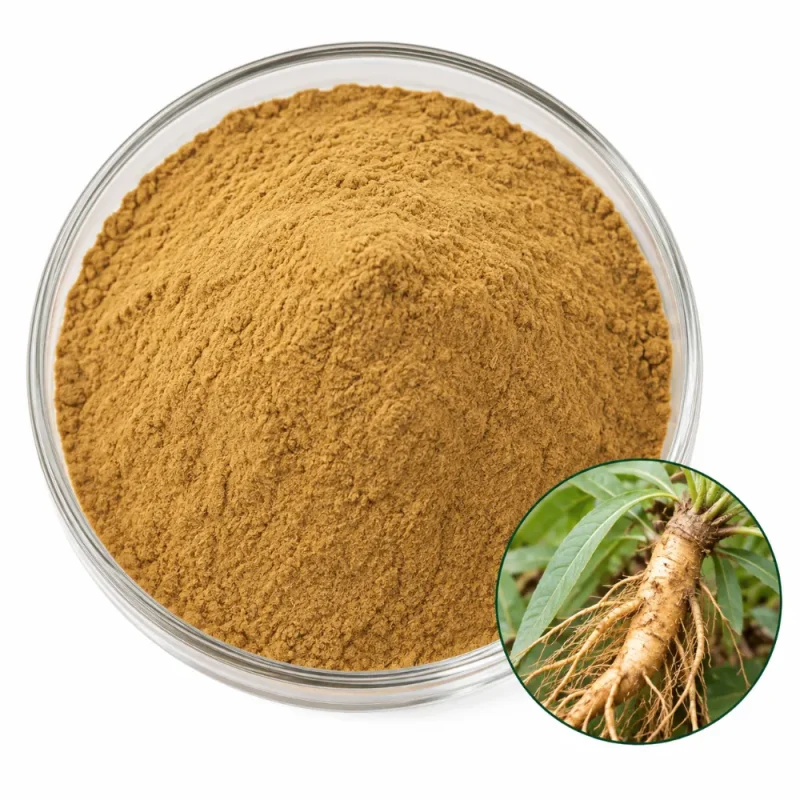
Isatis Indigotica Root Extract 0.1–5% Epigoitrin

The dried root of Isatis indigotica, the Chinese woad grown across northern China and known in the herb trade as ban lan gen, is extracted with ethanol to give this Isatis indigotica root extract. It is dried and milled to a light brown, 80 mesh powder that is only slightly soluble in water, with a mild earthy note.

Epigoitrin is measured by HPLC and offered as a 0.1–5% range, with 5% as the primary grade and 0.1% as the lower grade. Total alkaloids are tracked as a second marker. The lower grade suits herbal blends, while the higher grade is the one for compact fills where capsule size limits the dose.

Epigoitrin Standardization & Grades

Epigoitrin is a small sulfur-containing heterocycle, (S)-5-vinyl-oxazolidine-2-thione, that forms when the glucosinolate progoitrin is broken down by the plant’s own enzyme. It is the characteristic low-molecular-weight marker of Isatis indigotica Fortune ex Lindl. root, and a root extract is standardized to it because it is stable enough to measure and distinguishes the root from the leaf of the same plant. The root also carries indole alkaloids, lignans and amino acids that make up the background profile.

GradeAssay & MethodWhere It Fits
0.1% EpigoitrinHPLCBlends, high-inclusion powders
5% EpigoitrinHPLCCapsules and tablets, small fill weight

The span between the two grades is large, so the choice is mainly about how much root matrix a formula should carry. A 5% grade gives a small, concentrated fill, while a 0.1% grade is bulky and behaves like a root powder in blends. The same plant is supplied as a 10:1 root extract without a marker figure, the Isatis Root Extract Powder, as a milled root, Isatis Root Powder, and as a leaf extract with a different profile, the Isatis Indigotica Leaf Extract Powder.

Epigoitrin Analysis & Purity Risks

HPLC separates epigoitrin from the other small polar compounds of the root on a reversed-phase column. The oxazolidinethione group absorbs in the UV, and the peak is quantified against a reference standard. The epigoitrin figure is a single-compound result. The second marker, total alkaloids, is a group measurement of a different kind, and the two numbers are not interchangeable because one counts a single molecule and the other counts a class.

Identity rests on the fingerprint. The root shows epigoitrin and related nitrogen- and sulfur-containing compounds in a pattern that differs from the leaf, where indigo precursors and their derivatives dominate. The leaf extract is a different product with a different marker, and the stated plant part keeps the two apart.

The main purity risk is the naming overlap in the trade. Three different plants are sold under names close to ban lan gen: Isatis indigotica, the European woad Isatis tinctoria, and the acanthus-family Strobilanthes cusia, which is a different genus with different constituents. Databases also treat Isatis indigotica as a synonym of Isatis tinctoria, so trade papers may show either name. The root part and the stated species are therefore part of the specification.

Epigoitrin forms during processing, so its level reflects how the root was dried and handled. Roots that are crushed and left wet may convert the precursor fully, while roots dried whole may retain more precursor. Sample preparation uses a consistent extraction time and temperature for this reason, and the result is read against a standard prepared fresh.

Raw-material quality also matters. The root is harvested in autumn after the above-ground parts have died back, washed and dried before extraction, and thin lateral roots and soil residue are removed. Root that was dug early or stored damp shows lower marker levels and a stronger musty note, and these differences carry through to the finished extract.

Typical Specifications

Specification ItemProduct Information
Latin NameIsatis indigotica
Plant PartRoot & Rhizome
ProcessingEthanol Extraction
Compound ClassAlkaloids
Common NameIsatis Root, Chinese Woad
Ingredient TypeStandardized Extract
Marker Compound(s)Epigoitrin; total alkaloids
Primary Grade5% Epigoitrin (HPLC)
Available Grades0.1% · 5% Epigoitrin (HPLC)
AppearanceLight Brown powder
Solubility / DispersibilitySlightly Soluble in Water
Quality Parameters
Moisture (LOD)≤5.0%
Total Ash≤5.0%
Particle Size80 mesh
Heavy MetalsLead ≤2 ppm · Arsenic ≤1 ppm · Cadmium ≤1 ppm · Mercury ≤0.1 ppm
MicrobiologyTPC ≤1,000 cfu/g · Yeast & Mold ≤100 cfu/g · E. coli Negative · Salmonella Negative/25 g
Shelf Life24 months in unopened original packaging, cool and dry storage

Applications by Grade

5% Grade in Compact Root-Extract Capsules

The 5% grade of Isatis indigotica root extract reaches an epigoitrin target in a small fill, which suits two-piece capsules. The powder is hygroscopic and slightly sticky, so a flow agent and a dry filling room keep capsule weights consistent through the run.

5% Grade in Sulfur-Aware Tablet Blends

Tablets of the 5% grade need a dry binder and a film coat. The sulfur-containing marker has a faint cabbage-like note when the powder is moist, so a coat and a desiccant in the bottle keep that note from developing during storage.

0.1% Grade in Granulated Root Blends

Granulated blends for infusion can carry the 0.1% grade beside cut roots from the same herbal tradition. The extract behaves like a fine root powder at this level, so it is premixed with part of the carrier and sampled from several depths of the batch.

0.1% Grade in Drink Powder Bases

Instant drink powders use the 0.1% grade at gram-level inclusion. Its flavor is mildly bitter and earthy, so sweeteners and tea or malt flavors are used to balance it, and a fine grind avoids visible specks since the extract is only slightly soluble.

5% Grade in Tincture-Style Liquid Fills

Liquid fills can use the 5% grade in an alcohol-containing base where the marker dissolves better than in water. The base should be filtered after standing, because the less soluble root material settles as a brown sediment that must not be mistaken for a defect.

Technical & Quality Considerations

Isatis indigotica root extract is a light brown powder with a mild, earthy and slightly bitter character. It is only slightly soluble in water, and the polar marker dissolves in hot water and in aqueous alcohol, so warm preparation and gentle stirring give a more uniform dispersion than cold, still water.

Epigoitrin is a stable small molecule in the dry state, but the oxazolidinethione ring is sensitive to strong oxidants and to some metal ions, which can discolor a solution. Chelating agents and oxidant-free bases keep the marker stable, and a mildly acidic pH helps. The root matrix darkens slowly in humid air, so sealed packaging and a desiccant sachet hold the shade of the lot.

In production, the powder is sieved and premixed with part of the carrier. A low-humidity room and a grounded filler limit sticking and static, and local extraction at the charging point limits airborne dust. Drums are kept closed between charges to protect the powder from moisture.

Formulation work includes a compatibility check with oxidizing agents, copper or iron salts, and strongly alkaline ingredients. An accelerated stability run with the intended pack shows early whether color, flow and the epigoitrin figure hold across the shelf life.

Aroma and color give a quick check at receipt. A light brown powder with a mild, slightly sweet earthy note is expected for Isatis indigotica root extract, while a sulfurous or sharply cabbage-like smell can mean that the lot was handled wet. Both are visible before any assay result arrives.

Packaging & Commercial Supply

Essencefield supports product evaluation, formulation trials, commercial orders, and ongoing ingredient supply. Packaging, storage, and shipping arrangements are determined by product characteristics, order quantity, stability requirements, and destination-market needs.

Supply ItemGeneral Information
SampleAvailable upon request for formulation, testing, and supplier evaluation
Order Quantities100 g · 1 kg · 5 kg · 25 kg · 100 kg · 500 kg · Bulk
Sample Lead TimeTypically 5–7 days after sample confirmation
Production Lead TimeTypically 15–30 days after order and specification confirmation
PackagingSuitable protective inner packaging with bags, cartons, drums, or other appropriate outer packaging
StorageStore in tightly sealed, suitable protective packaging in a cool, dry environment. Protect from moisture, heat, and direct sunlight. Specific storage conditions follow the approved product specification.
DocumentationCOA · Product Specification · TDS · SDS · Applicable declarations (as applicable)

Final order quantities, lead times, packaging, documentation, and shipping arrangements are confirmed according to the selected product and commercial requirements.

Request Ingredient Specifications & Quote

Share your target specification, application, quantity, and documentation needs. We’ll help confirm suitable options, samples, and commercial supply details.