
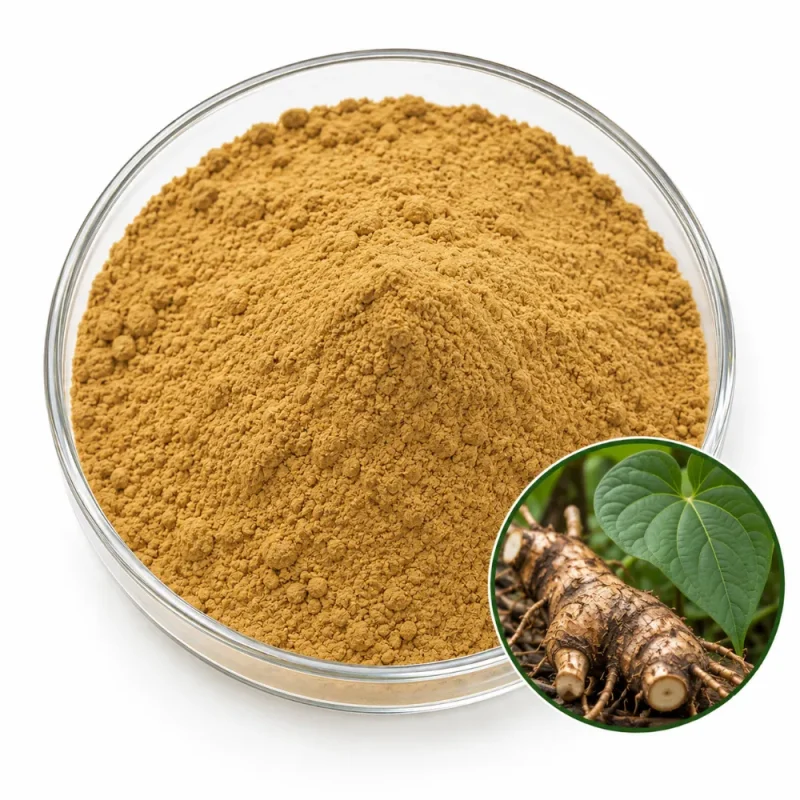
Kavalactone Standardization & Grades
Kavalactones are a family of lipophilic lactones derived from styrylpyrones, and six of them make up most of the content of kava root: kavain, dihydrokavain, methysticin, dihydromethysticin, yangonin and desmethoxyyangonin. They are the characteristic compounds of Piper methysticum G.Forst., and a kava extract is standardized to their sum because the six occur in different proportions in different cultivars. A total figure gives buyers one number, and the fingerprint shows how the six are balanced.
| Grade | Assay & Method | Where It Fits |
|---|---|---|
| 30% Kavalactones | HPLC | Oil-based fills, higher-inclusion blends |
| 70% Kavalactones | HPLC | Capsules and tablets, small fill weight |
The spread between the two grades is wide, so grade choice follows dose and carrier. At 70% the extract carries more than twice the kavalactones of the 30% grade per gram, which allows a compact capsule. At 30% the powder holds more of the root resin and starch, flows better and blends more easily. The same root is also supplied as a 10:1 ratio extract without a marker figure, the Kava Extract Powder.
Kava is a regulated botanical in several markets, with rules that differ by country on the plant part, the extraction solvent and the labeling. Brands review these rules for each destination before launch. Only the root is used in this extract, and the stem peelings and leaves are not part of the identity.
Cultivar and age shape the root. Kava roots are harvested after several years of growth, because older plants carry more lactones in the lateral roots than in the main stump, and the root is washed, dried and ground before extraction. A lot made from young roots or from heavily trimmed material has a lower kavalactone share and a larger proportion of starch, which is why the grade is measured on the finished powder.


