
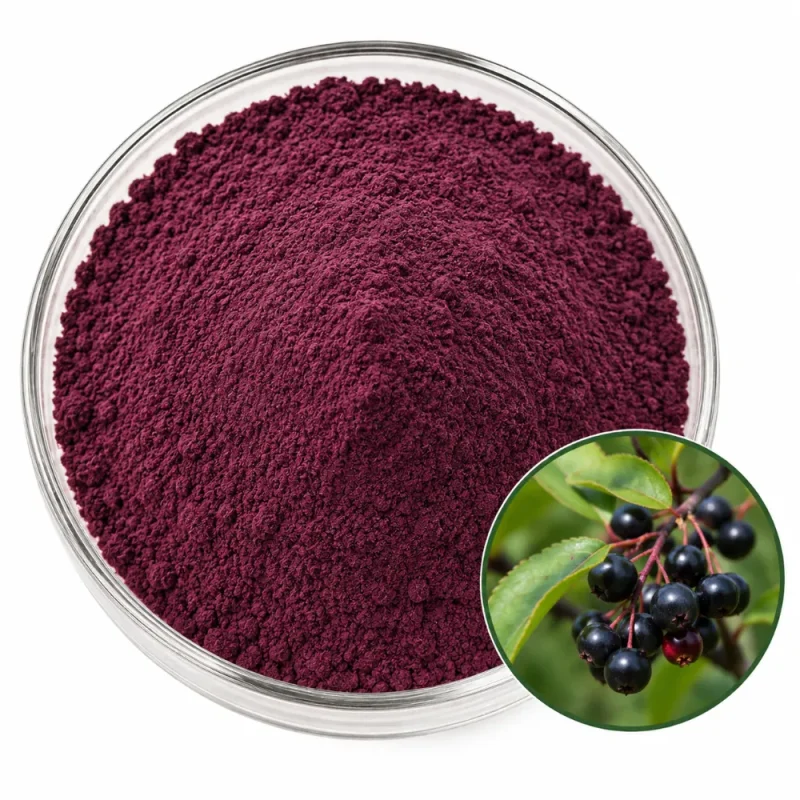
Anthocyanin Standardization & Grades
The berries of Aristotelia chilensis (Molina) Stuntz are among the anthocyanin-richest fruits known, and their pigments are dominated by delphinidin glycosides, with cyanidin glycosides in smaller amounts. Delphinidin carries three hydroxyl groups on its B ring, which makes its pigments deeply colored and more reactive than those of fruits where cyanidin or malvidin dominate. Standardizing to total anthocyanins gives buyers one figure for the pigment fraction as a group.
| Grade | Assay & Method | Where It Fits |
|---|---|---|
| 20% Total Anthocyanins | UV (pH differential) | Drink powders, higher-inclusion blends |
| 35% Total Anthocyanins | UV (pH differential) | Capsules and tablets, small fill weight |
The 35% grade carries about three-quarters more pigment than the 20% grade per gram, which permits a smaller fill and a deeper color at lower use rates. The 20% grade is bulkier and blends easily at gram-level inclusion. Maqui is also supplied as whole berry powders, the Maqui Berry Powder and the Freeze-Dried Maqui Berry Powder, which are fruit products without a pigment figure. The standardized extract is the one to specify when an anthocyanin figure has to appear on the specification.
The berry is the part used. Maqui berries are picked ripe, when the skin is nearly black, and they are frozen or dried promptly, since the pigment is concentrated in the skin and is lost when the fruit softens. The leaves and stems of the tree carry different compounds and are not part of this identity. The extract is therefore defined by the berry and by the anthocyanin fraction.


