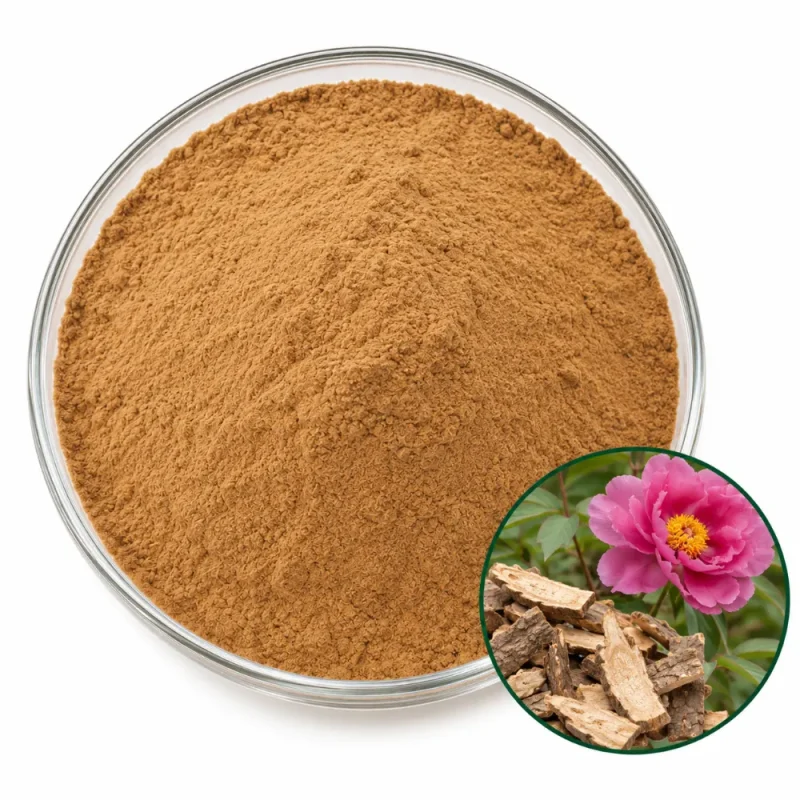
Moutan Bark Extract 10–50% Paeonol

The root bark of Paeonia suffruticosa, the tree peony cultivated in central China for its bark drug, moutan cortex, is extracted with ethanol to give this moutan bark extract. The concentrate is dried and milled to a light brown, 80 mesh powder that is only slightly soluble in water, with a faint sweet and phenolic aroma.

Paeonol is measured by HPLC and offered as a 10–50% range, with 50% as the primary grade and 10% as the lower grade. A 98–99% isolate belongs to the phytochemical range, not to this extract. The higher grade suits compact capsules and tablets, while the lower grade suits herbal blends that can carry more of the bark matrix.

Paeonol Standardization & Grades

Paeonol is 2′-hydroxy-4′-methoxyacetophenone, a small phenolic ketone that gives moutan bark its pharmacopeial identity. It sits in the root bark of Paeonia suffruticosa Andrews together with paeoniflorin, gallotannins and benzoylpaeoniflorin, and it is volatile enough to crystallize on the surface of the drying bark as a fine white frost. A moutan bark extract is standardized to paeonol because it is a defined, measurable compound that tracks the bark fraction of the plant.

GradeAssay & MethodWhere It Fits
10% PaeonolHPLCBlends, high-inclusion powders
50% PaeonolHPLCCapsules and tablets, small fill weight

The range is wide, so grade choice follows dose and carrier. At 50% the extract carries five times the paeonol of the 10% grade per gram, which allows a compact capsule. At 10% the powder keeps more of the bark matrix, including tannins and glycosides, and handles like a bark extract in blends. The same bark is also supplied as a 10:1 ratio extract without a marker figure, the Moutan Bark Extract Powder, as a milled bark, Moutan Bark Powder, and as a purified compound, Paeonol 99%.

The root bark is the only part used. Flower petals, leaves and the woody core of the root are removed or not used, and the herbaceous peony root, a different drug, is not part of this identity.

The bark is the part used. Moutan roots are dug after several years of growth, the root bark is split from the woody core and dried, and thin bark with a pale pinkish interior is preferred in the trade. The woody core, the leaves and the petals are not used, and a lot that includes core material shows a lower paeonol share and more starch.

Paeonol Analysis & Purity Risks

HPLC separates paeonol from paeoniflorin, gallic acid and the other bark constituents on a reversed-phase column. Paeonol has a strong chromophore from its acetophenone core, so detection is sensitive and the peak is sharp, and the result is paeonol itself, quantified against a reference standard. Because paeonol is much less polar than paeoniflorin, the two are read in different parts of the gradient run.

Volatility is the analytical hazard. Paeonol sublimes at moderate temperatures, so samples are not dried at high temperature before weighing and solutions are not concentrated by long evaporation. A result obtained after heating can be low for reasons that have nothing to do with the lot, and the same property explains why processing temperatures during drying and concentration have to be controlled.

Identity is read from the fingerprint. Paeonol in the presence of paeoniflorin and gallotannins, with the characteristic pattern of the root bark, distinguishes moutan from extracts that are simply spiked with purified paeonol, which is available as an inexpensive compound. A lot with a high paeonol figure and no paeoniflorin deserves a second look.

The botanical risk is the other peony. The root of the herbaceous peony (Paeonia lactiflora) is used as white or red peony root and contains paeoniflorin but little paeonol, and the roots of other tree peony species sold as moutan can differ. The stated species and the bark part are part of the identity. Whole root with the woody core would dilute the paeonol share and add starch.

Raw bark is separated from the core, dried and stored dry. Bark stored damp or in warm conditions loses paeonol by sublimation, and the extract made from it is weaker and darker.

Typical Specifications

Specification ItemProduct Information
Latin NamePaeonia suffruticosa
Plant PartBark & Stem
ProcessingEthanol Extraction
Compound ClassPolyphenols
Common NameMoutan Bark, Tree Peony Bark
Ingredient TypeStandardized Extract
Marker Compound(s)Paeonol
Primary Grade50% Paeonol (HPLC)
Available Grades10% · 50% Paeonol (HPLC)
AppearanceLight Brown powder
Solubility / DispersibilitySlightly Soluble in Water
Quality Parameters
Moisture (LOD)≤5.0%
Total Ash≤5.0%
Particle Size80 mesh
Heavy MetalsLead ≤2 ppm · Arsenic ≤1 ppm · Cadmium ≤1 ppm · Mercury ≤0.1 ppm
MicrobiologyTPC ≤1,000 cfu/g · Yeast & Mold ≤100 cfu/g · E. coli Negative · Salmonella Negative/25 g
Shelf Life24 months in unopened original packaging, cool and dry storage

Applications by Grade

50% Grade in Volatile-Aware Capsule Fills

The 50% grade of moutan bark extract reaches a paeonol target in a small fill, which suits two-piece capsules. Paeonol has a faint, sweet and phenolic odor and can sublime, so keep the filling room cool and the hoppers closed to hold the marker.

50% Grade in Cool-Compressed Tablets

Tablets of the 50% grade need a dry binder and low compression heat, because heat on the press drives paeonol out of the powder. A film coat seals the tablet and a sealed bottle keeps the marker from migrating into the cap liner.

10% Grade in Herbal Powder Blends

Dry herbal blends carry the 10% grade beside other bark and root powders. The extract is finer than the milled bark, so it is premixed with part of the carrier to avoid layering, and the pinkish-brown tone suits bark-based blends.

10% Grade in Granule Sachets

Granulated sachets can carry the 10% grade with a sweet or malt base that masks the astringency of the bark tannins. Paeonol is only slightly soluble in water, so the granule dissolves to a hazy brown solution, which labels should describe as normal.

50% Grade in Oil-Based Fills

Oil carriers dissolve paeonol better than water, so the 50% grade suits softgel-style fills and liquid-filled capsules. Keep the oil phase below the temperature at which paeonol sublimes during mixing, and seal the fill promptly to prevent loss.

Technical & Quality Considerations

Moutan bark extract is a light brown powder with a faintly sweet, phenolic and woody aroma that comes from paeonol. It is only slightly soluble in water, and paeonol dissolves in ethanol and in oils, so oil, alcohol-containing and suspension bases give a more uniform product than a plain aqueous mix.

Paeonol is a volatile solid. It sublimes at moderate temperatures, escapes slowly from open containers and can recrystallize on cool surfaces, so sealed packaging and a cool warehouse protect the marker. The phenolic hydroxyl group is also sensitive to oxidation in solution at higher pH, which darkens the extract, and mildly acidic bases hold the color better.

The tannin fraction of the bark darkens with iron and copper and binds proteins, so mineral premixes and protein bases need a compatibility trial. The dry powder takes up moisture and cakes in humid air, and a desiccant sachet holds it free-flowing.

During production, avoid prolonged hot-air drying of the extract and heated mixing steps, and use closed charging with local extraction, since fine dust is aromatic and irritating. An accelerated stability study in the intended pack shows early whether the paeonol figure, color and aroma hold across the shelf life.

A quick check at receipt is useful. A light brown to pinkish-brown, fine powder with a faint sweet and phenolic note is expected for moutan bark extract, while a flat smell can mean that paeonol has already been lost by sublimation during drying or storage. Both are visible before any assay result arrives.

Packaging & Commercial Supply

Essencefield supports product evaluation, formulation trials, commercial orders, and ongoing ingredient supply. Packaging, storage, and shipping arrangements are determined by product characteristics, order quantity, stability requirements, and destination-market needs.

Supply ItemGeneral Information
SampleAvailable upon request for formulation, testing, and supplier evaluation
Order Quantities100 g · 1 kg · 5 kg · 25 kg · 100 kg · 500 kg · Bulk
Sample Lead TimeTypically 5–7 days after sample confirmation
Production Lead TimeTypically 15–30 days after order and specification confirmation
PackagingSuitable protective inner packaging with bags, cartons, drums, or other appropriate outer packaging
StorageStore in tightly sealed, suitable protective packaging in a cool, dry environment. Protect from moisture, heat, and direct sunlight. Specific storage conditions follow the approved product specification.
DocumentationCOA · Product Specification · TDS · SDS · Applicable declarations (as applicable)

Final order quantities, lead times, packaging, documentation, and shipping arrangements are confirmed according to the selected product and commercial requirements.

Request Ingredient Specifications & Quote

Share your target specification, application, quantity, and documentation needs. We’ll help confirm suitable options, samples, and commercial supply details.