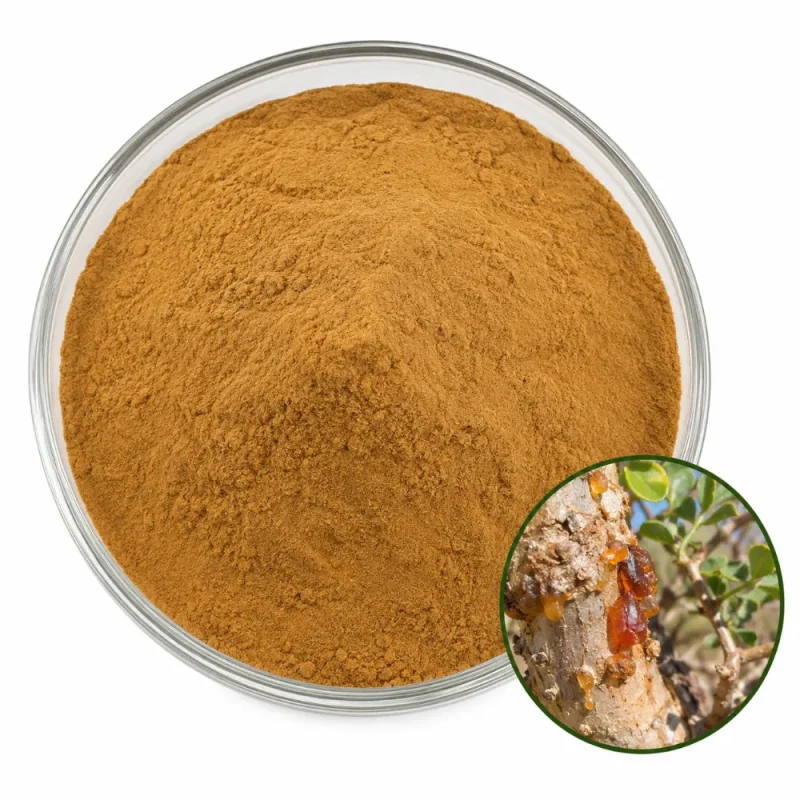
Myrrh Extract 1–20% Furanodienes

The oleo-gum resin of Commiphora myrrha, the thorny shrub of the Horn of Africa and southern Arabia that yields true myrrh, is extracted with ethanol to give this myrrh extract, which is standardized for its volatile furanosesquiterpene fraction. It is dried and milled to a light brown, 80 mesh powder with a warm, balsamic note.

Furanodienes are measured by HPLC and offered as a 1–20% range, with 20% as the primary grade and 1% as the lower grade. Total sesquiterpenes are tracked as a second marker. The higher grade fits small-fill capsules, and the lower grade fits oil-based fills and blends.

Furanodiene Standardization & Grades

Myrrh resin is a mixture of a water-soluble gum, a resin and a volatile oil, and the ethanol-soluble resin and oil fractions carry the sesquiterpenes that define its character. Among them are furanodiene, furanoeudesma-1,3-diene, curzerene and lindestrene, which are furan-ring sesquiterpenes from Commiphora myrrha (T.Nees) Engl. A myrrh extract is standardized to furanodienes because they are the most abundant and most characteristic members of this family, and a figure for them tells buyers how concentrated the sesquiterpene fraction is.

GradeAssay & MethodWhere It Fits
1% FuranodienesHPLCBlends, oil-based fills
20% FuranodienesHPLCCapsules, small fill weight

The spread is wide, so grade choice follows dose and carrier. At 20% the extract carries twenty times the furanodienes of the 1% grade per gram, which allows a compact capsule. At 1% the powder keeps more of the resin matrix and is easier to blend at gram-level inclusion. The same resin is also supplied as a 10:1 ratio extract without a marker figure, the Myrrh Extract Powder, and as a milled resin, Myrrh Powder. A specification that must state furanodienes is met by this standardized grade.

The water-soluble gum fraction of myrrh is not part of this extract, which is made from the ethanol-soluble resin and oil fraction.

The resin is the part used. Myrrh tears are hand-collected from the dried exudate on the bark, sorted by color and size, and cleaned of bark and sand before extraction. The leaves, twigs and bark of the shrub carry little of the sesquiterpene fraction and are not used. A myrrh extract is therefore defined by the resin and by the furanodiene figure.

Furanodiene Analysis & Purity Risks

HPLC separates the furanodienes from curzerene and the other sesquiterpenes on a reversed-phase column and detects them in the UV, where the furan chromophore absorbs. Each is quantified against a reference standard, and the furanodiene figure is the sum of the identified peaks. Total sesquiterpenes, the second marker, is a group measurement that includes compounds without a chromophore, so the two numbers do not correspond.

Heat is the analytical hazard. Furanodiene rearranges thermally to curzerene by a Cope-type shift, and the change is rapid in a hot gas chromatograph injector, so a GC analysis reports curzerene where the intact material contained furanodiene. HPLC at room temperature avoids this artifact, and the sample solutions are kept cool and protected from light for the same reason.

Identity is read from the fingerprint. A genuine Commiphora myrrha extract shows the furanodiene and furanoeudesmane cluster in a recognizable pattern, which separates it from other resins sold as myrrh.

The botanical risk is the resin trade. Sweet myrrh or opoponax comes from other Commiphora species, and bdellium and guggul come from different species again, with their own markers, so the stated species and the resin part are part of the identity. Resins mixed with bark, sand or the cheaper gums reduce the sesquiterpene share and raise the ash.

Raw resin is collected from the incisions of the bark, dried in the sun and sorted. Resin stored warm or exposed to light loses its volatile fraction, which shows as a weaker, flatter aroma in the extract.

Sample preparation needs low temperature and short handling. The extract is dissolved in cold acetonitrile or methanol, filtered and injected promptly from a cooled autosampler, because furan-ring sesquiterpenes oxidize and rearrange on standing. A standard solution that has stood for days at room temperature will give a drifting calibration and should be replaced.

Typical Specifications

Specification ItemProduct Information
Latin NameCommiphora myrrha
Plant PartResin & Gum
ProcessingEthanol Extraction
Compound ClassTerpenoids
Common NameMyrrh
Ingredient TypeStandardized Extract
Marker Compound(s)Furanodienes; total sesquiterpenes
Primary Grade20% Furanodienes (HPLC)
Available Grades1% · 20% Furanodienes (HPLC)
AppearanceLight Brown powder
Solubility / DispersibilityInsoluble in Water
Quality Parameters
Moisture (LOD)≤5.0%
Total Ash≤5.0%
Particle Size80 mesh
Heavy MetalsLead ≤2 ppm · Arsenic ≤1 ppm · Cadmium ≤1 ppm · Mercury ≤0.1 ppm
MicrobiologyTPC ≤1,000 cfu/g · Yeast & Mold ≤100 cfu/g · E. coli Negative · Salmonella Negative/25 g
Shelf Life24 months in unopened original packaging, cool and dry storage

Applications by Grade

20% Grade in Resin-Based Capsule Fills

The 20% grade of myrrh extract reaches a furanodiene target in a small fill, which suits two-piece capsules. The resinous powder is sticky and clings to hopper walls and tamping pins, so a flow agent, a cool, dry room and clean equipment keep fill weights steady.

20% Grade in Heat-Careful Tablets

Tablets of the 20% grade need a dry binder and low compression heat, because furanodiene rearranges when it is heated. A film coat seals the tablet and covers the bitter, balsamic taste of the resin, and a sealed bottle limits loss of the volatile fraction.

1% Grade in Oil-Based Softgels

The 1% grade disperses in an oil carrier, in which furanosesquiterpenes dissolve better than in water. This suits softgel-style fills and liquid-filled capsules, and a nitrogen blanket and an antioxidant in the oil slow oxidation of the furan ring during storage.

1% Grade in Herbal Resin Blends

Dry herbal blends carry the 1% grade beside other resins and gums, such as frankincense. The extract is finer than the milled resin, so it is premixed with part of the carrier, and the balsamic aroma should be checked against a retained sample after blending.

20% Grade in Lozenge and Chew Bases

Lozenge and chew bases carry the 20% grade in a hard sugar-free or gum base, where the resin’s bitter, aromatic flavor is balanced with mint or spice notes. Heat should be limited during cooking, and the extract added at the lowest practical temperature.

Technical & Quality Considerations

Myrrh extract is a light brown, sticky-textured powder with a warm, balsamic, bitter and slightly medicinal aroma. It does not dissolve in water. The sesquiterpenes dissolve in ethanol and in lipids, so oil, alcohol-containing and emulsified bases give a more uniform product than a plain aqueous mix.

The furan-ring sesquiterpenes are sensitive to heat, acid, light and oxygen. They oxidize at the electron-rich furan ring, rearrange under heat and polymerize in acid, which darkens the powder and weakens the aroma. Neutral bases, low processing temperatures, opaque packaging, an antioxidant and a cool warehouse protect the profile.

The resin is soft at warm temperatures, and the powder may form lumps when stored in a hot room. Dry storage in a closed liner with a desiccant sachet preserves the loose texture of the lot. Closed charging and local extraction limit airborne aromatic dust.

During production, sieve the powder and premix it with part of the carrier, since resin particles agglomerate. An accelerated stability study at moderate elevated temperature is more informative for this extract than a hot one, because heat changes the furanodiene profile and gives a false picture of the shelf life.

A quick check at receipt is useful. A light brown, fine powder with a warm, balsamic and slightly bitter note is expected for myrrh extract, while a flat smell or a very dark shade points to loss of volatiles or heat damage. Both are visible before any assay result arrives.

Packaging & Commercial Supply

Essencefield supports product evaluation, formulation trials, commercial orders, and ongoing ingredient supply. Packaging, storage, and shipping arrangements are determined by product characteristics, order quantity, stability requirements, and destination-market needs.

Supply ItemGeneral Information
SampleAvailable upon request for formulation, testing, and supplier evaluation
Order Quantities100 g · 1 kg · 5 kg · 25 kg · 100 kg · 500 kg · Bulk
Sample Lead TimeTypically 5–7 days after sample confirmation
Production Lead TimeTypically 15–30 days after order and specification confirmation
PackagingSuitable protective inner packaging with bags, cartons, drums, or other appropriate outer packaging
StorageStore in tightly sealed, suitable protective packaging in a cool, dry environment. Protect from moisture, heat, and direct sunlight. Specific storage conditions follow the approved product specification.
DocumentationCOA · Product Specification · TDS · SDS · Applicable declarations (as applicable)

Final order quantities, lead times, packaging, documentation, and shipping arrangements are confirmed according to the selected product and commercial requirements.

Request Ingredient Specifications & Quote

Share your target specification, application, quantity, and documentation needs. We’ll help confirm suitable options, samples, and commercial supply details.