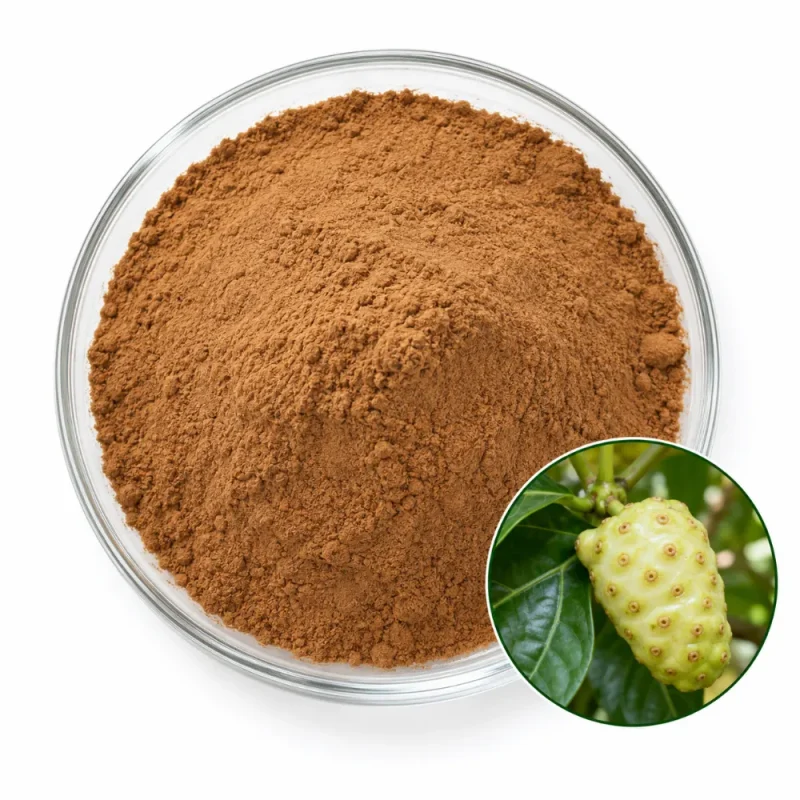
Noni Extract 10–40% Saponins

The ripe fruit of Morinda citrifolia, the noni or Indian mulberry of Pacific and Southeast Asian coasts, is extracted to give this noni extract, which is standardized for its saponin fraction. The concentrate is dried and milled to a light brown, 80 mesh powder that dissolves in water, with a muted, fermented-fruit note.

Saponins are measured by UV and offered as a 10–40% range, with 40% as the primary grade and 10% as the lower grade. A polyphenol-defined variant is a separate standardization. The higher grade fits small-fill capsules and tablets, and the lower grade fits drink mixes.

Saponin Standardization & Grades

The fruit of Morinda citrifolia L. is a pale, lumpy syncarp with a strong odor when ripe. Its chemistry is wide: iridoid glycosides such as asperulosidic acid and deacetylasperulosidic acid, scopoletin, phenolic acids, sugars and organic acids. The grade follows the saponin figure supplied for this material, a group figure for the glycoside fraction measured by color development. The iridoids and other fruit constituents accompany the saponins as background and are not part of the figure.

GradeAssay & MethodWhere It Fits
10% SaponinsUVDrink mixes, high-inclusion blends
40% SaponinsUVCapsules and tablets, small fill weight

The span is wide, so grade choice follows dose and carrier. At 40% the extract carries four times the saponin of the 10% grade per gram, which allows a compact capsule. At 10% the powder keeps more of the fruit matrix and dissolves quickly into beverages. The same fruit is also supplied as a 10:1 ratio extract without a marker figure, the Noni Extract Powder, and as whole fruit powders, the Noni Powder and the Freeze-Dried Noni Powder.

The ripe fruit is the only part used. Noni leaf, root and bark are separate materials with other chemistry, notably anthraquinones in the root, and they are not part of this identity.

Noni is also a crowded category of products. Juices, fermented drinks, puree powders and leaf teas share the name, and each is defined by different processing. A dry noni extract of the ripe fruit is a concentrated, standardized ingredient, and its specification names the species, the fruit and the saponin figure so that it cannot be mistaken for a juice-derived powder.

Saponin Analysis & Purity Risks

The UV method for saponins is colorimetric. The extract is reacted with vanillin and strong acid under controlled heating, and the color that develops is read against a saponin reference standard. The figure is a group total expressed as that reference, and it responds to any triterpenoid or steroidal glycoside, so it does not by itself show which glycosides are present.

Because the reaction is nonspecific, identity is read from the chromatographic fingerprint. Noni fruit shows the iridoid glycosides, scopoletin and organic acid markers typical of Morinda citrifolia, and this pattern distinguishes it from other fruit extracts sold in the same grade range. A lot with a high colorimetric total and none of these markers would not be accepted as noni extract.

The color reaction is sensitive to sugars and to other reducing material. Noni fruit is high in sugars, and free sugars carried into the extract react with the acid reagent and raise the apparent total, which is why a 40% extract depends on a purification step that removes them. Moisture and ash readings are also read with this in mind.

Purity risks follow from the naming. Fruit juice concentrates, fermented noni products and leaf extracts are all sold as noni, and they differ strongly in composition. Related Morinda species, such as Morinda officinalis, whose root is a different drug, are not interchangeable with Morinda citrifolia fruit. The stated species and the fruit part are part of the identity.

Raw fruit is harvested at the ripe, white-translucent stage, and processing removes the seeds before extraction. Overripe, fermented fruit gives a darker, more sour and strongly smelling extract.

Sample preparation matters for a sugar-rich fruit extract. The sample is dissolved in a defined solvent, cleared by centrifugation or filtration, and diluted into the working range before the color reaction, with the heating time and temperature held constant. A blank made from the same solvent corrects for background color, and the standard curve is prepared fresh because color development drifts with reagent age.

Typical Specifications

Specification ItemProduct Information
Latin NameMorinda citrifolia
Plant PartFruit & Berry
ProcessingEthanol Extraction
Compound ClassSaponins
Common NameNoni, Indian Mulberry
Ingredient TypeStandardized Extract
Marker Compound(s)Saponins
Primary Grade40% Saponins (UV)
Available Grades10% · 40% Saponins (UV)
AppearanceLight Brown powder
Solubility / DispersibilityWater Soluble
Quality Parameters
Moisture (LOD)≤5.0%
Total Ash≤5.0%
Particle Size80 mesh
Heavy MetalsLead ≤2 ppm · Arsenic ≤1 ppm · Cadmium ≤1 ppm · Mercury ≤0.1 ppm
MicrobiologyTPC ≤1,000 cfu/g · Yeast & Mold ≤100 cfu/g · E. coli Negative · Salmonella Negative/25 g
Shelf Life24 months in unopened original packaging, cool and dry storage

Applications by Grade

40% Grade in Hygroscopic Capsule Fills

The 40% grade of noni extract reaches a saponin target in a small fill, which suits two-piece capsules. The powder is hygroscopic and clings to tamping pins when damp, so a dry filling room, sealed hoppers and a flow agent keep capsule weights steady.

40% Grade in Moisture-Barrier Tablets

Tablets of the 40% grade need a dry binder and a moisture-barrier film coat, because the glycoside-rich powder softens in humid air. Direct compression works at low inclusion, while heavier loads call for granulation and a hardness check after a month.

10% Grade in Tropical Drink Powders

The 10% grade dissolves readily and fits instant drink powders and stick packs. The fruit’s characteristic pungent, cheesy odor is muted in the extract but remains, so strong tropical fruit, ginger or citrus flavors are used to cover it.

10% Grade in Gummy Bases

In gummies, the 10% grade is dissolved into the syrup before depositing. The sulfurous, fermented-fruit note intensifies with long heat, so the extract is added late in the cook, and a strong fruit flavor system covers what remains.

10% Grade in Shot and Concentrate Bases

Liquid shots and concentrates dissolve the 10% grade in an acidified water base. Saponins foam on filling, so a low-shear line or a vacuum step avoids entrained air, and a clarity check after a week at the storage temperature confirms that no haze develops.

Technical & Quality Considerations

Noni extract is a light brown powder with a pungent, fermented-fruit odor that is much milder than the fresh fruit. It dissolves in water to a clear to slightly hazy brown solution, and the dissolved saponins are surface-active, so agitation produces a foam that settles slowly.

Saponin glycosides hydrolyze under strong acid and heat, so neutral to mildly acidic bases keep the profile. The iridoid glycosides in the fruit are more fragile than the saponins: acid and enzymes convert them to reactive aglycones that darken. The color of the finished product shifts to dark brown in long hot holds.

The dry powder takes up moisture readily and cakes. Fine dust irritates the eyes and nose, so closed charging and local extraction help at the filler, and the odor of the powder is contained by sealed bins.

At the line, sieve the powder, premix it with part of the carrier and weigh the first units. A short accelerated stability run in the intended pack shows whether odor, color and clarity stay acceptable across the shelf life.

A quick check at receipt is useful. A light brown, fine powder with a muted, slightly sour and fermented-fruit smell is expected for noni extract, while a very strong cheesy or putrid odor points to overripe fruit and a very dark shade points to heat damage. Both are visible before any assay result arrives.

Packaging & Commercial Supply

Essencefield supports product evaluation, formulation trials, commercial orders, and ongoing ingredient supply. Packaging, storage, and shipping arrangements are determined by product characteristics, order quantity, stability requirements, and destination-market needs.

Supply ItemGeneral Information
SampleAvailable upon request for formulation, testing, and supplier evaluation
Order Quantities100 g · 1 kg · 5 kg · 25 kg · 100 kg · 500 kg · Bulk
Sample Lead TimeTypically 5–7 days after sample confirmation
Production Lead TimeTypically 15–30 days after order and specification confirmation
PackagingSuitable protective inner packaging with bags, cartons, drums, or other appropriate outer packaging
StorageStore in tightly sealed, suitable protective packaging in a cool, dry environment. Protect from moisture, heat, and direct sunlight. Specific storage conditions follow the approved product specification.
DocumentationCOA · Product Specification · TDS · SDS · Applicable declarations (as applicable)

Final order quantities, lead times, packaging, documentation, and shipping arrangements are confirmed according to the selected product and commercial requirements.

Request Ingredient Specifications & Quote

Share your target specification, application, quantity, and documentation needs. We’ll help confirm suitable options, samples, and commercial supply details.