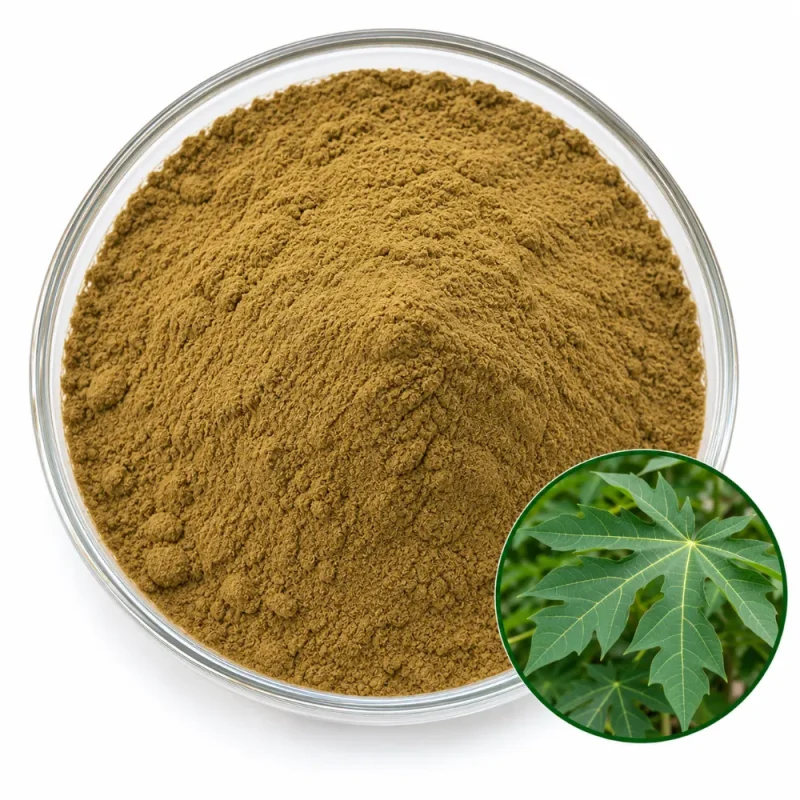
Papaya Leaf Extract 20–40% Glycosides

The large, palmate leaves of Carica papaya, the tropical papaya tree, are extracted with ethanol to give this papaya leaf extract, which is a leaf product and not a fruit or latex product. The concentrate is dried and milled to a green, 80 mesh powder with a grassy, bitter leaf character.

Glycosides are offered as a 20–40% range, with 40% as the primary grade and 20% as the lower grade. The figure describes the glycoside fraction as a group. The higher grade fits small-fill capsules and tablets, and the lower grade fits drink powders and blends.

Glycoside Standardization & Grades

The leaf of Carica papaya L. contains a family of glycosylated compounds, among them flavonol glycosides based on kaempferol and quercetin, phenolic acid glycosides and a small cyanogenic-type glycoside fraction, along with the piperidine alkaloid carpaine. A papaya leaf extract is standardized to glycosides as a group because the fraction is large and varied, and no single glycoside represents the whole. The figure tells buyers how concentrated the extract is in the glycoside class.

GradeAssay & MethodWhere It Fits
20% GlycosidesGroup figureDrink powders, higher-inclusion blends
40% GlycosidesGroup figureCapsules and tablets, small fill weight

The 40% grade carries twice the glycoside fraction of the 20% grade per gram, so a capsule reaches its target with half the fill, while the 20% grade is bulkier and blends easily at gram-level inclusion. The same plant is also supplied as a 10:1 ratio leaf extract, the Carica Papaya Leaf Extract Powder, as a general Papaya Extract Powder, and as the fruit, Papaya Powder, which is a different material.

Papaya fruit, papain from the latex and the seed are separate materials with different chemistry, and they are not part of this identity.

Glycoside Analysis & Purity Risks

A glycoside group figure counts compounds that share a sugar attached to a non-sugar part, and it cannot be translated into a content of kaempferol glycosides, quercetin glycosides or any other named subgroup. Two lots with the same figure can therefore differ in individual composition. The usefulness of such a figure depends on knowing the procedure that produced it, which is why lots are compared only when they are measured by the same procedure.

For identity, the chromatographic fingerprint is used. A papaya leaf extract shows the flavonol glycoside cluster, with rutin and kaempferol glycosides as leading peaks, and carpaine as a separate, basic peak. The pattern separates it from extracts of other tropical leaves sold in the same grade range.

The botanical risk is the name. Papaya extract is sold from the fruit, the leaf, the seed and the latex, and each is a different product. The leaf extract on a specification should name the leaf, and the species Carica papaya should not be confused with the mountain papaya (Vasconcellea) or the pawpaw (Asimina triloba), which are different plants.

A second risk is the glycoside fraction itself. Because the figure is a group total, added glycoside-rich material such as a stevia, rutin or hesperidin ingredient could raise it without adding papaya compounds. The fingerprint is the practical control for such additions.

Raw material is harvested from mature trees, dried at moderate temperature and cleaned of petioles. Leaves dried slowly in damp air turn brown and lose glycosides to enzymatic breakdown, and the extract made from them is darker and weaker.

Carpaine is a point to watch. It is a basic alkaloid and reacts differently from the glycosides in sample preparation, so analysts extract in acid for it and in alcohol for the flavonol glycosides.

A practical point concerns alkaloids and glycosides together. Carpaine is basic and the flavonol glycosides are neutral to weakly acidic, so a single extraction at one pH recovers them unevenly. Reproducible results need a defined solvent, pH and extraction time, which is why a group figure is trustworthy only when the same procedure is applied to every lot.

Typical Specifications

Specification ItemProduct Information
Latin NameCarica papaya
Plant PartLeaf & Herb
ProcessingEthanol Extraction
Compound ClassSaponins
Common NamePapaya Leaf, Papaya
Ingredient TypeStandardized Extract
Marker Compound(s)Glycosides
Primary Grade40% Glycosides
Available Grades20% · 40% Glycosides
AppearanceGreen powder
Solubility / DispersibilitySlightly Soluble in Water
Quality Parameters
Moisture (LOD)≤5.0%
Total Ash≤5.0%
Particle Size80 mesh
Heavy MetalsLead ≤2 ppm · Arsenic ≤1 ppm · Cadmium ≤1 ppm · Mercury ≤0.1 ppm
MicrobiologyTPC ≤1,000 cfu/g · Yeast & Mold ≤100 cfu/g · E. coli Negative · Salmonella Negative/25 g
Shelf Life24 months in unopened original packaging, cool and dry storage

Applications by Grade

40% Grade in Leaf-Extract Capsule Fills

The 40% grade of papaya leaf extract reaches a glycoside target in a small fill, which suits two-piece capsules. The green powder is mildly hygroscopic and sticks to tamping pins when damp, so a flow agent and a dry filling room keep capsule weights consistent.

40% Grade in Coated Tablets

Tablets of the 40% grade need a dry binder and a film coat to limit moisture and cover the green-brown speckling of the leaf. Flavonol glycosides darken in humid air, so a coated tablet in a sealed pack holds its shade better than an uncoated one.

20% Grade in Green-Tinted Drink Powders

The 20% grade disperses into instant drink powders and stick packs, giving a pale green-yellow haze because it is only slightly soluble. Its flavor is grassy and bitter, and mint, pineapple or green tea flavors suit it well.

20% Grade in Tropical Tea Granules

Granulated blends for infusion pair the 20% grade with cut papaya leaf or tropical herbs. The extract dissolves more slowly than the cut leaf, so it is dosed as a fine powder inside the bag, and a slight haze on steeping is expected.

40% Grade in Chewable Tablet Bases

Chewable tablets can mask the bitterness of the 40% grade with fruit flavors and sweeteners. Bitter alkaloid traces such as carpaine need a strong flavor system, and a taste check after storage shows whether the bitterness has changed over time.

Technical & Quality Considerations

Papaya leaf extract is a green to green-brown powder with a grassy, bitter and slightly herbal character. It is only slightly soluble in water. The glycosides dissolve better in warm water and aqueous alcohol, while the less polar material settles as a fine green sediment in still liquids.

Flavonol glycosides are fairly heat-stable but oxidize in solution under light and metal ions, and they hydrolyze under strong acid and heat to the less soluble aglycones. Neutral to mildly acidic bases, short heat treatment and opaque packaging keep the profile stable. Chlorophyll-related pigments fade to olive and brown, which is why shelf-life color checks are part of the quality plan.

The dry powder takes up moisture and cakes when damp. Closed charging and local extraction keep the green dust out of the air at the filler.

A receiving check helps: a green, fine powder with a mild grassy note is expected, while a dark brown cast points to heat damage and a musty smell suggests damp storage. Then an accelerated stability run in the intended pack shows early whether color, flow and taste stay stable.

Texture and color are quick checks on the lot. A green, free-flowing fine powder is expected for papaya leaf extract, while hard lumps point to moisture uptake in transit and a bleached yellow cast points to light damage. Sieving the lot before use removes lumps, and the sieve residue should be recorded.

Packaging & Commercial Supply

Essencefield supports product evaluation, formulation trials, commercial orders, and ongoing ingredient supply. Packaging, storage, and shipping arrangements are determined by product characteristics, order quantity, stability requirements, and destination-market needs.

Supply ItemGeneral Information
SampleAvailable upon request for formulation, testing, and supplier evaluation
Order Quantities100 g · 1 kg · 5 kg · 25 kg · 100 kg · 500 kg · Bulk
Sample Lead TimeTypically 5–7 days after sample confirmation
Production Lead TimeTypically 15–30 days after order and specification confirmation
PackagingSuitable protective inner packaging with bags, cartons, drums, or other appropriate outer packaging
StorageStore in tightly sealed, suitable protective packaging in a cool, dry environment. Protect from moisture, heat, and direct sunlight. Specific storage conditions follow the approved product specification.
DocumentationCOA · Product Specification · TDS · SDS · Applicable declarations (as applicable)

Final order quantities, lead times, packaging, documentation, and shipping arrangements are confirmed according to the selected product and commercial requirements.

Request Ingredient Specifications & Quote

Share your target specification, application, quantity, and documentation needs. We’ll help confirm suitable options, samples, and commercial supply details.