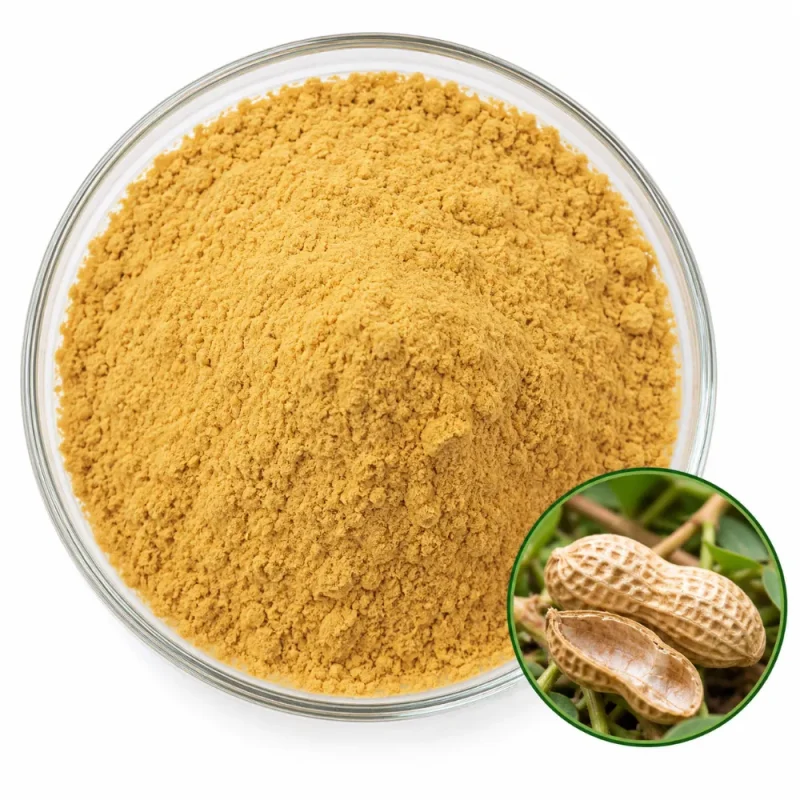
Peanut Shell Extract 20% Luteolin standardized extract

The dried pod shells of Arachis hypogaea, the peanut or groundnut, are an agricultural by-product that is milled and extracted with ethanol to give this peanut shell extract. The shells are milled and the concentrate is dried to a yellow-brown, 80 mesh powder with a mild, woody note.

Luteolin is measured by HPLC at a single 20% grade. The peanut seed and its red skin are different materials. The powder fits capsules, tablets and oil-based fills where a defined luteolin source is wanted. The single grade suits capsules, tablets and oil-based fills, and it keeps ordering and testing simple across repeat lots.

Luteolin Standardization & Grades

Luteolin is a tetrahydroxyflavone, 3′,4′,5,7-tetrahydroxyflavone, and the shell of Arachis hypogaea L. is one of its richer agricultural sources. The shell is a lignocellulosic material, rich in fiber, and its extractable phenolic fraction is dominated by luteolin and its glycosides, with eriodictyol and other flavonoids in smaller amounts. Standardizing a peanut shell extract to luteolin gives buyers one defined figure for this fraction.

The grade is a single 20% level, so each lot is measured against the same target and the same method. A 20% luteolin figure is a strong concentration and implies a purification step that removes the fiber and the sugars of the shell. The luteolin in the shell is partly glycosidic, so the figure counts luteolin as the aglycone after the defined extraction conditions. The same flavone is also supplied as a purified compound, Luteolin 98%, a different product with a higher purity.

Peanut skin extract, the Peanut Skin Extract Powder, is built on the red seed coat and its procyanidins, and the seed itself is available as Peanut Powder. Neither shares the shell’s luteolin profile.

The shell is the part used, and it is worth saying why. Peanut shells are produced in very large quantities by the shelling industry, and they are a clean, dry, lignocellulosic by-product. Turning that stream into a defined flavonoid extract needs milling, extraction and a purification step, and the luteolin figure is the quality check that the purification has concentrated the flavone. Peanut shell extract is therefore defined by the shell and by the luteolin figure.

Luteolin Analysis & Purity Risks

HPLC separates luteolin from apigenin, eriodictyol and the other flavones of the shell on a reversed-phase column. Flavones absorb strongly in the UV, so detection is sensitive, and the peak is quantified against a luteolin reference standard. Luteolin is poorly soluble, so sample preparation uses methanol or dimethyl sulfoxide with sonication, and complete dissolution is confirmed with a spiked sample.

Whether the figure includes glycosides matters. In the raw shell, a large share of luteolin is bound to sugars, and the extraction and hydrolysis conditions decide how much is counted as free luteolin. A figure stated as luteolin after a defined hydrolysis is not comparable with a figure for free luteolin in an unhydrolyzed extract, and the fingerprint shows the balance of free and bound forms.

Identity is read from the fingerprint. Luteolin with eriodictyol and a series of related flavonoid peaks is typical of the shell, and the pattern separates the extract from luteolin-spiked material, because added purified luteolin gives a clean luteolin peak and no companions. Luteolin is also found in celery, parsley, chamomile and many other plants, so the figure alone does not identify the source.

The botanical risk is the part. The seed coat or skin, the kernel and the shell are all called peanut by-products, and they are different materials. The shell is the stated part here. Contaminants are a second risk, because shells collected from processing lines can carry soil, sand and residues from the field, so cleaning before extraction is part of the raw-material control.

Raw shells are collected clean, dried and stored dry, because shells that have taken up moisture develop mold quickly, which shows as a musty smell in the extract.

Typical Specifications

Specification ItemProduct Information
Latin NameArachis hypogaea
Plant PartSeed & Grain
ProcessingEthanol Extraction
Compound ClassFlavonoids, Polyphenols
Common NamePeanut Shell, Groundnut Shell
Ingredient TypeStandardized Extract
Marker Compound(s)Luteolin
Primary Grade20% Luteolin (HPLC)
AppearanceYellow-Brown powder
Solubility / DispersibilityInsoluble in Water
Quality Parameters
Moisture (LOD)≤5.0%
Total Ash≤5.0%
Particle Size80 mesh
Heavy MetalsLead ≤2 ppm · Arsenic ≤1 ppm · Cadmium ≤1 ppm · Mercury ≤0.1 ppm
MicrobiologyTPC ≤1,000 cfu/g · Yeast & Mold ≤100 cfu/g · E. coli Negative · Salmonella Negative/25 g
Shelf Life24 months in unopened original packaging, cool and dry storage

Applications by Grade

20% Grade in Pigmented Capsule Fills

The 20% grade of peanut shell extract reaches a luteolin target in a small fill, which suits two-piece capsules. The yellow-brown powder stains equipment and is slightly tacky, so a flow agent, a dry filling room and prompt cleaning keep the line clean.

20% Grade in Film-Coated Tablets

Tablets of the 20% peanut shell grade need a dry binder and an opaque film coat. Luteolin is a yellow pigment, so the core shows through light coats, and a tinted coat gives an even appearance while protecting the flavone from light and humidity.

20% Grade in Oil-Phase Softgels

Luteolin is far more soluble in lipids than in water, which suits softgel-style fills and liquid-filled capsules. Mill the powder fine, because luteolin crystals settle in the oil, and keep the fill under gentle agitation while it is dispensed.

20% Grade in Emulsified Drink Concentrates

Beverage concentrates can carry the 20% grade in an emulsified base, because the extract does not dissolve in water. Homogenization keeps the flavone dispersed, a golden-yellow tint is expected in the finished concentrate, and a stabilizer limits settling during storage.

20% Grade in Stick-Pack Premixes

Stick-pack premixes use the 20% peanut shell grade in a bulking carrier so the filler can meter an accurate dose of this water-insoluble powder. Label directions should call for shaking, and a fine grind avoids yellow specks in the glass.

Technical & Quality Considerations

Peanut shell extract is a yellow-brown powder with a mild, woody and slightly nutty character. It does not dissolve in water. Luteolin dissolves in ethanol, in dimethyl sulfoxide and in some lipids, so oil, alcohol-containing and suspension bases give a more uniform product than a plain aqueous mix.

Luteolin is relatively stable as a dry solid, but the catechol group on its B ring makes it prone to oxidation in solution, particularly at higher pH and in the presence of iron or copper, where it turns brown. It also chelates metals and forms colored complexes. Chelating agents, mildly acidic bases and opaque packaging hold the shade.

The dry powder takes up little moisture but cakes in a warm warehouse. Closed charging and local extraction keep the fine yellow-brown dust out of the air and off equipment.

A receiving check helps: a yellow-brown, fine powder with a faint woody note is expected, while a gray or green cast points to impurities or metal contact and a musty smell suggests damp shells. Then an accelerated stability run in the intended pack shows early whether color, flow and the luteolin figure hold across the shelf life.

Packaging & Commercial Supply

Essencefield supports product evaluation, formulation trials, commercial orders, and ongoing ingredient supply. Packaging, storage, and shipping arrangements are determined by product characteristics, order quantity, stability requirements, and destination-market needs.

Supply ItemGeneral Information
SampleAvailable upon request for formulation, testing, and supplier evaluation
Order Quantities100 g · 1 kg · 5 kg · 25 kg · 100 kg · 500 kg · Bulk
Sample Lead TimeTypically 5–7 days after sample confirmation
Production Lead TimeTypically 15–30 days after order and specification confirmation
PackagingSuitable protective inner packaging with bags, cartons, drums, or other appropriate outer packaging
StorageStore in tightly sealed, suitable protective packaging in a cool, dry environment. Protect from moisture, heat, and direct sunlight. Specific storage conditions follow the approved product specification.
DocumentationCOA · Product Specification · TDS · SDS · Applicable declarations (as applicable)

Final order quantities, lead times, packaging, documentation, and shipping arrangements are confirmed according to the selected product and commercial requirements.

Request Ingredient Specifications & Quote

Share your target specification, application, quantity, and documentation needs. We’ll help confirm suitable options, samples, and commercial supply details.