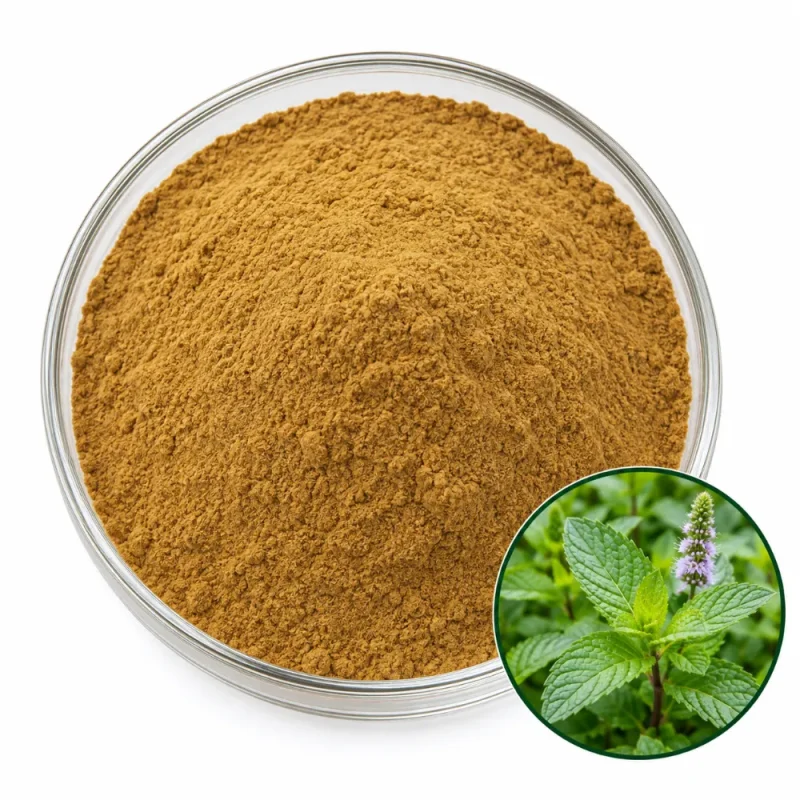
Peppermint Extract 1–20% Rosmarinic Acid / Menthol

The leaves of Mentha piperita, the cultivated hybrid peppermint of temperate gardens, are extracted with ethanol to give this peppermint extract, which is a polar phenolic extract rather than an essential oil. It is dried and milled to a green, 80 mesh powder with a cool, minty note that is milder than the oil.

Rosmarinic acid and menthol are offered as a 1–20% range, with 20% as the primary grade and 1% as the lower grade, measured by HPLC. The higher grade suits compact capsules, while the lower grade suits drink powders and blends that can carry more of the leaf.

Marker Compounds & Standardization

Peppermint carries two chemically different marker families. Rosmarinic acid is a polar caffeic acid ester that dominates the phenolic fraction of the leaf of Mentha piperita L., together with luteolin and hesperidin-type glycosides. Menthol is a cyclic monoterpene alcohol that is the main component of the volatile oil. A grade that names both asks the extract to hold a polar phenolic and a volatile terpene at once, which is a demanding specification that depends on how the extract is made and stored.

GradeAssay & MethodWhere It Fits
1% Rosmarinic Acid / MentholHPLCDrink powders, blends
20% Rosmarinic Acid / MentholHPLCCapsules and tablets, small fill weight

The span is wide, so grade choice follows dose and carrier. At the 20% grade the extract holds twenty times the marker of the 1% grade in each gram, so capsules can be small. At 1% the powder keeps most of the leaf matrix and dissolves into beverages. The same herb is also supplied as a 10:1 ratio extract without a marker figure, the Peppermint Extract Powder, and as a milled leaf, Peppermint Leaf Powder.

The leaf is the only part used. Stems and flowering tops carry less of both markers and are not part of this identity. The essential oil, which is a separate product, is not part of this identity either.

The leaf and its harvest stage matter for both markers. Rosmarinic acid builds up in leaves that are cut before flowering, while the oil and menthol peak around flowering, so a harvest between the two stages compromises on one or the other. Peppermint extract is therefore defined by the leaf, the harvest approach and the two marker figures.

Analytical Methods & Purity Risks

HPLC reads rosmarinic acid directly, since the caffeoyl chromophore absorbs strongly in the UV. Menthol is a harder analyte, because it has no strong chromophore and it is volatile. Its figure needs a detector that does not rely on UV absorbance, and sample handling that keeps the compound from evaporating, such as closed vials and cool autosampler trays. The two markers therefore come from different parts of the analytical program, and the result for each is quantified against its own reference standard.

The volatility of menthol governs the whole specification. Drying and concentrating an ethanolic extract drives off a large share of the volatile oil, so a spray-dried or vacuum-dried powder holds only what the process retained, and a menthol figure at a given level means that retention was controlled. A lot with a high rosmarinic acid figure and almost no menthol is a different product from one that holds both.

Identity is read from the fingerprint. Rosmarinic acid with the luteolin and hesperidin glycosides is typical of peppermint leaf, and this pattern separates it from extracts of other herbs sold in the same grade range.

The botanical risk is the genus. Peppermint (Mentha × piperita) is a hybrid of water mint and spearmint, and the mints are traded under overlapping names. Corn mint (Mentha arvensis) is the main commercial source of natural menthol, and spearmint (Mentha spicata) contains carvone and little menthol, so the species is named. The leaf part is also part of the identity.

Harvest and drying matter. The herb is cut at the start of flowering and dried quickly at a low temperature, since slow or hot drying loses oil and bleaches the green color.

Typical Specifications

Specification ItemProduct Information
Latin NameMentha piperita
Plant PartLeaf & Herb
ProcessingEthanol Extraction
Compound ClassPolyphenols
Common NamePeppermint
Ingredient TypeStandardized Extract
Marker Compound(s)Rosmarinic Acid; Menthol
Primary Grade20% Rosmarinic Acid / Menthol (HPLC)
Available Grades1% · 20% Rosmarinic Acid / Menthol (HPLC)
AppearanceGreen powder
Solubility / DispersibilitySlightly Soluble in Water
Quality Parameters
Moisture (LOD)≤5.0%
Total Ash≤5.0%
Particle Size80 mesh
Heavy MetalsLead ≤2 ppm · Arsenic ≤1 ppm · Cadmium ≤1 ppm · Mercury ≤0.1 ppm
MicrobiologyTPC ≤1,000 cfu/g · Yeast & Mold ≤100 cfu/g · E. coli Negative · Salmonella Negative/25 g
Shelf Life24 months in unopened original packaging, cool and dry storage

Applications by Grade

20% Grade in Cool-Filled Capsules

The 20% grade of peppermint extract reaches a marker target in a small fill, which suits two-piece capsules. Because menthol is volatile, keep the filling room cool and the hoppers closed, and use sealed bottles so the cooling note does not leave the pack.

20% Grade in Gentle-Heat Tablets

Tablets of the 20% grade need a dry binder and low compression heat, since heat on the press drives off menthol. A film coat seals the tablet and traps the aroma, and a sealed bottle with a desiccant limits migration into the closure liner.

1% Grade in Cooling Drink Powders

The 1% grade disperses into instant drink powders, giving a pale green haze because it is only slightly soluble. Its fresh, minty and slightly bitter taste suits lemon, cucumber and green tea flavors, and the powder should be added late in blending.

1% Grade in Lozenge and Chew Bases

Lozenge and chew bases carry the 1% grade, where menthol and the bitter leaf note combine with sugar-free sweeteners. Cooking temperatures should stay moderate and the extract is added at the end, because volatiles are lost at high heat.

20% Grade in Herbal Tea Granules

Granulated blends for infusion pair the 20% grade with cut peppermint leaf, which gives a strong minty aroma and a dissolved phenolic base. The extract is dosed as a fine powder inside the bag and kept apart from moist ingredients.

Technical & Quality Considerations

Peppermint extract is a green to green-brown powder with a cool, minty and slightly bitter character that is milder than the fresh herb. It is only slightly soluble in water. Rosmarinic acid dissolves better in warm water and aqueous alcohol, while menthol dissolves in ethanol and in lipids, so a mixed aqueous-alcohol or emulsified base holds both.

Menthol is volatile and sublimes at room temperature, so open storage and warm rooms lower its figure over time. Rosmarinic acid is an ester that hydrolyzes in strong alkali and darkens by oxidation in solution with iron or copper. Sealed, opaque packaging, low warehouse temperatures and chelating agents protect both markers.

The dry powder takes up moisture and cakes when damp. Closed charging and local extraction keep the minty dust out of the air at the filler.

A receiving check helps: a green, fine powder with a fresh minty note is expected, while a flat smell points to loss of volatiles and a brown cast points to heat damage. Then an accelerated stability run at a moderate temperature in the intended pack shows early whether aroma, color and the marker figures hold across the shelf life.

Packaging & Commercial Supply

Essencefield supports product evaluation, formulation trials, commercial orders, and ongoing ingredient supply. Packaging, storage, and shipping arrangements are determined by product characteristics, order quantity, stability requirements, and destination-market needs.

Supply ItemGeneral Information
SampleAvailable upon request for formulation, testing, and supplier evaluation
Order Quantities100 g · 1 kg · 5 kg · 25 kg · 100 kg · 500 kg · Bulk
Sample Lead TimeTypically 5–7 days after sample confirmation
Production Lead TimeTypically 15–30 days after order and specification confirmation
PackagingSuitable protective inner packaging with bags, cartons, drums, or other appropriate outer packaging
StorageStore in tightly sealed, suitable protective packaging in a cool, dry environment. Protect from moisture, heat, and direct sunlight. Specific storage conditions follow the approved product specification.
DocumentationCOA · Product Specification · TDS · SDS · Applicable declarations (as applicable)

Final order quantities, lead times, packaging, documentation, and shipping arrangements are confirmed according to the selected product and commercial requirements.

Request Ingredient Specifications & Quote

Share your target specification, application, quantity, and documentation needs. We’ll help confirm suitable options, samples, and commercial supply details.