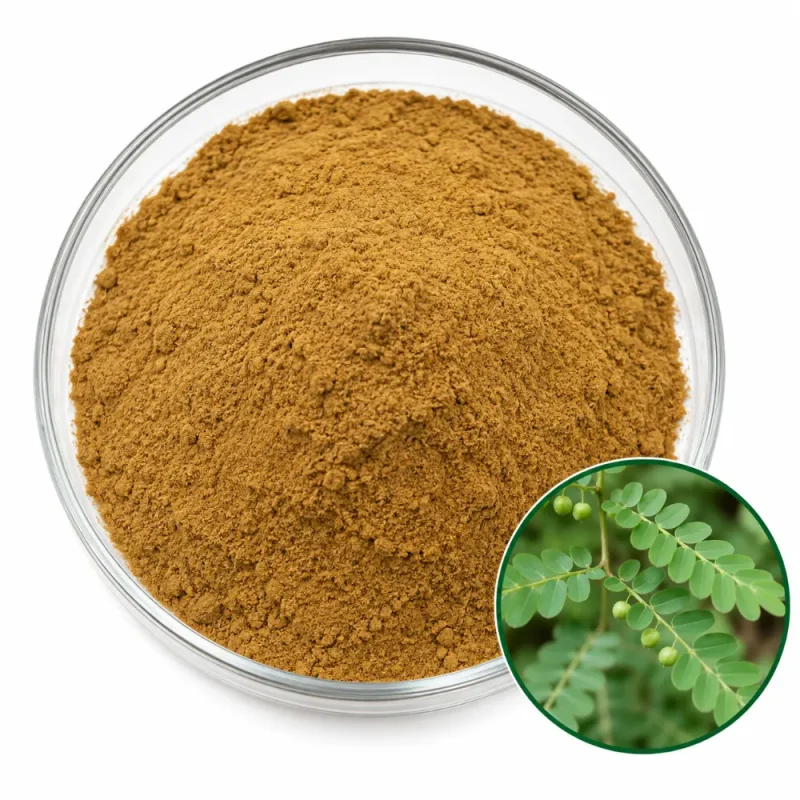
Phyllanthus amarus Extract 3% Bitter Principles

The aerial parts of Phyllanthus amarus, a small annual herb of tropical roadsides and fields known in Ayurvedic trade as bhumyamalaki, are extracted with ethanol to give this Phyllanthus amarus extract. The concentrate is dried and milled to a light brown, 80 mesh powder with a woody, astringent character.

Bitter principles are offered at a single 3% grade. The figure describes the bitter fraction of the herb as a group. The identity statement fixes the species, because several look-alike Phyllanthus herbs are traded, and the aerial parts are the stated material.

Bitter Principle Standardization & Grades

Phyllanthus amarus Schumach. & Thonn. is a member of the leaf-flower family, and its bitterness comes from a mixed group of constituents: the lignans phyllanthin and hypophyllanthin, hydrolyzable tannins such as corilagin and geraniin, and flavonoids including rutin and quercetin glycosides. No single compound represents the whole bitter fraction, so the extract is standardized to bitter principles as a group, a figure that tells buyers how concentrated the extract is in the bitter-tasting material of the herb.

The grade is a single 3% level, so each lot is measured against the same target and the same procedure. A modest group figure suits a herb in which a wide range of polar and mid-polar compounds are extracted together, and it avoids implying a concentrated marker ingredient. The herb is also supplied as a 10:1 ratio extract without a marker figure, the Phyllanthus Amarus Extract Powder. Where a bitter fraction figure is wanted, this standardized grade is the one to order.

No milled herb or single-compound sibling of this species is currently listed in the catalog. The number is a group figure, and it should not be read as a figure for phyllanthin, hypophyllanthin or any tannin.

The aerial herb is the part used. Phyllanthus amarus is a small annual that is pulled up whole at flowering and cleaned of its roots. The leaves and the thin green stems carry the lignans and flavonoids, while the root carries very little, so a lot that includes root shows a lower bitter share. A Phyllanthus amarus extract is therefore defined by the species and by the aerial herb.

Bitter Principle Analysis & Purity Risks

Bitter principles is a group measurement, not a single-compound assay. It counts several kinds of compound together, and the lignans, tannins and flavonoids contribute to it in different degrees. A procedure has to be applied the same way to every lot for the figure to be comparable.

For identity, the chromatographic fingerprint is the practical tool. Phyllanthus amarus shows phyllanthin and hypophyllanthin as lipophilic lignan peaks, with corilagin and geraniin as polar tannin peaks and rutin among the flavonoids. This pattern separates it from other Phyllanthus herbs, which carry the same classes of compound in different proportions.

The botanical risk is the genus. Phyllanthus amarus, Phyllanthus niruri, Phyllanthus fraternus and Phyllanthus urinaria are close, visually similar herbs that are used and sold under overlapping names, and herbarium studies show that they are often mixed up in trade. The Indian gooseberry (Phyllanthus emblica), a tree whose fruit is sold as amla, is also called a Phyllanthus but is an entirely different material. The stated species and the aerial parts are part of the identity.

A second risk is the part and the age. Roots and fruits of the herb carry different compounds, and old, woody plants carry fewer lignans. The herb is harvested whole at the flowering stage, dried promptly and cleaned of roots and soil before extraction. Herb dried slowly in damp air turns dark and loses tannins to oxidation, giving a darker, weaker extract.

Sample preparation affects the reading. The lignans dissolve in methanol or ethanol, while the tannins and flavonoid glycosides dissolve in aqueous alcohol, so a single solvent recovers the groups unevenly and the procedure fixes both the solvent and the extraction time. A calibration curve made from fresh reference solutions keeps the results of different days comparable.

Typical Specifications

Specification ItemProduct Information
Latin NamePhyllanthus amarus
Plant PartLeaf & Herb
ProcessingEthanol Extraction
Compound ClassPolyphenols
Common NamePhyllanthus, Stone Breaker
Ingredient TypeStandardized Extract
Marker Compound(s)Bitter Principles
Primary Grade3% Bitter Principles
AppearanceLight Brown powder
Solubility / DispersibilitySlightly Soluble in Water
Quality Parameters
Moisture (LOD)≤5.0%
Total Ash≤5.0%
Particle Size80 mesh
Heavy MetalsLead ≤2 ppm · Arsenic ≤1 ppm · Cadmium ≤1 ppm · Mercury ≤0.1 ppm
MicrobiologyTPC ≤1,000 cfu/g · Yeast & Mold ≤100 cfu/g · E. coli Negative · Salmonella Negative/25 g
Shelf Life24 months in unopened original packaging, cool and dry storage

Applications by Grade

3% Grade in Bitter Capsule Fills

The 3% grade of Phyllanthus amarus extract fits two-piece capsules at a moderate fill weight. The tannin-rich powder is astringent and slightly tacky, so an opaque shell, a dry filling room and a flow agent keep capsule weights steady and the bitter dust off the line.

3% Grade in Coated Tablets

Tablets of the 3% grade need a dry binder and a film coat, since the astringent, bitter taste shows at the tablet surface. A coat also keeps moisture out, and a hardness check after a month of storage confirms that the tannins have not softened the tablet.

3% Grade in Herbal Powder Blends

Dry herbal blends carry the 3% grade beside other bitter herbs, such as andrographis or neem leaf. The extract is finer than the cut herb, so it is premixed with part of the carrier to avoid layering, and the blend is sampled from several depths for uniformity.

3% Grade in Granule Sachets

Granulated sachets carry the 3% grade with a sweet or honey-type base that masks the bitterness. The extract dissolves only partly, so the drink is a hazy brown suspension, and label directions should call for stirring before drinking.

3% Grade in Chewable Tablet Bases

Chewable tablets can mask the bitterness of the 3% grade with fruit flavors and sweeteners. Tannins darken in the presence of alkaline fillers and iron, so neutral or slightly acidic excipients are used and the color is checked after storage.

Technical & Quality Considerations

Phyllanthus amarus extract is a light brown powder with a woody, astringent and bitter character. It is only slightly soluble in water. The tannins and flavonoid glycosides dissolve in warm water and aqueous alcohol, while the lipophilic lignans dissolve poorly and settle as a fine sediment in still liquids.

Hydrolyzable tannins such as corilagin hydrolyze under strong acid, alkali and heat to gallic and ellagic acids, and they oxidize with iron and copper to darker colors. The lignans phyllanthin and hypophyllanthin are fairly stable, but they are lipophilic and can adsorb to plastic surfaces in dilute liquids.

The powder is hygroscopic enough to cake and darken when it is left open. Closed charging and local extraction keep the astringent, bitter dust out of the air at the filler, and cleaning between lots prevents carry-over of the taste.

A receiving check helps: a light brown, fine powder with a dry, woody note is expected, while a green cast points to unremoved chlorophyll-bearing material and a musty smell suggests damp herb. Then an accelerated stability run in the intended pack shows early whether color, flow and taste remain acceptable across the shelf life.

Texture and color are quick checks on the lot. A light brown, free-flowing fine powder is expected for Phyllanthus amarus extract, while hard lumps point to moisture uptake in transit and a dull gray cast points to oxidized tannins. Sieving the lot before use removes lumps, and the residue should be noted.

Packaging & Commercial Supply

Essencefield supports product evaluation, formulation trials, commercial orders, and ongoing ingredient supply. Packaging, storage, and shipping arrangements are determined by product characteristics, order quantity, stability requirements, and destination-market needs.

Supply ItemGeneral Information
SampleAvailable upon request for formulation, testing, and supplier evaluation
Order Quantities100 g · 1 kg · 5 kg · 25 kg · 100 kg · 500 kg · Bulk
Sample Lead TimeTypically 5–7 days after sample confirmation
Production Lead TimeTypically 15–30 days after order and specification confirmation
PackagingSuitable protective inner packaging with bags, cartons, drums, or other appropriate outer packaging
StorageStore in tightly sealed, suitable protective packaging in a cool, dry environment. Protect from moisture, heat, and direct sunlight. Specific storage conditions follow the approved product specification.
DocumentationCOA · Product Specification · TDS · SDS · Applicable declarations (as applicable)

Final order quantities, lead times, packaging, documentation, and shipping arrangements are confirmed according to the selected product and commercial requirements.

Request Ingredient Specifications & Quote

Share your target specification, application, quantity, and documentation needs. We’ll help confirm suitable options, samples, and commercial supply details.