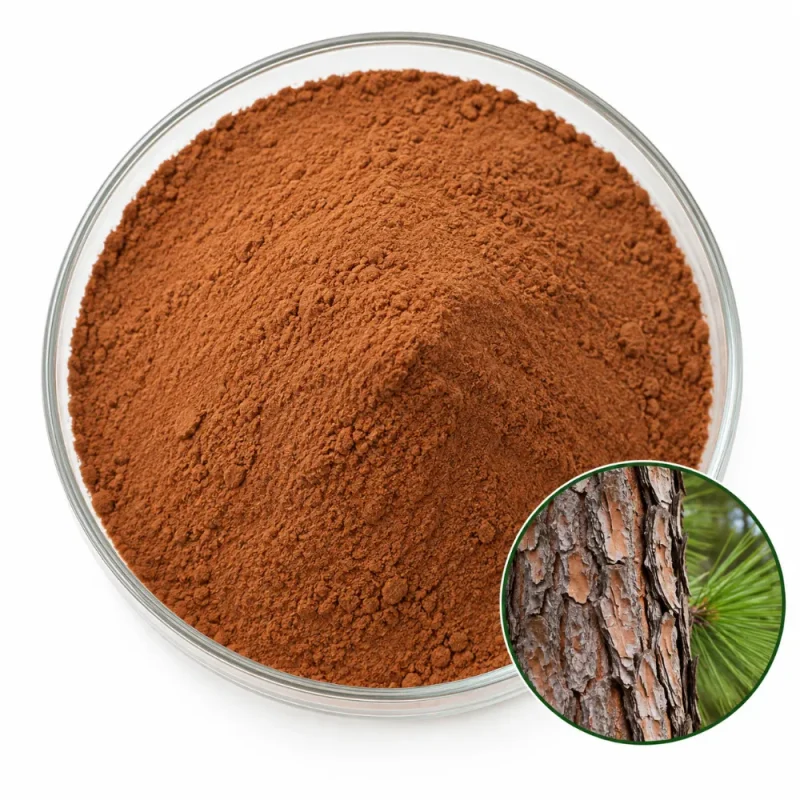
Pine Bark Extract 95% OPC / Proanthocyanidins

The inner bark of Pinus pinaster, the maritime pine of the Atlantic and western Mediterranean coasts, is extracted to give this pine bark extract, which is standardized for its proanthocyanidin fraction. The concentrate is dried to a red-brown powder, milled to 80 mesh, that is only slightly soluble in water.

Oligomeric proanthocyanidins (OPC) and proanthocyanidins are measured by UV at a single 95% grade. A range grade of the same plant is a separate listing. The powder fits capsules, tablets and powder blends that need a defined proanthocyanidin source. It suits capsules, tablets and powder blends, and the single grade keeps ordering and testing simple.

Proanthocyanidin Standardization & Grades

Proanthocyanidins are condensed tannins, polymers of flavan-3-ol units such as catechin and epicatechin joined by carbon bonds. In the bark of Pinus pinaster Aiton the units are mainly procyanidins, built from catechin and epicatechin, and they range from dimers and trimers, which are the oligomers called OPC, to long polymers. A pine bark extract is standardized to proanthocyanidins because they are the characteristic and dominant polyphenols of the bark. The 95% figure describes an extract in which nearly all of the phenolic material is of this type.

The grade is a single 95% level, so each lot is measured against the same target and the same method. A 95% proanthocyanidin figure is very high and implies an extract purified of sugars, phenolic acids and low-molecular-weight material. The same bark is also supplied as a French maritime pine bark extract with a range of 65 to 95% procyanidins, the French Maritime Pine Bark Extract ≥65–95% Procyanidins/OPC, and as a 10:1 ratio extract, the Pine Bark Extract Powder. That range product is the one to consider when the lower tiers are acceptable.

The bark is the only part used. Needles, cones and the resin of the same tree are different materials with other chemistry, and they are not part of this identity.

Proanthocyanidin Analysis & Purity Risks

The UV method for proanthocyanidins is colorimetric. The sample is heated with acid in butanol, which cleaves the interflavan bonds and converts the extension units to colored anthocyanidins, and the color is read against a reference standard. The result is a group total. It counts oligomers and polymers together, since both release anthocyanidins, so a figure called OPC by this method is a total proanthocyanidin result and not a count of the small oligomers alone.

An HPLC result for single monomers and dimers will be much lower, and it cannot be converted into the UV number. The vanillin method is an alternative colorimetric approach that responds mainly to the terminal units and gives a different answer, which is why a stated method is part of the specification.

Identity is read from the fingerprint. The pattern of catechin, epicatechin and procyanidin dimers and trimers, with taxifolin and phenolic acids as minor companions, is typical of Pinus pinaster bark and differs from that of grape seed, which contains gallated units, and from that of other pine barks. A lot with the correct total and a pattern that includes gallates or a different monomer mix is examined.

The botanical risk is the pine. Several pine species are used for bark extracts, including the Monterey pine (Pinus radiata) and the Masson pine (Pinus massoniana), and they differ in their proanthocyanidin profile and content. The name French maritime pine refers to a specific species and source, and the page states only the species and the bark. Grape seed and other proanthocyanidin-rich extracts can be added to raise the total.

Raw bark is stripped, dried and stored dry. Bark that is stored damp or heated loses color and tannins by oxidation to phlobaphenes, giving a darker, red-brown, less soluble extract.

Typical Specifications

Specification ItemProduct Information
Latin NamePinus pinaster
Plant PartBark & Stem
ProcessingEthanol Extraction
Compound ClassPolyphenols
Common NamePine Bark, Maritime Pine
Ingredient TypeStandardized Extract
Marker Compound(s)OPC / Proanthocyanidins
Primary Grade95% OPC / Proanthocyanidins (UV)
AppearanceRed-Brown powder
Solubility / DispersibilitySlightly Soluble in Water
Quality Parameters
Moisture (LOD)≤5.0%
Total Ash≤5.0%
Particle Size80 mesh
Heavy MetalsLead ≤2 ppm · Arsenic ≤1 ppm · Cadmium ≤1 ppm · Mercury ≤0.1 ppm
MicrobiologyTPC ≤1,000 cfu/g · Yeast & Mold ≤100 cfu/g · E. coli Negative · Salmonella Negative/25 g
Shelf Life24 months in unopened original packaging, cool and dry storage

Applications by Grade

95% Grade in Compact Capsule Fills

The 95% grade of pine bark extract delivers a proanthocyanidin target in a very small fill, which suits two-piece capsules. The red-brown powder is hygroscopic and tacky, so a dry filling room, a flow agent and sealed hoppers keep capsule weights steady.

95% Grade in Pigment-Aware Tablets

Tablets of the 95% grade need a dry binder and an opaque film coat, because the tannin-rich powder stains and darkens when it picks up moisture. A coat in a matching shade and a desiccant in the bottle hold an even tablet color.

95% Grade in Protein-Free Drink Powders

Instant drink powders carry the 95% grade at very low doses. The astringent, drying mouthfeel is strong, so fruit acids and sweeteners balance it, and the powder should not be mixed with milk or protein bases, in which tannins bind protein and form a cloudy precipitate.

95% Grade in Gummy Bases

In gummies, the 95% grade is dissolved into the syrup late in the cook. Tannins react with pectin and gelatin, which can firm or cloud the mass. A trial batch is run to see how the gel behaves, and the color of the finished piece is checked after storage.

95% Grade in Contract Blending

Contract blenders use the 95% grade as a concentrated component in multi-ingredient powders. Because the dose is small, blend in stages and verify uniformity on a pilot batch, since the dark, sticky powder can streak a pale carrier.

Technical & Quality Considerations

Pine bark extract is a red-brown powder with a dry, astringent and faintly resinous character. It is only slightly soluble in water, and the oligomers dissolve better than the long polymers, so the solution is a hazy reddish-brown that clears partly on warming. Ethanol-containing bases dissolve the extract more completely.

Proanthocyanidins are sensitive to several conditions. Strong acid and heat cleave the interflavan bonds and release colored anthocyanidins, which shifts the shade and the molecular profile. Oxidation turns the extract darker, and iron and copper form blue-black complexes, so mineral premixes and iron-fortified bases need compatibility trials.

The dry powder is hygroscopic and cakes when damp. Closed charging and local extraction keep the fine red-brown dust out of the air and off equipment, since it stains surfaces.

A receiving check helps: a red-brown, fine powder with a dry, resinous note is expected, while a very dark or gray cast points to oxidation and a sharp smell suggests solvent or heat damage. Then an accelerated stability run in the intended pack shows early whether color, flow and the proanthocyanidin figure hold across the shelf life.

Packaging & Commercial Supply

Essencefield supports product evaluation, formulation trials, commercial orders, and ongoing ingredient supply. Packaging, storage, and shipping arrangements are determined by product characteristics, order quantity, stability requirements, and destination-market needs.

Supply ItemGeneral Information
SampleAvailable upon request for formulation, testing, and supplier evaluation
Order Quantities100 g · 1 kg · 5 kg · 25 kg · 100 kg · 500 kg · Bulk
Sample Lead TimeTypically 5–7 days after sample confirmation
Production Lead TimeTypically 15–30 days after order and specification confirmation
PackagingSuitable protective inner packaging with bags, cartons, drums, or other appropriate outer packaging
StorageStore in tightly sealed, suitable protective packaging in a cool, dry environment. Protect from moisture, heat, and direct sunlight. Specific storage conditions follow the approved product specification.
DocumentationCOA · Product Specification · TDS · SDS · Applicable declarations (as applicable)

Final order quantities, lead times, packaging, documentation, and shipping arrangements are confirmed according to the selected product and commercial requirements.

Request Ingredient Specifications & Quote

Share your target specification, application, quantity, and documentation needs. We’ll help confirm suitable options, samples, and commercial supply details.