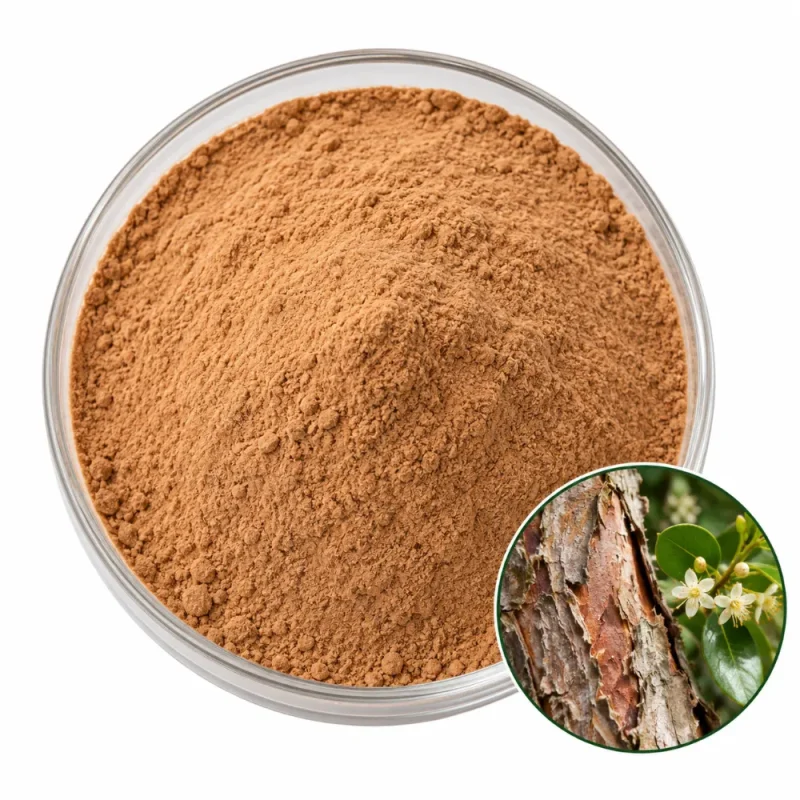
Quillaja Saponaria Extract 30–80% Saponins

Quillaja saponaria extract comes from the bark of the soapbark tree, Quillaja saponaria Molina, an evergreen of the family Quillajaceae. Ethanol extraction concentrates its triterpenoid saponins, and the concentrate is dried to a light brown powder that dissolves in water.

Total saponins are measured by UV spectrophotometry, with a primary grade of 80% and a lower grade of 30%. The powder is 80 mesh. The 80% grade suits emulsion concentrates and capsule fills, while the 30% grade suits foaming drink mixes and bulk blends.

Quillaja Saponin Standardization & Grades

Saponins are glycosides. A triterpenoid core, built here largely on quillaic acid, carries branched sugar chains. The sugar end attracts water and the core attracts oil, so the molecule lowers surface tension. That is why a solution foams and why the compounds hold oil droplets apart. The botanical entity is Quillaja saponaria Molina, and the bark is the defined part, because the wood of the same tree carries little saponin.

Quillaja saponaria extract is standardized to this class because the foaming and emulsifying behavior of the bark follows the saponin load. The polyphenols, sugars and tannins that travel with it add color and weight but little surface activity.

GradeAssay & MethodWhere It Fits
30% SaponinsUVFoaming drink mixes, bulk blends
80% SaponinsUVEmulsion concentrates, capsule fills

Grade choice follows the job. The 80% grade delivers more than twice the surface activity per gram, so an emulsion concentrate or a capsule reaches its target with a small charge of powder. The 30% grade is the bulkier, darker and more astringent solid. It is chosen where the foam is wanted at a gram weight that a stick pack or premix can carry without dosing errors.

Quillaja Saponin Analysis & Purity Risks

A UV assay does not read saponins directly, because the triterpenoid core has almost no absorbance of its own. The sample is reacted with a color-forming reagent, the absorbance of the product is read, and the result is calculated against a reference saponin. The percentage is therefore an equivalent, tied to that reference and that reaction. It cannot be turned into an HPLC figure for individual compounds.

Quillaja saponins are not one molecule. The bark carries a large family of closely related glycosides that differ in their sugar chains and acyl groups. An HPLC trace shows a cluster of overlapping peaks rather than a single marker. For that reason the class total is the practical release figure, and the chromatographic fingerprint is used for identity, since the pattern of the cluster separates quillaja from other saponin sources.

Purity risks follow from the material class. Yucca saponins rest on a steroidal skeleton and foam differently, soapnut and shikakai saponins have other triterpenoid cores, and a related Quillaja species grows in Brazil. The reaction responds to more than one class of substance. A lot that carries polyphenols and sugars through in quantity can therefore read higher than its true saponin load, so the fingerprint is read alongside the percentage.

Bark source is a second identity question. Quillaja saponaria grows as a wild-harvested and planted tree in Chile, and the saponin content of the bark depends on tree age and on which layer is stripped. Quillaja saponaria extract made from a mixed bark lot therefore needs the same fingerprint check at each batch, because a layer with more cork and less inner bark lowers the saponin share of the finished powder.

Sample preparation matters as much as the reagent. The powder is dissolved in a defined solvent and diluted into the linear range of the curve, and a reagent blank is run beside it. Because the bark pigments also absorb light, a sample blank without the reagent is subtracted so that the brown color of the powder is not counted as saponin.

Typical Specifications

Specification ItemProduct Information
Latin NameQuillaja saponaria
Plant PartBark & Stem
ProcessingEthanol Extraction
Compound ClassSaponins
Common NameQuillaja, Soapbark
Ingredient TypeStandardized Extract
Marker Compound(s)Total saponins (quillaic acid-based triterpenoid glycosides)
Primary Grade80% Saponins (UV)
Available Grades30% · 80% Saponins (UV)
AppearanceLight Brown powder
Solubility / DispersibilityWater Soluble
Quality Parameters
Moisture (LOD)≤5.0%
Total Ash≤5.0%
Particle Size80 mesh
Heavy MetalsLead ≤2 ppm · Arsenic ≤1 ppm · Cadmium ≤1 ppm · Mercury ≤0.1 ppm
MicrobiologyTPC ≤1,000 cfu/g · Yeast & Mold ≤100 cfu/g · E. coli Negative · Salmonella Negative/25 g
Shelf Life24 months in unopened original packaging, cool and dry storage

Applications by Grade

80% Grade for Emulsion Concentrates

The 80% grade holds oil-soluble ingredients in water as fine droplets. A small charge of this saponin-rich powder stabilizes a flavor or vitamin concentrate. The light brown color of the powder passes into the finished liquid, so it suits opaque or tinted emulsions better than clear ones.

30% Grade in Foaming Drink Mixes

The 30% grade gives a foam head to dry drink mixes at a gram weight that a stick pack can carry. It dissolves in cold water but has a slightly bitter, astringent edge. Citrus or ginger flavor bases cover it better than neutral or milky ones.

80% Grade in Capsule Fills

Capsule fills use the 80% grade because the saponin load per gram is high and the fill stays small. The powder is hygroscopic, so fill it in a dry room and add a flow agent to stop the powder bridging in the hopper.

30% Grade for Powder Premixes

Premixes of the 30% grade carry a surface-active component into larger dry blends. Sift it with the bulking ingredient first. The fine particles cake when a damp ingredient is added, and they foam heavily during later dissolution.

80% Grade in Tablet Blends

Tablets of the 80% grade need a dry binder and a lubricant that does not itself foam in the disintegration medium. Tablet hardness and disintegration time are checked after storage, since moisture uptake softens a saponin-rich compact and slows breakup in the test medium.

30% Grade for Carbonated Mixers

In mixers and sparkling drink concentrates the 30% grade is added as a foam stabilizer. The dose is kept low, because excess saponin makes the head collapse into coarse bubbles and leaves a bitter aftertaste in a clear drink.

Technical & Quality Considerations

Quillaja saponaria extract is a light brown powder that dissolves readily in water to a clear to slightly hazy brown solution. The solution foams on agitation, and the foam is stable enough to complicate pumping, filling and conveying. A dosing tank needs low-shear mixing, a deaerating step or a food-compatible antifoam. The saponin glycosides are stable across the neutral to mildly acidic range. Prolonged storage at low pH in a beverage can hydrolyze the sugar chains and slowly reduce surface activity.

Polyphenols that travel with the saponins react with iron, and iron-containing fillers darken the powder. Use stainless contact surfaces and low-iron carriers. The powder takes up moisture from the air, so it is weighed in a controlled room and stored in sealed liners.

For scale-up, premix with part of the carrier before the main blend. Check fill weight at each lot change, because the two grades differ widely in bulk. Hard water can also reduce the foam in a finished drink, so a trial with the intended water source is worth running. A retained sample from each lot allows color and solution clarity to be compared by eye before release.

Packaging & Commercial Supply

Essencefield supports product evaluation, formulation trials, commercial orders, and ongoing ingredient supply. Packaging, storage, and shipping arrangements are determined by product characteristics, order quantity, stability requirements, and destination-market needs.

Supply ItemGeneral Information
SampleAvailable upon request for formulation, testing, and supplier evaluation
Order Quantities100 g · 1 kg · 5 kg · 25 kg · 100 kg · 500 kg · Bulk
Sample Lead TimeTypically 5–7 days after sample confirmation
Production Lead TimeTypically 15–30 days after order and specification confirmation
PackagingSuitable protective inner packaging with bags, cartons, drums, or other appropriate outer packaging
StorageStore in tightly sealed, suitable protective packaging in a cool, dry environment. Protect from moisture, heat, and direct sunlight. Specific storage conditions follow the approved product specification.
DocumentationCOA · Product Specification · TDS · SDS · Applicable declarations (as applicable)

Final order quantities, lead times, packaging, documentation, and shipping arrangements are confirmed according to the selected product and commercial requirements.

Request Ingredient Specifications & Quote

Share your target specification, application, quantity, and documentation needs. We’ll help confirm suitable options, samples, and commercial supply details.