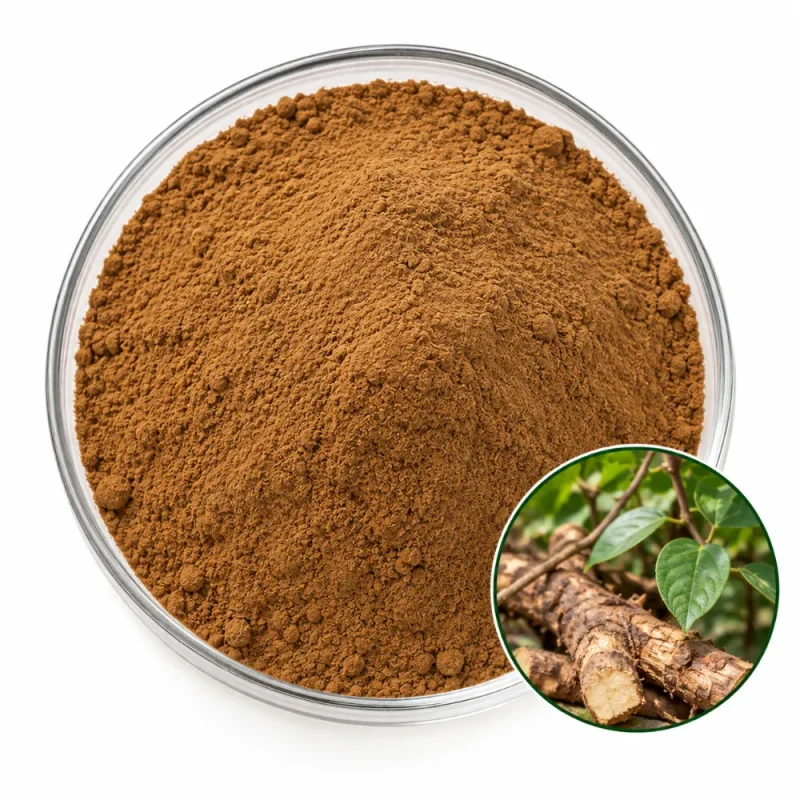
Salacia Extract 20% Saponins

Salacia extract is prepared from the roots of Salacia reticulata Wight, a woody climber of the family Celastraceae that grows in Sri Lanka and southern India. Ethanol extraction concentrates the glycoside fraction of the root, and the concentrate is dried to a light brown powder.

The extract is offered as a single 20% saponin grade, measured by UV spectrophotometry. The powder is 80 mesh and water soluble, which suits capsules, tablets, stick packs and dissolved formats where a root extract with a stated saponin level is specified.

Salacia Saponin Standardization & Grades

Saponins are glycosides in which a triterpenoid or steroidal core carries sugar chains, and they are measured here as a class. The botanical entity is Salacia reticulata Wight, and the defined part is the root, which is the traditional material for this species. Salacia extract is standardized to saponins at 20%, so the figure describes how far the root has been concentrated and gives the formulator a single number for calculating the inclusion rate.

This is one grade, not a range, so there is no grade table to choose from. The 20% powder is the grade that the specification is written around. It is the form to use when the formula requires a saponin figure on the label of the ingredient, and it is blended at larger inclusion where the fill weight allows. The same root is also supplied as a 10:1 ratio extract with no marker figure, the Salacia Extract Powder, for formulas that do not need a saponin number.

Salacia Saponin Analysis & Purity Risks

A UV assay does not read saponins directly, because the aglycone cores have little absorbance of their own. The sample is reacted with a color-forming reagent, the product is read in the UV-visible range, and the result is calculated against a reference saponin. The percentage is an equivalent tied to that reference. It cannot be converted into an HPLC figure for single compounds or compared with a result on another basis.

It is important to be clear about what this figure does not cover. The root of Salacia is best known in the literature for sulfur-containing sugar derivatives, salacinol and kotalanol, and for the xanthone glycoside mangiferin. These are separate chemical families, and some suppliers standardize their Salacia extracts to one of them instead. A saponin figure counts the glycosides that respond in the color reaction and leaves those compounds outside the percentage.

For identity, an HPLC fingerprint is read beside the UV total. The pattern of the polar glycosides, the mangiferin peak and the friedelane-type triterpenes helps separate Salacia reticulata from related species such as Salacia oblonga and Salacia chinensis, which are sold under the same trade name in some markets.

Purity risks follow from the material class. The woody stem and the root differ in composition, and the defined part is the root. Roots collected from older plants contain more lignified tissue, which dilutes the extractable fraction. A lot with high tannin carry-over can also read higher in a colorimetric saponin test, so the fingerprint is checked alongside the percentage.

Sample handling is part of the method. The extract is dissolved in a defined volume of solvent, diluted into the range of the calibration curve, and read against a reagent blank. Because the brown color of Salacia extract also absorbs in the visible range, a sample blank without the color-forming reagent is subtracted, so that pigment is not counted as saponin. Salacia extract run without that blank reads high.

Typical Specifications

Specification ItemProduct Information
Latin NameSalacia reticulata
Plant PartRoot & Rhizome
ProcessingEthanol Extraction
Compound ClassSaponins
Common NameSalacia, Kothala Himbutu
Ingredient TypeStandardized Extract
Marker Compound(s)Total saponins
Primary Grade20% Saponins (UV)
AppearanceLight Brown powder
Solubility / DispersibilityWater Soluble
Quality Parameters
Moisture (LOD)≤5.0%
Total Ash≤5.0%
Particle Size80 mesh
Heavy MetalsLead ≤2 ppm · Arsenic ≤1 ppm · Cadmium ≤1 ppm · Mercury ≤0.1 ppm
MicrobiologyTPC ≤1,000 cfu/g · Yeast & Mold ≤100 cfu/g · E. coli Negative · Salmonella Negative/25 g
Shelf Life24 months in unopened original packaging, cool and dry storage

Applications by Grade

Capsule Fills at 20%

The 20% powder reaches its saponin target in a moderate capsule fill. It is hygroscopic and slightly sticky once it has taken up moisture, so a dry filling room and a flow agent prevent bridging in the hopper and keep the fill weight steady across a run.

Tablet Blends with a Root Extract

Tablets of the 20% powder need a dry binder and a lubricant. The extract compacts as a slightly tacky solid, so a film coat limits moisture pickup and hardness is checked after storage, because the glycoside-rich compact softens when humidity rises.

Stick-Pack Drink Powders

The powder dissolves in cold water to a clear to slightly hazy brown drink, which makes it usable in stick-pack mixes. The saponins foam when stirred, so a short stir and a mild flavor base give a cleaner result than vigorous shaking.

Powder Premixes with Bulking Carrier

Premixes carry the 20% powder in a larger dry blend. Sift it with the bulking ingredient first, and mix in two steps, because the small share of a sticky root extract spreads unevenly if it is added in one charge to a large batch.

Soft-Chew Bases

Soft chews take the 20% powder in a cooked base. Add it after the main cook, since long heating darkens the brown color, and disperse it in part of the syrup first to avoid lumps that appear as dark specks in a light chew.

Effervescent Tablets and Granules

Effervescent tablets and granules take the 20% powder because it dissolves cleanly and keeps the dose small. The acid and carbonate system shifts the pH of the solution, and the saponins foam strongly when the gas evolves, so the tablet size and the dissolution time are tested in the final glass.

Technical & Quality Considerations

Salacia extract is a light brown powder with a mild woody scent and a slightly bitter, astringent taste. It dissolves in water to a brown solution. The saponins lower surface tension, so the solution foams on agitation. The foam complicates pumping and filling, and a dosing tank needs low-shear mixing or a food-compatible antifoam. The glycosides are stable across the neutral range, while strongly acidic conditions at high temperature slowly hydrolyze the sugar chains.

Mangiferin and the tannin-type material in the root chelate iron and darken the powder on contact with carbon steel, so stainless contact surfaces and low-iron carriers are the better choice. The extract takes up moisture from the air and cakes in humid storage. Sealed liners with desiccant keep the powder free flowing, and drums are stored away from heat.

Check fill weight at each lot change and compare each lot with a retained sample for color. Roots from different harvest sites range from tan to deeper brown, and the tone of the powder follows the root source.

Salacia extract also needs attention during blending with proteins and minerals. The tannin-type material in the root binds protein, and a drink that mixes the extract with whey or casein can turn hazy, which is a routine trial item for protein formulas. Calcium-rich bases can form a fine precipitate with the phenolics, so the order of addition is fixed and recorded.

Packaging & Commercial Supply

Essencefield supports product evaluation, formulation trials, commercial orders, and ongoing ingredient supply. Packaging, storage, and shipping arrangements are determined by product characteristics, order quantity, stability requirements, and destination-market needs.

Supply ItemGeneral Information
SampleAvailable upon request for formulation, testing, and supplier evaluation
Order Quantities100 g · 1 kg · 5 kg · 25 kg · 100 kg · 500 kg · Bulk
Sample Lead TimeTypically 5–7 days after sample confirmation
Production Lead TimeTypically 15–30 days after order and specification confirmation
PackagingSuitable protective inner packaging with bags, cartons, drums, or other appropriate outer packaging
StorageStore in tightly sealed, suitable protective packaging in a cool, dry environment. Protect from moisture, heat, and direct sunlight. Specific storage conditions follow the approved product specification.
DocumentationCOA · Product Specification · TDS · SDS · Applicable declarations (as applicable)

Final order quantities, lead times, packaging, documentation, and shipping arrangements are confirmed according to the selected product and commercial requirements.

Request Ingredient Specifications & Quote

Share your target specification, application, quantity, and documentation needs. We’ll help confirm suitable options, samples, and commercial supply details.