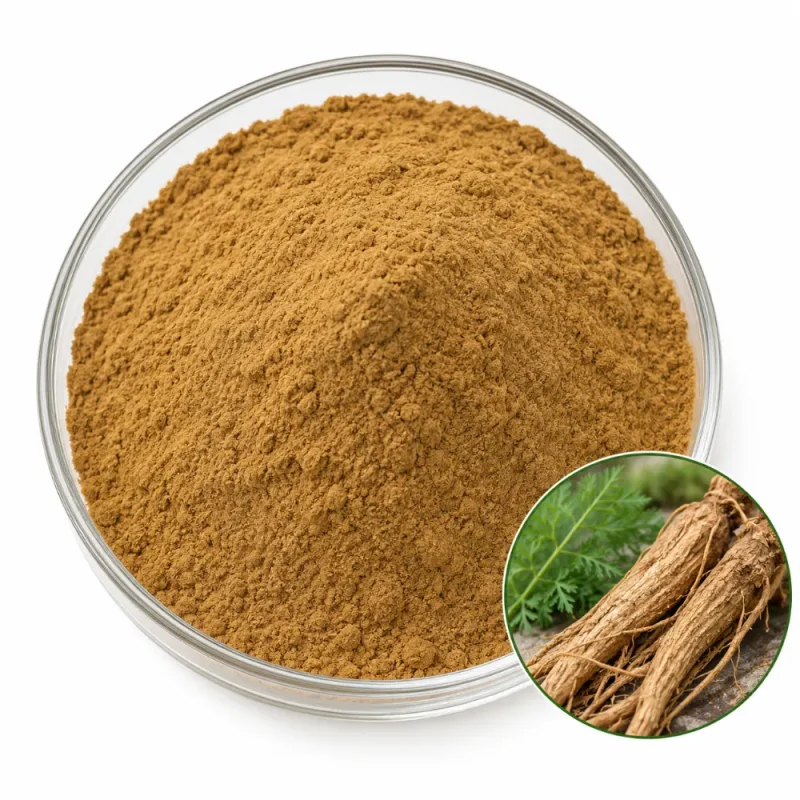
Saposhnikovia Divaricata Extract 0.5–5% Chromones

Saposhnikovia divaricata extract is prepared from the root of Saposhnikovia divaricata (Turcz.) Schischk., the plant sold in Chinese medicine as fang feng, a perennial of the family Apiaceae. Ethanol extraction concentrates the chromone fraction of the root, and the concentrate is dried to a light brown powder.

Total chromones are measured by HPLC, with a primary grade of 5% and a lower grade of 0.5%. The powder is 80 mesh and insoluble in water. The 5% grade fits capsules and tablets, while the 0.5% grade fits blends at larger inclusion.

Saposhnikovia Chromone Standardization & Grades

Chromones are benzopyran-4-one compounds, a family of oxygen heterocycles related to the flavonoids. The root of Saposhnikovia divaricata carries a characteristic set, among them prim-O-glucosylcimifugin, cimifugin and 5-O-methylvisammioside, together with coumarins, polysaccharides and a small volatile oil. The extract is standardized to chromones because they are the group that identifies the root and that a laboratory can measure by chromatography.

The botanical entity is Saposhnikovia divaricata (Turcz.) Schischk., and the part is the root. The plant was formerly named Ledebouriella seseloides, and that name still appears on older documents. The same root is also supplied as a 10:1 ratio extract with no marker figure, Saposhnikovia Root Extract Powder, and as the milled root, Saposhnikovia Root Powder.

GradeAssay & MethodWhere It Fits
0.5% ChromonesHPLCBlends, larger inclusion
5% ChromonesHPLCCapsules and tablets, small fill

The 5% grade carries ten times the chromone load of the 0.5% grade per gram, so a capsule reaches its target with a small fill. Saposhnikovia divaricata extract in the 5% grade is also the easier powder to weigh accurately. The 0.5% grade is the bulky powder, and it behaves like a concentrated root extract in blends where the marker is a background specification and not the main feature.

Saposhnikovia Chromone Analysis & Purity Risks

An HPLC assay separates the individual chromones, reads each as a distinct peak against a reference standard, and sums the peaks counted. The total depends on which compounds are included, so two certificates are comparable only when they list the same compounds. A chromone total cannot be converted into a UV total flavonoid figure, which measures a different class.

The data record for this product names two chromone glycosides as secondary markers, prim-O-glucosylcimifugin and 5-O-methylvisammioside. They are used here as the identity peaks and are described without numbers. Their ratio shifts with the age of the root and with the drying conditions, because the glycosides can partly lose their sugar and change into the aglycone cimifugin.

Purity risks follow from the material class. Fang feng is a name applied in several regions to roots of different Apiaceae plants, and these regional substitutes do not carry the same chromone pattern. The root of Saposhnikovia divaricata is the defined part. Wild-grown and cultivated roots differ, and roots processed with sulfur fumigation, a traditional drying aid, change the profile. HPLC identity confirms the pattern before a lot is accepted.

Sample preparation uses an alcohol solvent with sonication, followed by filtration and injection, since chromone glycosides dissolve better in alcohol than in water.

Sulfur fumigation deserves a note of its own. The traditional drying aid leaves sulfite residues on the root and changes the color of the powder. For an extract the residue is checked at the root stage, and an HPLC pattern with an unusual distribution of chromone peaks points to a processed lot that is reviewed before acceptance.

Typical Specifications

Specification ItemProduct Information
Latin NameSaposhnikovia divaricata
Plant PartRoot & Rhizome
ProcessingEthanol Extraction
Compound ClassPolyphenols
Common NameFang Feng, Siler Root
Ingredient TypeStandardized Extract
Marker Compound(s)Total chromones (prim-O-glucosylcimifugin, 5-O-methylvisammioside)
Primary Grade5% Chromones (HPLC)
Available Grades0.5% · 5% Chromones (HPLC)
AppearanceLight Brown powder
Solubility / DispersibilityInsoluble in Water
Quality Parameters
Moisture (LOD)≤5.0%
Total Ash≤5.0%
Particle Size80 mesh
Heavy MetalsLead ≤2 ppm · Arsenic ≤1 ppm · Cadmium ≤1 ppm · Mercury ≤0.1 ppm
MicrobiologyTPC ≤1,000 cfu/g · Yeast & Mold ≤100 cfu/g · E. coli Negative · Salmonella Negative/25 g
Shelf Life24 months in unopened original packaging, cool and dry storage

Applications by Grade

5% Grade for Capsule Fills

The 5% grade reaches its chromone target in a small fill. The light brown powder has an aromatic, slightly sweet root note, and a flow agent plus a dry room prevent the fine particles from bridging in the hopper.

0.5% Grade in Dry Blends

The 0.5% grade blends with other root extracts in dry mixes, where the chromones are one marker among several. Sieve it with the carrier first and mix in two steps so that the share spreads evenly through the batch.

5% Grade in Tablet Blends

Tablets of the 5% grade need a dry binder and a glidant. The extract compacts as a slightly oily solid, so a film coat helps with odor and moisture, and hardness and disintegration are rechecked after storage.

0.5% Grade for Stick-Pack Mixes

Stick-pack mixes use the 0.5% grade with a bulking carrier at higher gram weight. The powder does not dissolve, so the mix is for stirring into a thick base and not for clear drinks, where it would settle.

5% Grade in Softgel Suspensions

The insoluble 5% grade is milled into an oil phase for softgel fills. Particle size and viscosity are checked before encapsulation, because settling in the fill mass causes uneven dosing across the batch, and a suspending agent is added where needed.

5% Grade for Powder Premixes

Premixes carry the 5% grade in larger dry blends. Sift it with the bulking ingredient first, and mix in two steps, since the small share of an aromatic root extract spreads unevenly if it is added in a single charge.

Technical & Quality Considerations

The extract is a light brown powder with a warm, aromatic, slightly sweet root scent and a mild bitterness. It is insoluble in water, and an aqueous drink appears as a fine suspension. Chromone glycosides dissolve more readily in alcohol, and an ethanol-based tincture base carries the extract more evenly than water does. Wetting agents, milling and a viscous carrier improve dispersion in aqueous bases.

Chromone glycosides hydrolyze under strongly acidic conditions and at elevated temperature, forming the aglycones with a different retention time. A formula with a long hot hold or a low pH changes the HPLC pattern, and the product is added late in the process where possible. Phenolic constituents also bind iron, so stainless contact surfaces and low-iron fillers are preferred.

The powder takes up moisture slowly and clumps in humid storage, so sealed liners with desiccant are used. Compare each lot with a retained sample for color and aroma, and verify fill weight when switching between the two grades, since they differ widely in bulk.

Saposhnikovia divaricata extract also carries coumarins that fluoresce and absorb in the UV range, and they can show up as extra peaks in a chromatogram. Reading the chromone peaks at the right wavelength and with a defined gradient keeps these peaks from being counted in the chromone figure.

Packaging & Commercial Supply

Essencefield supports product evaluation, formulation trials, commercial orders, and ongoing ingredient supply. Packaging, storage, and shipping arrangements are determined by product characteristics, order quantity, stability requirements, and destination-market needs.

Supply ItemGeneral Information
SampleAvailable upon request for formulation, testing, and supplier evaluation
Order Quantities100 g · 1 kg · 5 kg · 25 kg · 100 kg · 500 kg · Bulk
Sample Lead TimeTypically 5–7 days after sample confirmation
Production Lead TimeTypically 15–30 days after order and specification confirmation
PackagingSuitable protective inner packaging with bags, cartons, drums, or other appropriate outer packaging
StorageStore in tightly sealed, suitable protective packaging in a cool, dry environment. Protect from moisture, heat, and direct sunlight. Specific storage conditions follow the approved product specification.
DocumentationCOA · Product Specification · TDS · SDS · Applicable declarations (as applicable)

Final order quantities, lead times, packaging, documentation, and shipping arrangements are confirmed according to the selected product and commercial requirements.

Request Ingredient Specifications & Quote

Share your target specification, application, quantity, and documentation needs. We’ll help confirm suitable options, samples, and commercial supply details.