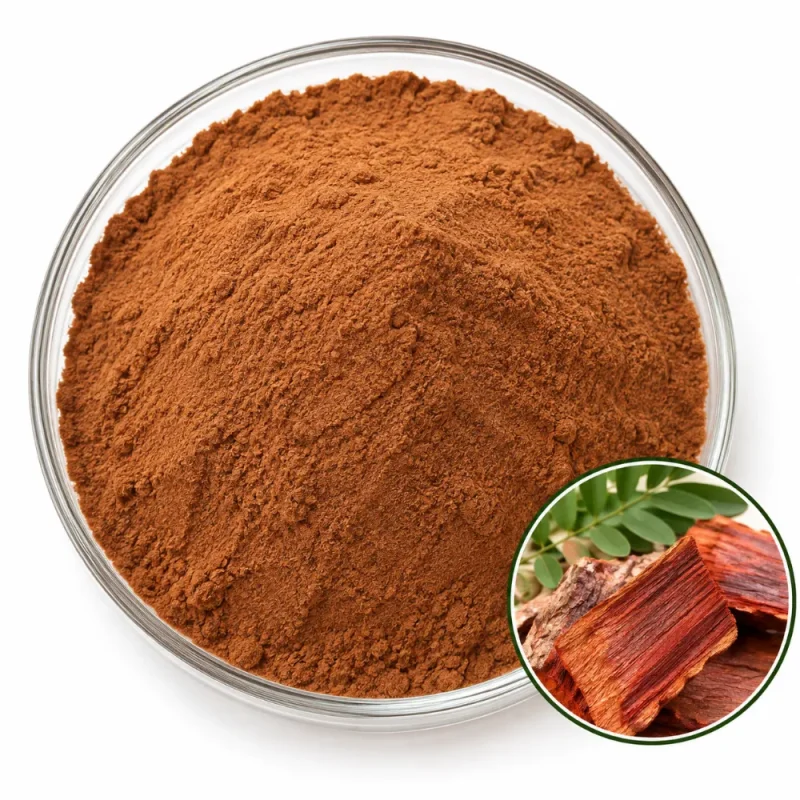
Sappanwood Extract 15% Tannins

Sappanwood extract is prepared from the heartwood of Caesalpinia sappan L., a thorny tree of the family Fabaceae grown across South and Southeast Asia. Ethanol extraction concentrates the tannin and polyphenol fraction of the wood, and the concentrate is dried to a red-brown powder that dissolves in water.

The extract is offered as a single 15% tannin grade, measured by UV spectrophotometry. The powder is 80 mesh. It suits drink powders, capsules and tablets where a tannin-rich heartwood extract with a defined figure is specified.

Sappanwood Tannin Standardization & Grades

Tannins are plant polyphenols large enough to bind proteins. The heartwood of sappanwood is known above all for brazilin, a homoisoflavonoid that oxidizes to the red pigment brazilein, and it also carries sappanchalcone, other homoisoflavonoids and tannins. The extract is standardized to tannins at 15% because the figure is measurable by a routine colorimetric method and it expresses how far the heartwood has been concentrated.

The botanical entity is Caesalpinia sappan L., and the part is the heartwood. The sapwood and bark carry little of the red pigment. The name brazilwood is shared with a different tree, Paubrasilia echinata, so buyers should confirm the species when a source document says only brazilwood. The same heartwood is also supplied as a 10:1 ratio extract with no marker figure, the Caesalpinia Sappan Extract Powder.

This is one grade, not a range, so there is no grade table. The 15% powder is the grade the specification is written around, and inclusion rates are calculated from that figure. Brazilin and brazilein are not counted in a tannin percentage, so the extract’s red tone and its tannin load are two separate properties of the same powder. Sappanwood extract at 15% therefore needs a color check as well as an assay.

Sappanwood Tannin Analysis & Purity Risks

A UV tannin assay is a colorimetric reading. The sample reacts with a reagent that responds to phenolic hydroxyl groups, the absorbance is read in the UV-visible range, and the result is calculated against a reference phenol. Some protocols then subtract the portion that is not bound by hide powder, to separate tannins from smaller phenolics. Each protocol gives a different number, so a figure is comparable only on the same basis.

The assay is not specific. Brazilin and brazilein are phenolic and react in the same test, so a heartwood extract rich in those pigments reads higher than its tannin content alone would give. The HPLC fingerprint shows brazilin and brazilein as distinct peaks, which separates sappanwood from other tannin-rich woods, and a UV result cannot be converted into an HPLC value.

Purity risks follow from the material class. Dye-grade sappanwood from the trade is sometimes mixed with other red woods, and the shared trade name brazilwood links this tree to others. The defined part is the heartwood, and wood with a large share of pale sapwood dilutes the red pigment. Brazilin oxidizes to brazilein in air and in alkaline conditions, so storage and extraction history changes the color at the same tannin level.

The traditional trade in sappanwood has shrunk in recent decades, and a sourcing record that names the species and the part is worth keeping with each lot.

Heartwood sourcing adds a practical point. The red core of the tree is cut into chips and dried before extraction, and chips that were stored damp pick up mold and darken. A lot made from clean, dry heartwood chips gives a clearer red-brown solution than one made from stored sapwood-rich material, and microbiology is tested for that reason.

Typical Specifications

Specification ItemProduct Information
Latin NameCaesalpinia sappan
Plant PartBark & Stem
ProcessingEthanol Extraction
Compound ClassPolyphenols
Common NameSappanwood, Sappan Heartwood
Ingredient TypeStandardized Extract
Marker Compound(s)Tannins
Primary Grade15% Tannins (UV)
AppearanceRed-Brown powder
Solubility / DispersibilityWater Soluble
Quality Parameters
Moisture (LOD)≤5.0%
Total Ash≤5.0%
Particle Size80 mesh
Heavy MetalsLead ≤2 ppm · Arsenic ≤1 ppm · Cadmium ≤1 ppm · Mercury ≤0.1 ppm
MicrobiologyTPC ≤1,000 cfu/g · Yeast & Mold ≤100 cfu/g · E. coli Negative · Salmonella Negative/25 g
Shelf Life24 months in unopened original packaging, cool and dry storage

Applications by Grade

Drink Powders with Natural Red Tone

The 15% powder dissolves in cold water to a clear orange-red to red-brown drink. Acid shifts the tone toward orange and yellow, and neutral to alkaline water pushes it toward red and violet, so the finished pH is fixed and tested.

Capsule Fills at 15%

Capsules take the 15% powder at moderate fill weight. It is hygroscopic and tends to stain equipment red-brown, so a dry filling room, a flow agent and prompt cleaning of the line keep the lots from carrying color over.

Tablet Blends

Tablets of the 15% powder need a dry binder and a lubricant. A film coat limits moisture uptake and staining of the punch faces, and hardness is checked after storage since the tannin-rich solid softens in humid rooms.

Stick-Pack Mixes with Carrier

Stick-pack mixes carry the 15% powder in a bulking base. Avoid protein-based carriers, because the tannins bind protein and cause haze or flocculation when the mix is stirred into a drink. A maltodextrin carrier keeps the cup clear.

Gummy Color and Flavor Bases

Gummies take the powder as a color-contributing ingredient. Add it after the main cook, because long heating shifts the tone, and test the finished pH since the red shifts toward orange in an acidic pectin base.

Sports-Style Drink Sachets

Sachet drink mixes carry the 15% powder with a bulking carrier. The sachet film is checked for staining at the seal, because the red-brown powder transfers color to laminated layers, and the pack is stored dark to protect the pigment.

Technical & Quality Considerations

Sappanwood extract is a red-brown powder with a woody, slightly astringent scent. It dissolves in water to a red-brown solution whose color follows the pH. At low pH the tone is orange-yellow, and as the pH rises it turns red and then violet. Brazilin oxidizes slowly to brazilein, so the color of a solution deepens on standing in air, and the shade needs to be fixed by a stability trial.

Tannins and the homoisoflavonoids chelate iron, forming dark complexes. Carbon-steel surfaces and iron-containing fillers therefore darken the powder, and stainless equipment with low-iron carriers is the better choice. The polyphenols also bind proteins and some minerals, so milk-based or calcium-rich formulas are tested for haze.

The powder takes up moisture and cakes in humid storage. Sealed liners with desiccant keep it free flowing. Check fill weight at each lot change and compare each lot with a retained sample for color, because the red-to-brown balance moves with the ratio of brazilein to other phenolics.

Sappanwood extract also reacts with metal ions beyond iron. Aluminum and tin salts shift the tone of brazilein toward violet or purple, which was exploited in dyeing for centuries, so metal contact in a process line causes visible color changes. Food-grade stainless steel and glass-lined vessels avoid this.

Packaging & Commercial Supply

Essencefield supports product evaluation, formulation trials, commercial orders, and ongoing ingredient supply. Packaging, storage, and shipping arrangements are determined by product characteristics, order quantity, stability requirements, and destination-market needs.

Supply ItemGeneral Information
SampleAvailable upon request for formulation, testing, and supplier evaluation
Order Quantities100 g · 1 kg · 5 kg · 25 kg · 100 kg · 500 kg · Bulk
Sample Lead TimeTypically 5–7 days after sample confirmation
Production Lead TimeTypically 15–30 days after order and specification confirmation
PackagingSuitable protective inner packaging with bags, cartons, drums, or other appropriate outer packaging
StorageStore in tightly sealed, suitable protective packaging in a cool, dry environment. Protect from moisture, heat, and direct sunlight. Specific storage conditions follow the approved product specification.
DocumentationCOA · Product Specification · TDS · SDS · Applicable declarations (as applicable)

Final order quantities, lead times, packaging, documentation, and shipping arrangements are confirmed according to the selected product and commercial requirements.

Request Ingredient Specifications & Quote

Share your target specification, application, quantity, and documentation needs. We’ll help confirm suitable options, samples, and commercial supply details.